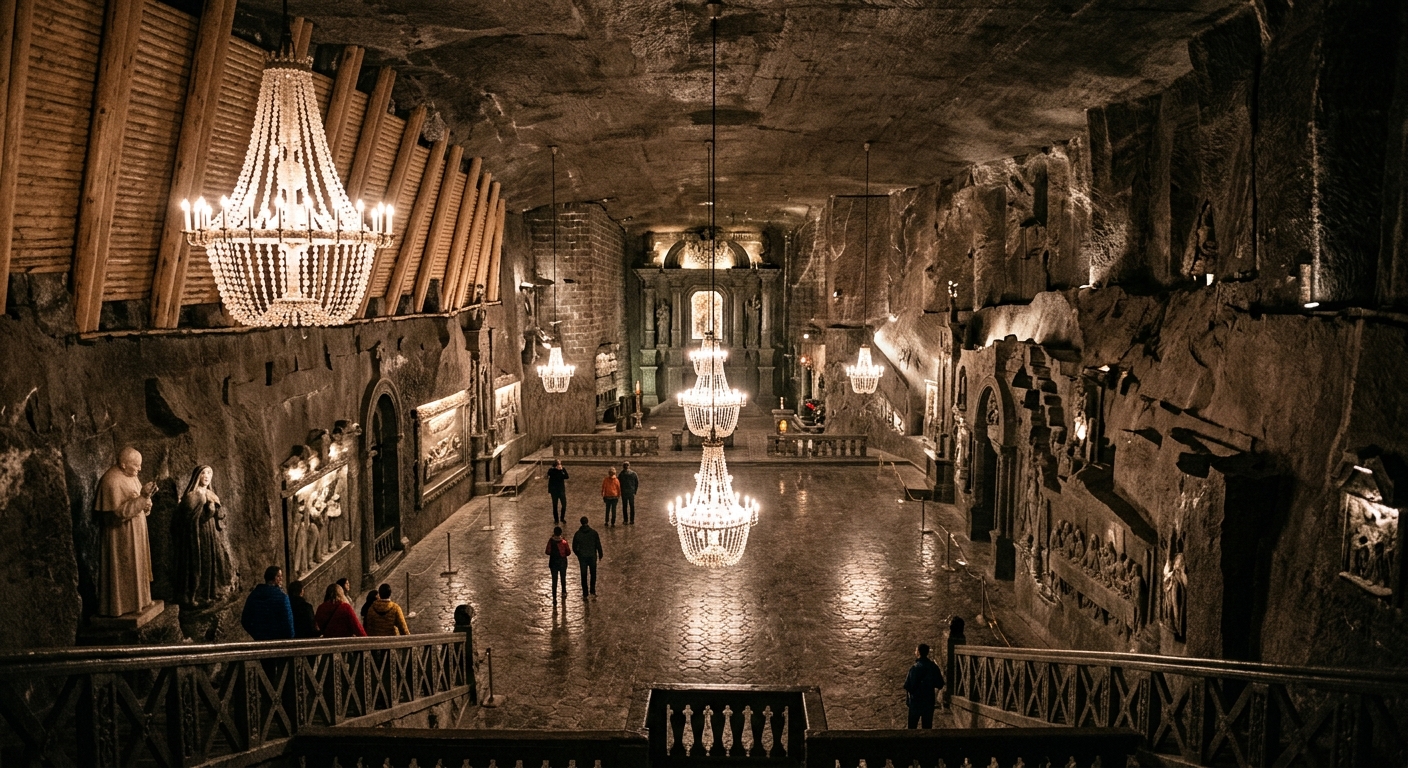
Imagine descending 327 feet beneath the earth’s surface, expecting to find dark tunnels and rocky caverns, only to stumble upon a magnificent cathedral complete with intricate sculptures, glittering chandeliers, and towering columns. Now imagine discovering that every single element of this sacred space has been carved entirely from salt. Welcome to the Chapel of St. Kinga in Poland’s Wieliczka Salt Mine, one of the most extraordinary underground wonders on our planet.
A Mine That Rewrote History
The Wieliczka Salt Mine has been producing table salt continuously since the 13th century, making it one of the world’s oldest operating salt mines. But what transformed this industrial site into a UNESCO World Heritage landmark wasn’t just its economic importance. Deep within its labyrinthine tunnels, generations of miners created something that shouldn’t exist: an entire underground world of art, all carved from the very salt they were extracting.
The mine stretches over 178 miles of galleries across nine levels, reaching depths of 1,073 feet. But it’s not the impressive statistics that leave visitors speechless. It’s the realization that what appears to be stone architecture is actually crystallized ancient seawater, sculpted by human hands into forms that rival the greatest cathedrals above ground.
The Crown Jewel: Chapel of St. Kinga
The chapel dedicated to St. Kinga (the patron saint of salt miners) represents the pinnacle of this underground artistry. Carved entirely from salt between 1896 and 1963, this sacred space measures 177 feet long, 49 feet wide, and soars to heights of 39 feet. Every surface tells a story sculpted in salt.
Miraculous Salt Sculptures
The chapel’s walls feature intricate bas-reliefs depicting biblical scenes, all carved directly from the salt rock. The altar showcases a stunning sculpture of the Last Supper, while salt statues of saints watch over the space with an otherworldly luminescence. Even the floor beneath visitors’ feet consists of polished salt that has been walked upon by millions over the decades.
Perhaps most remarkable are the chandeliers hanging from the salt ceiling. These aren’t made of crystal or glass, but of pure salt crystals that have been carefully shaped and arranged to create breathtaking light fixtures. When illuminated, they cast an ethereal glow that transforms the entire chapel into something that seems more celestial than terrestrial.
The Science Behind the Salt
The salt deposits that make up Wieliczka were formed approximately 13.6 million years ago when the ancient Carpathian Sea evaporated, leaving behind massive layers of salt. This geological treasure trove consists primarily of halite (rock salt), but also contains other minerals that create the varied colors and textures that make the sculptures so visually striking.
Why Salt Makes the Perfect Medium
Salt’s unique properties make it an surprisingly ideal material for sculpture. It’s soft enough to carve with relative ease, yet durable enough to maintain intricate details for centuries. The mineral also has natural preservative qualities, which help protect the artwork from decay. Additionally, the stable underground environment, with its consistent temperature and humidity levels, creates perfect conditions for long-term preservation.
The translucent quality of salt allows light to penetrate slightly into the carved surfaces, creating an inner glow that gives the sculptures an almost living appearance. This optical property transforms simple carved forms into luminous works of art that seem to pulse with inner light.
A Living Gallery Beneath the Earth
The Chapel of St. Kinga is just one highlight in what amounts to an entire underground city of salt sculptures. Throughout the mine’s accessible levels, visitors encounter chambers filled with mythological figures, historical scenes, and religious iconography, all carved from salt by miners who worked these tunnels.
The Miners as Artists
What makes this achievement even more remarkable is that most of these masterpieces were created not by professional artists, but by the miners themselves. Working by candlelight during their spare time, these laborers transformed their workplace into an artistic wonder. They used the same tools they employed for salt extraction, simple chisels and picks, to create works of art that have amazed visitors for generations.
The tradition continues today, with contemporary artists still adding to the mine’s collection. Modern power tools and improved lighting have allowed for even more detailed work, but the fundamental challenge remains the same: creating beauty from salt.
More Than Just Art
Beyond its artistic treasures, Wieliczka offers visitors a unique microclimate that has proven beneficial for respiratory health. The salt-saturated air in the mine’s chambers is naturally sterile and has been used for therapeutic purposes, particularly for treating asthma and allergies. Underground chambers serve as treatment centers where patients can benefit from the purified air environment.
A Testament to Human Creativity
The Wieliczka Salt Mine cathedral stands as proof that human creativity knows no bounds. In what could have been simply an industrial site, generations of workers created one of the world’s most unique artistic achievements. The fact that this masterpiece exists 327 feet underground, carved entirely from salt by miners working in challenging conditions, makes it one of the most improbable and inspiring human accomplishments on our planet.
Today, as visitors descend into these illuminated salt chambers, they witness something that challenges our understanding of what’s possible. In a world where we’re constantly amazed by technological achievements, the simple beauty of hand-carved salt reminds us that the most extraordinary wonders often come from the marriage of human imagination with the raw materials our planet provides.





This is absolutely stunning, but I keep thinking about how the ocean that formed this salt deposit was probably filled with ancient cetaceans and marine life we’ll never fully understand. There’s something both beautiful and melancholic about humans creating art from the remains of primordial seas while we’re simultaneously destroying the living oceans that still contain creatures like humpbacks whose songs are just as complex and moving as any cathedral. The Wieliczka Salt Mine is genuinely breathtaking though, and it’s kind of a hopeful reminder that we’re capable of creating magnificent things when we put our minds to it.
Log in or register to replywendy youre touching on something that really gets me, and im glad dave brought up the ocean angle because it connects to something ive been thinking about with migration routes and habitat loss. those ancient seas that created salt deposits like this one were basically the highways for species we’ll never see, and now were losing modern migration corridors at an alarming rate. ive been tracking shifts in shorebird patterns for two decades and its heartbreaking how many routes theyve had to abandon, so theres something bittersweet about humans creating beauty in a dead seabed when were actively destroying the living ones.
Log in or register to replyngl wendy thats such a cool observation, makes me think about how the deep ocean today is still doing that thing where it creates these wild untouched galleries we barely understand. im genuinely moved by the parallel – like at 700 meters down we find creatures with bioluminescence that looks almost deliberately artistic, and here humans carved that same ancient seawater into art. theres something really profound about how the ocean keeps inspiring us to create beauty, whether its fossilized salt or living light shows in the abyssal zone.
Log in or register to reply