
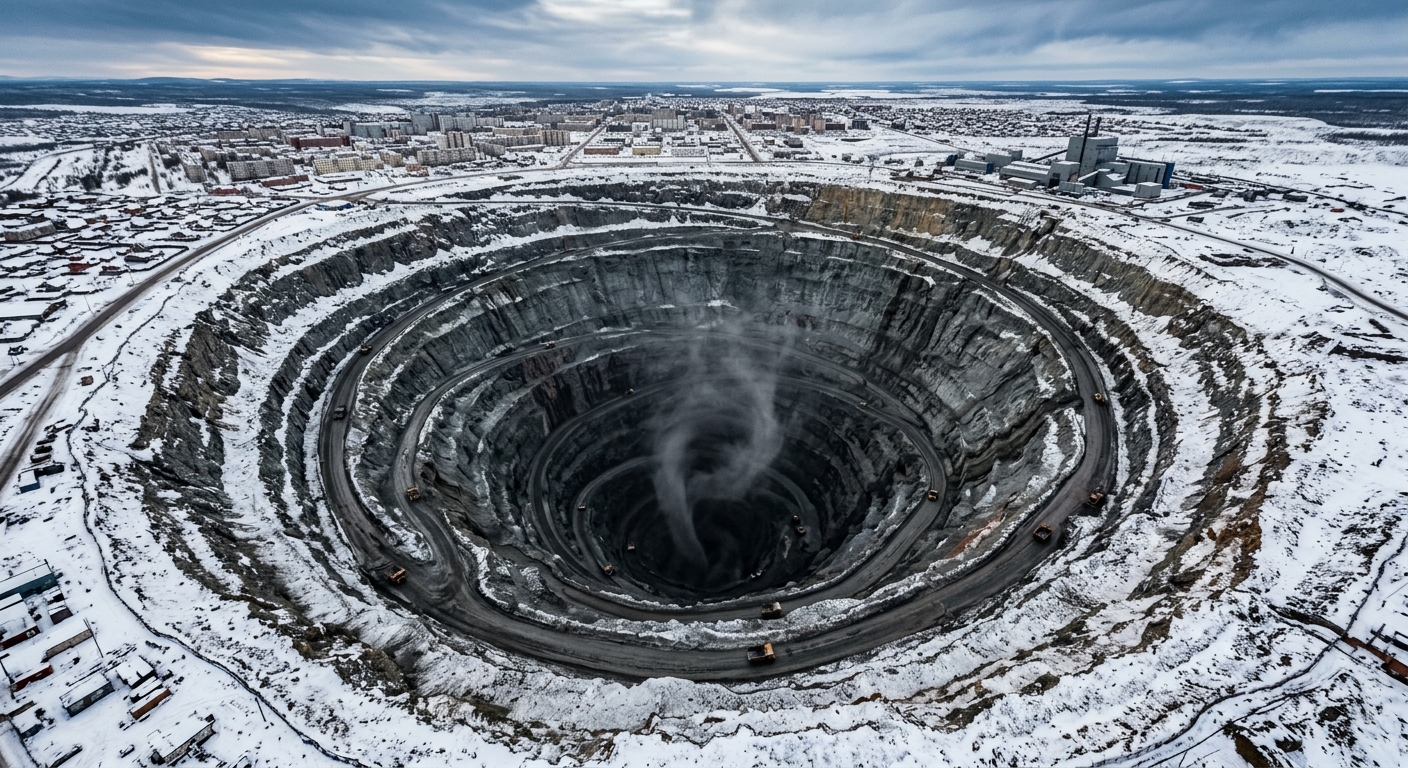
Deep in the frozen wilderness of eastern Siberia lies one of Earth’s most terrifying geological features: a gaping wound in the planet’s surface so massive and deep that it literally pulls aircraft from the sky. The Mir Mine, also known as the Mirny Mine, is not just another mining operation. It’s a monstrous crater that has earned the chilling nickname “the navel of the Earth” and carries aviation warnings that sound like science fiction.
A Hole So Deep It Defies Comprehension
The Mir Mine plunges an astounding 525 meters (1,722 feet) into the Earth’s crust, with a diameter stretching 1.2 kilometers (0.75 miles) across. To put this mind-bending scale into perspective, you could stack the Empire State Building one and a half times inside this crater and still not reach ground level. The entire city of Vatican could fit comfortably within its rim with room to spare.
This colossal excavation began in 1957 during the Soviet era as a diamond mining operation. What started as humanity’s quest for precious gems eventually became something far more extraordinary: an accidental atmospheric phenomenon that demonstrates the raw power of physics in action.
The Deadly Downdraft Phenomenon
The mine’s enormous size creates what atmospheric scientists call a “significant downdraft effect.” When air masses encounter this massive depression in the landscape, they behave in ways that can spell disaster for aircraft. The phenomenon works like this:
- Air flowing over the relatively flat Siberian landscape suddenly encounters the massive void
- The air mass gets compressed and accelerated as it rushes down into the crater
- This creates powerful downward air currents that can extend hundreds of feet above the rim
- Aircraft flying overhead can be caught in these invisible air rivers and pulled downward
The downdraft is so powerful and unpredictable that the Russian government has officially banned helicopters from flying over the mine. This isn’t a mere precautionary measure, it’s a response to actual incidents where aircraft have been compromised by the mine’s atmospheric effects.
The Helicopter Incident That Changed Everything
While details remain somewhat classified due to the mine’s strategic importance during the Soviet era, reports indicate that at least one helicopter was indeed caught in the mine’s downdraft and crashed. The incident occurred when the aircraft was flying at what should have been a safe altitude above the crater. Witnesses described seeing the helicopter suddenly lose altitude rapidly, as if being pulled by invisible hands toward the abyss below.
The pilot reportedly struggled to regain control, but the downdraft proved stronger than the helicopter’s ability to climb. The aircraft was essentially “swallowed” by the mine’s atmospheric disturbance, leading to the immediate implementation of the no-fly zone that exists to this day.
Engineering Marvel Turned Atmospheric Monster
The Mir Mine represents one of humanity’s most ambitious engineering projects, but it also serves as a stark reminder of how human activities can create unintended consequences on a massive scale. During its operational years, the mine produced some of the world’s finest diamonds, including stones so large and perfect they were reserved for the Soviet state collection.
The mining operation employed thousands of workers who descended into the ever-deepening pit daily. Special precautions had to be taken even for ground operations, as the mine’s depth created its own microclimate. In winter, the temperature difference between the surface and the bottom of the mine could be so extreme that car tires would shatter like glass, and diesel fuel would freeze solid.
A Geological Time Machine
Beyond its atmospheric effects, the Mir Mine offers scientists an unprecedented glimpse into Earth’s geological history. The exposed rock walls reveal layers of sediment and mineral deposits that span millions of years. Researchers have discovered fossils and mineral formations that provide crucial insights into how this region of Siberia evolved over geological time.
The mine has also revealed the complex geological processes that created the diamond deposits in the first place. The precious stones were formed deep within the Earth’s mantle and brought to the surface through ancient volcanic pipes called kimberlites.
Modern Day Status and Ongoing Mysteries
Today, the Mir Mine stands abandoned, partially flooded with water that has created an eerie lake at its bottom. The water is estimated to be over 200 meters deep, adding another layer of mystery to this already otherworldly location. The combination of the deep water and the continuing downdraft effects has created a unique ecosystem that scientists are only beginning to understand.
Satellite imagery reveals the full scope of this man-made geographical feature, and the images are nothing short of breathtaking. From space, the mine looks like a massive eye staring back at the cosmos, or a portal to the planet’s inner depths.
The Continuing Aviation Hazard
The no-fly zone around the Mir Mine remains in effect, serving as a permanent reminder of the power that large geographical features can exert on our atmosphere. Meteorologists continue to study the site to better understand how such formations affect local weather patterns and air currents.
Modern aircraft with advanced navigation systems still give the area a wide berth, not just because of regulations, but because the downdraft phenomenon remains as dangerous today as it was decades ago. The laws of physics haven’t changed, and neither has the mine’s ability to create these treacherous air conditions.
The Mir Mine stands as one of Earth’s most fascinating examples of how human engineering can create unintended natural phenomena. It’s a place where geology, physics, and human ambition intersect in ways that continue to captivate scientists and thrill-seekers alike, even as it remains forever off-limits to aircraft brave enough to challenge its atmospheric grip.




Wow, this is a fascinating example of how extreme geological features reshape their entire environment, though I’d be curious to see the actual incident reports since I know the no-fly zone is real but want to verify the “suction” mechanism. Speaking of natural systems creating unexpected hazards, spiders actually use similarly precise physics with their webs, catching prey through vibration detection and silk tensile strength that engineers are still trying to replicate. Nature’s engineering, whether it’s massive mines or spider architecture, reminds us how much we still have to learn about these systems!
Log in or register to replyhonestly this is wild but im way more fascinated by the actual deep sea vortexes we get around 2000+ meters down, like the way water density shifts create these insane circulation patterns that basically trap entire ecosystems in there. the mir mine is intense dont get me wrong but at least we can see it from above lol, whereas down in the hadal zones were literally discovering new species in these deep trench systems every year and most people have no idea theyre even there. youre right tho stan, id want to see those incident reports too since atmospheric vortexes are tricky to verify.
Log in or register to replyI’m curious about the actual meteorological mechanism here too, Stan – the downdrafts around deep mining operations are real and well-documented, but they’re usually about differential heating and pressure gradients rather than literal suction. The Mir no-fly zone is definitely in place, though I’d love to see the specific incident data since most dramatic crater stories end up being more nuanced when you dig into the actual reports. Dave’s point about density-driven circulation is interesting because it’s the same physics at work, just expressed differently depending on whether we’re talking air or water.
Log in or register to reply