
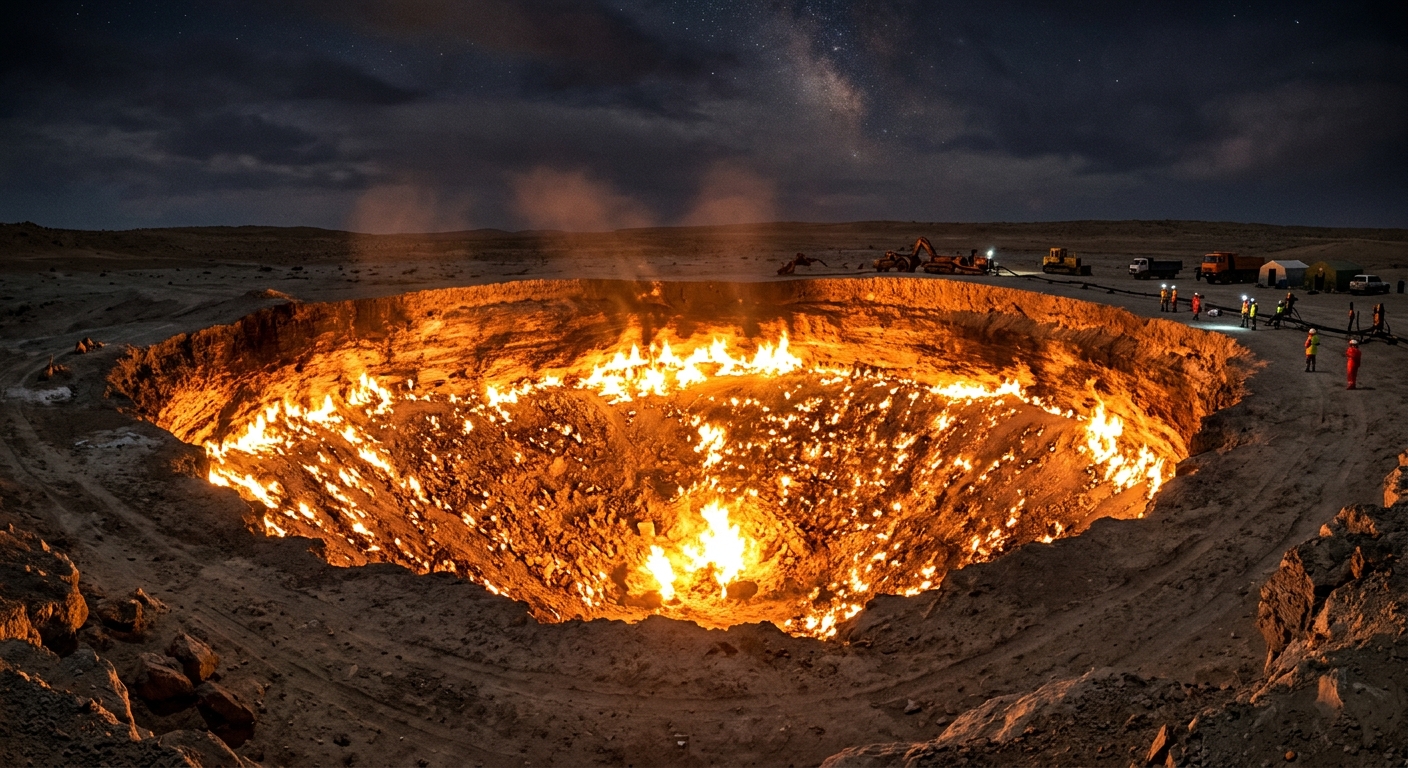
In the heart of Turkmenistan’s Karakum Desert lies one of the most surreal and haunting sights on Earth: a massive crater that has been burning continuously for over five decades. Known locally as the “Door to Hell” or “Gates of Hell,” this fiery pit has become an unwitting tourist attraction and a persistent headache for government officials who have repeatedly tried, and failed, to extinguish its flames.
The Birth of an Accidental Inferno
The story of the Darvaza gas crater begins in 1971, during the height of the Soviet Union’s ambitious industrial expansion. Soviet geologists were conducting natural gas exploration in the Karakum Desert when disaster struck. The ground beneath their drilling equipment suddenly collapsed, creating a massive crater approximately 70 meters wide and swallowing their equipment whole.
The collapse released dangerous methane gas into the atmosphere, posing a serious threat to nearby communities and the environment. In what seemed like a reasonable solution at the time, the geologists decided to burn off the gas, expecting it would be consumed within days or weeks at most. They had no idea they were about to create one of the world’s most persistent fires.
A Fire That Refuses to Die
What the Soviet scientists couldn’t have predicted was the sheer volume of natural gas reserves beneath the crater. The flames they lit in 1971 are still burning today, more than 50 years later, fed by an seemingly inexhaustible supply of natural gas seeping from underground deposits.
The crater’s flames reach temperatures of over 1,000 degrees Celsius (1,832 degrees Fahrenheit), creating an otherworldly spectacle that can be seen from miles away, especially at night. The intense heat has created a unique ecosystem around the crater’s rim, where the ground remains warm year-round despite the desert’s extreme temperature fluctuations.
The Science Behind the Eternal Flame
The Darvaza crater sits atop one of the world’s largest natural gas reserves. The Karakum Desert contains vast underground pockets of methane and other hydrocarbons that have been accumulating for millions of years. When the ground collapsed, it created a direct pathway for these gases to reach the surface, providing a constant fuel source for the flames.
The crater’s unique bowl shape acts like a natural furnace, concentrating the heat and creating optimal conditions for combustion. Wind patterns in the desert help maintain the fire by providing a steady supply of oxygen while preventing the flames from spreading beyond the crater’s boundaries.
Government Battles Against the Blaze
Over the decades, the Turkmenistan government has made multiple attempts to extinguish the crater, viewing it as a massive waste of valuable natural resources. Each attempt has ended in failure, highlighting the extraordinary challenges of fighting a fire with such an abundant fuel source.
Early Soviet Efforts
The first serious extinction attempts began in the 1980s when Soviet authorities recognized the economic value of the gas being burned. They tried various methods including:
- Smothering the flames with sand and clay
- Pumping water into the crater
- Using chemical fire suppressants
- Attempting to cap the gas flow with heavy machinery
Each method failed spectacularly. The intense heat made it impossible for workers to get close enough to effectively smother the flames, and the constant gas pressure simply reignited any temporarily extinguished areas.
Modern Extinction Attempts
In 2010, then-President Gurbanguly Berdimuhamedov ordered scientists to find a way to extinguish the crater, citing environmental concerns and the waste of natural resources. Teams of international fire suppression experts were brought in to assess the situation.
Advanced techniques were employed, including:
- Specialized foam designed for gas fires
- Controlled explosions to disrupt gas flow
- Drilling relief wells to reduce pressure
- High-pressure water cannons operated by remote control
Despite these sophisticated approaches, the crater continued burning. The underground gas reserves proved far more extensive than initially estimated, and the complex geology of the area made it nearly impossible to predict or control gas flow patterns.
Environmental and Economic Impact
The burning crater releases an estimated 4.5 billion cubic feet of natural gas annually, representing millions of dollars in lost revenue for Turkmenistan’s gas-dependent economy. The environmental impact includes the release of carbon dioxide and other greenhouse gases, though some scientists argue that burning the methane is actually preferable to allowing it to escape directly into the atmosphere, as methane is a far more potent greenhouse gas than carbon dioxide.
Unexpected Benefits
While the government views the crater as a problem, it has inadvertently become one of Turkmenistan’s most famous tourist attractions. Thousands of visitors travel to the remote desert location each year to witness the spectacular sight, bringing tourism revenue to the region.
The crater has also become an unexpected laboratory for studying extremophile organisms and geological processes. Scientists have discovered unique bacterial communities thriving in the high-temperature environment around the crater’s edges.
The Future of the Door to Hell
In 2022, President Serdar Berdimuhamedov announced renewed efforts to extinguish the crater, emphasizing its negative environmental impact and the need to conserve natural resources. However, given the track record of previous attempts, many experts remain skeptical about the likelihood of success.
Some geologists suggest that the only effective solution might be to drill relief wells to capture and redirect the gas for commercial use, essentially turning the problem into a solution. However, the technical challenges and costs of such an operation in the remote desert location make this approach uncertain.
As it stands, the Door to Hell continues to burn, a testament to the incredible power of natural forces and the limitations of human intervention. Whether it will burn for another 50 years or finally succumb to extinction efforts remains one of geology’s most fascinating ongoing mysteries.

I love what you’re both saying here, especially Beth’s point about how we keep trying to suppress problems instead of understanding them. It actually reminds me of what Jane Goodall observed with chimpanzee communities, you know? When we try to “manage” wild populations without really understanding their social structures and needs, things just get messier. The Darvaza crater feels like nature’s way of telling us that some systems are too complex for our quick fixes, and maybe that should humble us into doing better research before we intervene with conservation efforts too. Sometimes the crater burns, and sometimes we need to sit with that and learn instead of just fighting it.
Log in or register to replyhonestly this reminds me of how we keep trying to “fix” habitat issues the same way, like we think we can just suppress problems and theyll go away. with the Darvaza crater its kind of fascinating in a morbid way, but it also makes you think about all the ways were underestimating what nature can sustain. ive been watching wetland restoration projects for years and its the same lesson over and over, nature doesnt cooperate with our timelines. definitely would be a humbling museum exhibit though.
Log in or register to replyThis is exactly the kind of thing that should be in every natural history museum’s “Earth systems” wing, honestly. There’s something about seeing how spectacularly we can fail to control natural processes that really drives home how complex geology actually is, you know? The crater isn’t some anomaly, it’s just showing us that we’re poking at systems we barely understand, and I think that’s the good kind of humbling that gets people genuinely curious about what’s happening underground.
Log in or register to reply