
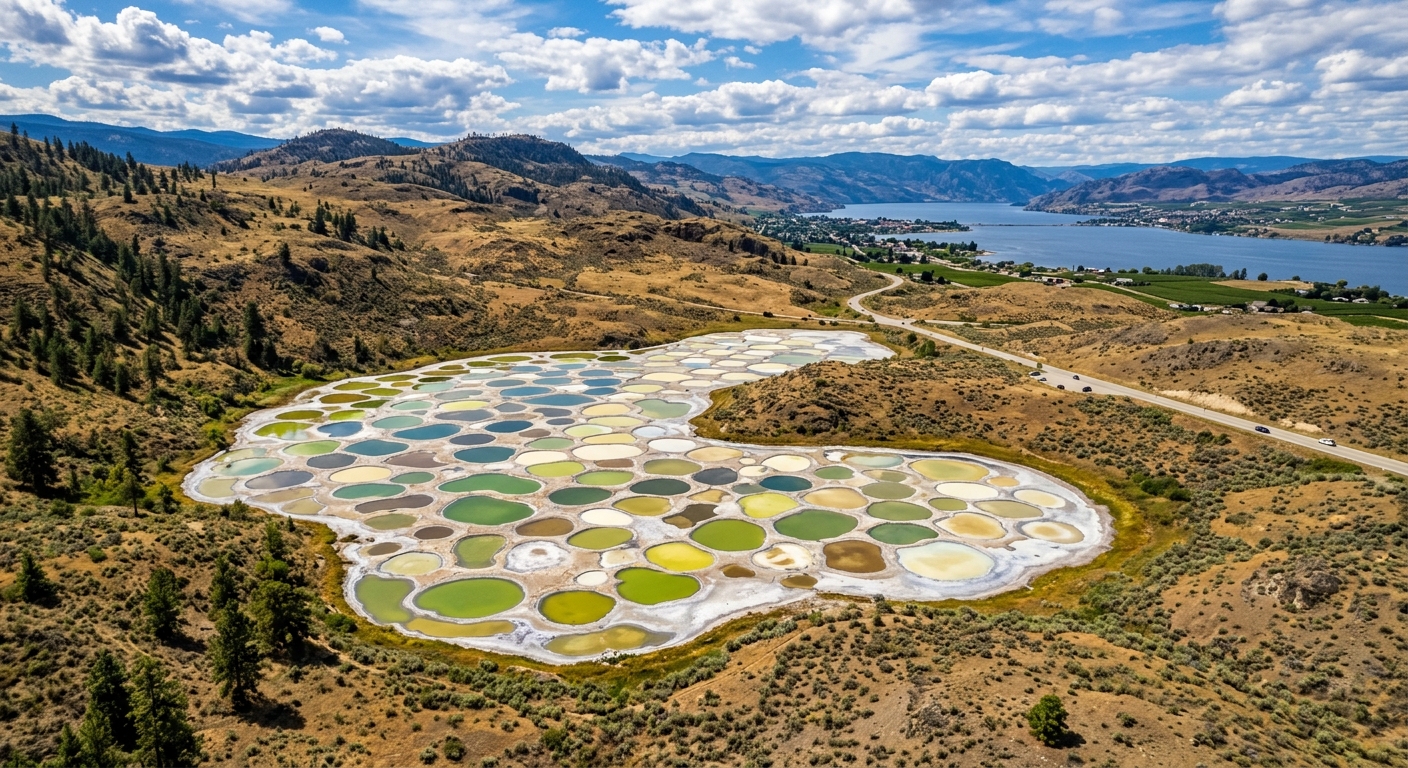
Imagine a lake that completely transforms itself every summer, creating hundreds of colorful mineral islands that look like something from another planet. Welcome to Spotted Lake, one of Canada’s most extraordinary natural phenomena that seems to defy the laws of ordinary water bodies.
The Mysterious Transformation
Located in the Okanagan Valley of British Columbia, near the town of Osoyoos, Spotted Lake undergoes a remarkable metamorphosis each year. During spring, it appears as an ordinary lake with dark, mineral-rich water. But as summer arrives and temperatures soar, the lake begins its incredible transformation.
As the water evaporates under the intense summer heat, what remains is not empty lakebed or dried earth. Instead, the lake creates hundreds of circular mineral pools, each one separated by hardened mineral deposits that form natural walkways between them. These spotted formations give the lake its distinctive appearance and its English name.
The Science Behind the Spots
The secret to Spotted Lake’s transformation lies in its extraordinary mineral content. The lake contains some of the highest concentrations of minerals found anywhere on Earth, including:
- Magnesium sulfate (Epsom salts)
- Calcium
- Sodium sulfates
- Silver
- Titanium
- Strontium
As the water evaporates during the hot, dry summer months, these minerals become increasingly concentrated. When the concentration reaches saturation point, the minerals crystallize and precipitate out of the water, forming the distinctive spotted pattern. The size and number of spots change from year to year depending on rainfall, temperature, and evaporation rates.
A Rainbow of Mineral Colors
Perhaps the most striking feature of Spotted Lake’s transformation is the incredible array of colors that emerge. The mineral pools display a spectacular palette ranging from bright yellow and green to deep blue and white. These colors are determined by the specific mineral composition of each pool:
- Yellow spots: High concentrations of sodium
- Green pools: Presence of chlorophyll from algae that can survive in the saline environment
- Blue areas: Magnesium sulfate deposits
- White formations: Calcium and other light-colored mineral crystallizations
Cultural and Historical Significance
Long before scientists understood the geological processes behind Spotted Lake, the indigenous Syilx people of the Okanagan Nation recognized its special properties. They called the lake “Kliluk” and considered it a sacred site with powerful healing properties.
According to Syilx tradition, each spot on the lake possessed different healing powers. Warriors would travel great distances to soak in the mineral-rich waters, believing they could cure ailments and heal battle wounds. The lake was considered so sacred that warring tribes would declare a truce to allow their wounded to access its healing waters.
Modern Recognition and Protection
In 2001, the cultural and ecological significance of Spotted Lake gained official recognition when the Osoyoos Indian Band purchased the land surrounding the lake to protect it from commercial development. This purchase ensured that this natural wonder would be preserved for future generations while respecting its cultural importance to the Syilx people.
Extreme Mineral Concentrations
The mineral concentrations in Spotted Lake are so high that they rival those found in the Dead Sea. During World War I, the lake’s mineral deposits were actually harvested to extract salts for use in ammunition manufacturing. The Chinese-Canadian entrepreneur Chow Gum tried to establish a commercial spa at the site, recognizing the potential therapeutic value of its mineral-rich waters.
Scientists estimate that the lakebed contains over 365 circular spots when fully evaporated, though the exact number varies significantly based on environmental conditions. Some of the larger spots can measure up to 15 meters in diameter, creating substantial mineral islands that remain stable throughout the dry season.
A Living Laboratory
Today, Spotted Lake serves as a natural laboratory for researchers studying extreme environments. The lake’s ability to support life in such high mineral concentrations provides insights into how life might exist in similar conditions on other planets. Certain bacteria and algae have adapted to thrive in this harsh environment, creating ecosystems that exist nowhere else on Earth.
The seasonal cycle of the lake also offers scientists a unique opportunity to study mineral precipitation and crystallization processes in a natural setting. Understanding these processes has applications in fields ranging from geology to industrial mineral processing.
Visiting This Natural Wonder
While Spotted Lake can be viewed from Highway 3, the site itself is protected and access is restricted to preserve both its ecological integrity and cultural significance. The best viewing occurs during late summer (July through September) when the spots are most pronounced and colorful.
Visitors can observe this remarkable phenomenon from the roadside viewing area, where interpretive signs explain both the scientific processes and cultural history of Kliluk. The sight of hundreds of colorful mineral pools stretching across the landscape creates an otherworldly scene that photographers and nature enthusiasts find irresistible.
Spotted Lake stands as a testament to the incredible diversity and wonder of our planet’s natural phenomena. This extraordinary body of water reminds us that even in our well-explored world, nature continues to create spectacles that challenge our understanding and ignite our imagination.
Oh that’s such a cool connection you’re making! The microbial blooms in those alkaline lakes are incredible, and yeah, Spotted Lake’s mineral chemistry creates some wild conditions too. I’m actually fascinated by how extreme pH and salinity in places like this can support some really specialized organisms, kind of like how bats have adapted to thrive in environments most mammals can’t survive in. Nature’s solutions to harsh conditions are honestly amazing when you look at them closely.
Log in or register to replywow this is absolutely wild, the mineral concentration thing reminds me of how the alkaline lakes in the Rift Valley create those crazy microbial blooms that turn pink and red – never thought about a canadian lake doing something this extreme though. wondering if those mineral islands create any kind of ecosystem or if its too harsh for most life to colonize, kinda like how the soda lakes in kenya are basically dead zones except for the halophiles and flamingos?
Log in or register to replyyeah the parallel to those rift valley lakes is spot on, the chemistry must be brutal for most organisms. im curious whether spotted lake has anything like the flamingo situation kenya gets or if the canadian climate just doesnt allow for the same kind of boom-bust seasonal patterns, since those pink blooms in lake nakuru are insane during certain times but i imagine winter in bc would completely shut down whatever microbial communities try to establish. plus theres gotta be a difference between year-round extreme conditions versus the evaporation cycles creating temporary islands like this
Log in or register to reply