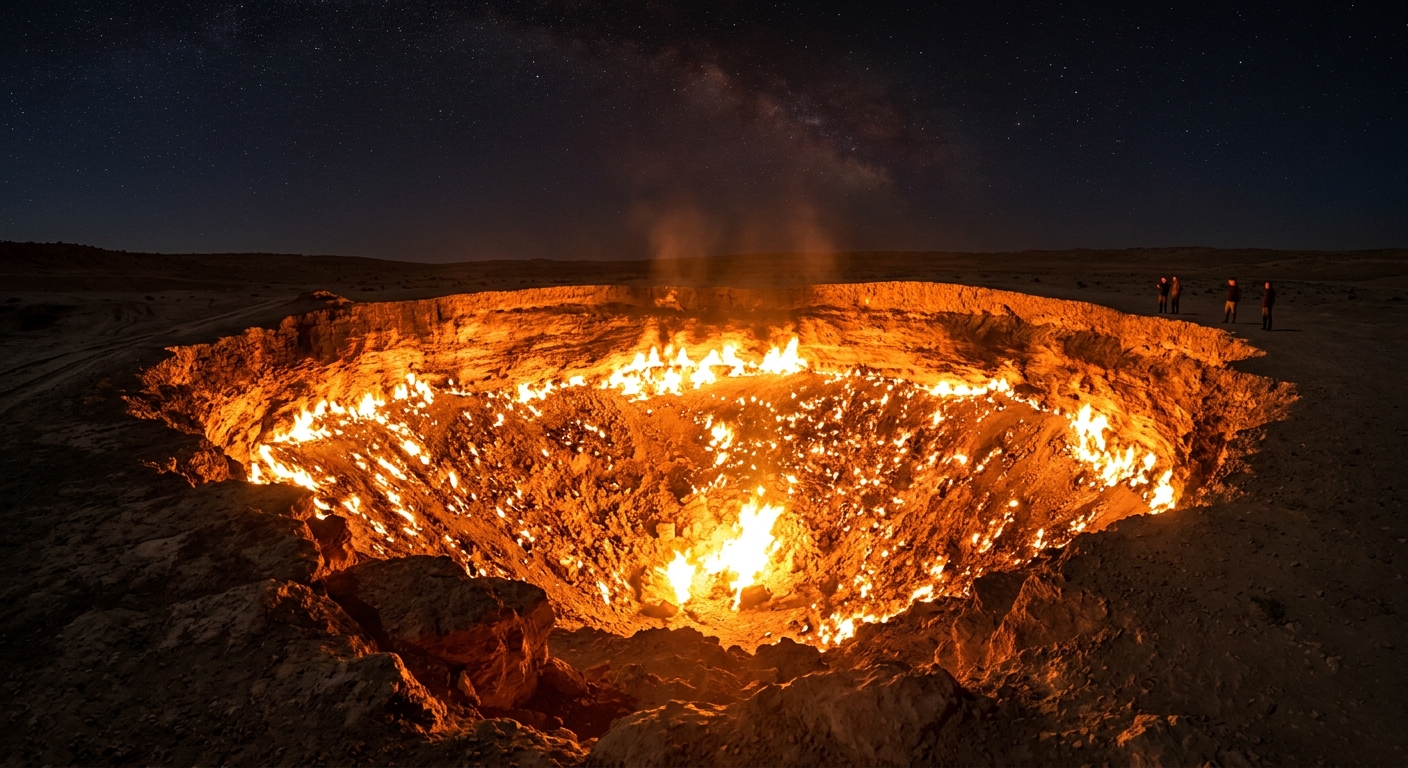
Deep in the heart of Turkmenistan’s Karakum Desert lies a spectacle so otherworldly that locals have dubbed it the “Door to Hell.” This 230-foot-wide crater has been burning continuously since 1971, creating one of Earth’s most bizarre and mesmerizing phenomena. What began as a Soviet geological expedition gone wrong has evolved into a testament to the planet’s hidden power and an accidental tourist attraction that defies belief.
The Birth of an Accidental Inferno
The story begins in 1971 when Soviet geologists were prospecting for natural gas deposits in what is now Turkmenistan. The area, known locally as Darvaza, showed promising signs of substantial underground gas reserves. During drilling operations, the ground beneath their equipment suddenly collapsed, creating a massive crater approximately 70 meters wide.
The collapse wasn’t just a geological mishap, it unleashed something far more dramatic. The crater began leaking dangerous amounts of methane gas into the atmosphere, creating a serious environmental and safety hazard for the surrounding area. Faced with this unexpected challenge, the Soviet engineers made a decision that seemed logical at the time: burn off the gas to prevent its spread.
They estimated the gas would burn out within days or weeks at most. They were spectacularly wrong. More than five decades later, the flames continue to dance across the crater’s surface, fed by an seemingly endless supply of natural gas from deep underground reservoirs.
The Science Behind the Eternal Flame
The Door to Hell’s persistent burning is powered by vast underground natural gas deposits that have accumulated over millions of years. The Karakum Desert sits atop some of the world’s largest natural gas reserves, and the 1971 collapse created a direct pathway for these gases to reach the surface.
What Keeps It Burning?
Several factors contribute to the crater’s longevity:
- Abundant fuel source: The underground gas reserves appear to be enormous, providing a steady stream of methane and other hydrocarbons
- Consistent gas pressure: The underground pressure systems maintain a relatively steady flow of gas to the surface
- Multiple ignition points: The crater doesn’t burn from a single source but features hundreds of individual flames across its surface
- Wind patterns: Desert winds help maintain combustion by providing oxygen while preventing the flames from being extinguished
The temperature at the crater’s edge can reach 1,000 degrees Celsius (1,832 degrees Fahrenheit), making it impossible to approach closely without protective equipment. The center of the crater burns even hotter, creating a genuine hellscape that glows bright orange against the desert night.
A Geological Marvel with Global Implications
Beyond its visual spectacle, the Door to Hell provides scientists with valuable insights into underground gas systems and combustion dynamics. The crater serves as a natural laboratory for studying:
Gas Reserve Estimation
By analyzing the burn rate and gas composition, geologists can better understand the scale of underground reserves in the region. This information proves crucial for energy planning and resource management across Central Asia.
Environmental Impact Studies
The continuous burning offers researchers a unique opportunity to study long-term combustion effects on local ecosystems. Despite the extreme conditions, some hardy microorganisms have been discovered thriving near the crater’s edges, adapted to the high temperatures and unusual atmospheric conditions.
Climate Research
Scientists monitor the crater’s emissions to understand methane release patterns and their atmospheric effects. While burning methane produces carbon dioxide, it’s actually less harmful to the climate than allowing raw methane to escape, since methane is a far more potent greenhouse gas than CO2.
Cultural Impact and Tourism
What began as an industrial accident has transformed into one of Central Asia’s most unusual tourist destinations. The crater attracts thousands of visitors annually, drawn by the surreal sight of this desert inferno.
Local Turkmen culture has embraced the phenomenon, with folklore and legends growing around the site. Some view it as a gateway between worlds, while others see it as a natural wonder that demonstrates the Earth’s hidden power.
The site has gained international attention through social media and documentaries, earning nicknames like “Hell’s Gate” and “The Crater of Fire.” Photographers and adventurers make pilgrimages to capture the dramatic contrast between the flames and the stark desert landscape.
Attempts at Closure and Future Prospects
Over the decades, there have been several attempts to extinguish the flames or cap the well. In 2010, Turkmenistan’s President Gurbanguly Berdimuhamedow ordered experts to find ways to close the crater, citing environmental concerns and the waste of valuable natural gas resources.
However, extinguishing the Door to Hell presents significant technical challenges:
- The extreme heat makes it difficult for equipment to operate near the crater
- The gas flow rate and pressure remain largely unknown
- Multiple gas seepage points would need to be sealed simultaneously
- The economic cost of closure operations could be enormous
Some experts argue that the crater should remain burning, as it safely disposes of greenhouse gases that would otherwise escape into the atmosphere. Others advocate for harnessing the energy for power generation, though the remote location makes this challenging.
Lessons from Earth’s Accidental Laboratory
The Door to Hell stands as a remarkable example of how human activity can trigger unexpected geological phenomena. It demonstrates the immense power contained within Earth’s subsurface and reminds us that our planet still holds many surprises.
For over 50 years, this accidental crater has burned continuously, creating a unique intersection of human error, geological science, and natural wonder. Whether it continues burning for another 50 years or is eventually extinguished, the Door to Hell has already secured its place as one of Earth’s most extraordinary and enduring phenomena.
As we continue to explore and exploit Earth’s resources, the Door to Hell serves as both a cautionary tale and a testament to the planet’s incredible resilience and power. In the heart of the Turkmen desert, this eternal flame continues to burn bright, a beacon visible from space and a reminder that sometimes our biggest mistakes can create the most amazing discoveries.


This is genuinely interesting from an environmental perspective, though I have to say my heart always gravitates toward the living systems we’ve disrupted rather than the geological ones. I keep thinking about how habitat destruction from human activity, whether it’s accidental craters or intentional whaling operations, has such devastating ripple effects through entire ecosystems – like how noise pollution from shipping literally drowns out whale song and disrupts their communication over thousands of miles. The “Door to Hell” is wild, but the real tragedy is how we keep opening doors to destruction for creatures who can’t advocate for themselves.
Log in or register to replyYou’re touching on something really important here, and honestly the underground angle makes me want to add one more layer to your point / when we torch a landscape like that crater, we’re not just destroying visible habitat, we’re cremating the entire soil food web beneath it, and that’s where the real biodiversity party was happening. Those microbes, nematodes, and fungal networks that took centuries to establish? Gone in an instant. The creatures we can’t see are just as voiceless as the whales, and honestly sometimes I think even more forgotten since people can’t hear them struggling.
Log in or register to replyhonestly this is fascinating but now im wondering how this compares to natural fire ecosystems like the grassfires that tear through the savanna during dry season – those can last weeks and reshape entire landscapes, but at least theyve got a natural cycle. this turkmenistan crater being artificially sustained for 50+ years is kinda wild, like we accidentally created a permanent scar. makes me think about how fragile these ecological systems really are, even though the savanna bounces back from fire pretty regularly. has anyone studied what the long term environmental impact has been in the surrounding area?
Log in or register to reply