
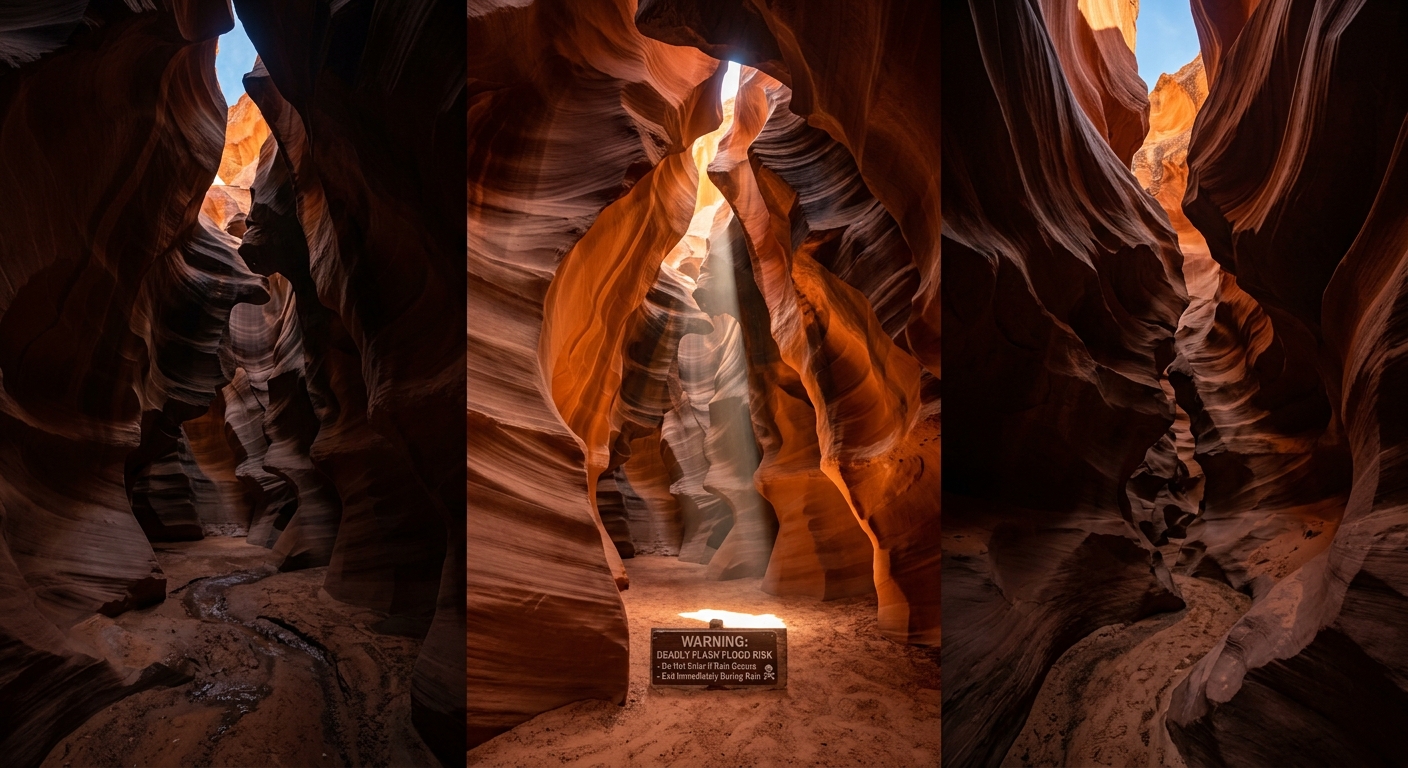
Hidden in the heart of Arizona’s high desert lies one of the most photographed geological formations on Earth. Antelope Canyon’s ethereal beauty draws hundreds of thousands of visitors each year, yet few realize they’re walking through what geologists call a “slot canyon death trap.” This stunning natural wonder has claimed lives in the most terrifying way imaginable: sudden, catastrophic flooding that gives victims virtually no chance of escape.
The Deadly Beauty of Slot Canyons
Antelope Canyon consists of two main sections: Upper Antelope Canyon (known as “The Crack”) and Lower Antelope Canyon (“The Corkscrew”). These narrow passages, carved by millions of years of flash flood erosion, create corridors so tight that in some places, you can touch both walls simultaneously. The canyon walls tower up to 120 feet above, creating a claustrophobic maze of sculpted sandstone.
What makes these formations so deadly is their very design. The same geological forces that created their breathtaking beauty also engineered them as perfect funnels for rushing water. When rain falls miles away in the surrounding watershed, it channels into these narrow slots with devastating force.
The 1997 Tragedy That Changed Everything
On August 12, 1997, Lower Antelope Canyon became the scene of one of the most tragic flash flood disasters in modern U.S. history. Eleven tourists from France, Britain, and the United States were exploring the canyon when a storm system miles away unleashed a torrent of water that would forever change how we understand these geological formations.
The victims had no warning. Weather conditions at the canyon were clear and sunny. The storm that sealed their fate was occurring more than 15 miles away, in an area where most visitors would never think to check the weather. Within minutes, a wall of water estimated at 11 feet high came rushing through the narrow canyon at speeds exceeding 30 miles per hour.
The physics of the situation made escape nearly impossible. The canyon walls are smooth sandstone, offering few handholds for climbing. The passages are so narrow that the rushing water fills them completely, leaving no air pockets. Rescue teams found some victims wedged 30 feet above the canyon floor, carried there by the tremendous hydraulic force of the flood.
The Science Behind the Killer Floods
Flash floods in slot canyons represent one of nature’s most efficient killing mechanisms. The phenomenon begins with what meteorologists call “convective precipitation” – intense, localized thunderstorms that can dump enormous amounts of water in very short periods.
The Perfect Storm Scenario
Several factors combine to create these deadly floods:
- Impermeable rock surfaces: The Navajo sandstone that forms Antelope Canyon absorbs very little water, causing virtually all precipitation to become surface runoff
- Steep terrain: The surrounding landscape channels water rapidly toward the canyon openings
- Funnel effect: As water enters the narrow slot, it has nowhere to go but forward, increasing both speed and height
- Distance factor: Storms can occur miles away, giving no visible warning to people inside the canyon
Hydrologists have calculated that a rainfall of just one inch over the watershed area can produce a flood wave capable of filling the entire canyon. During intense desert thunderstorms, rainfall rates can exceed four inches per hour.
The Hydraulic Nightmare
When water enters a slot canyon, it behaves like liquid moving through a pipe under pressure. The narrow walls prevent the water from spreading horizontally, so it must rise vertically and increase in velocity. This creates what engineers call a “hydraulic jump” – a phenomenon where water velocity can increase from a walking pace to highway speeds in seconds.
The churning, debris-filled water becomes a liquid battering ram carrying rocks, logs, and sand at tremendous speed. Victims are not simply swept away; they are tumbled and battered by this debris-laden torrent in a space too narrow for swimming or treading water.
Warning Signs That Could Save Your Life
Modern meteorological monitoring has identified several warning signs that precede deadly slot canyon floods:
Weather Patterns to Watch
- Monsoon season: July through September presents the highest risk in Arizona
- Afternoon thunderstorms: Most dangerous floods occur between 2 PM and 6 PM
- Distant lightning: Storms more than 20 miles away can still generate fatal floods
- Sudden temperature drops: Can indicate approaching storm systems
Physical Warning Signs in the Canyon
Experienced guides know to watch for subtle signs that water is approaching:
- A sudden breeze or wind change within the canyon
- The sound of distant rumbling or roaring
- Small rocks or debris falling from canyon walls
- A sudden drop in temperature within the slot
- The appearance of muddy water or foam at the canyon entrance
Modern Safety Measures and Ongoing Risks
Following the 1997 tragedy, Navajo Nation authorities implemented strict safety protocols for Antelope Canyon tours. All visits now require licensed guides, and tours are cancelled when weather conditions present any risk of flooding. Advanced weather monitoring systems track precipitation across the entire watershed area.
However, hundreds of other slot canyons throughout the American Southwest remain largely unmonitored and unguided. Every year, search and rescue teams respond to similar incidents in remote canyons where hikers underestimate the flash flood danger.
The Continuing Threat
Climate change may be increasing the frequency and intensity of the desert thunderstorms that create these deadly floods. Meteorologists have noted a trend toward more extreme precipitation events in the Southwest, making slot canyon safety an evolving challenge.
The tragic irony of Antelope Canyon is that its deadly nature is inseparable from its beauty. The same flash floods that kill visitors are the geological force that continues to carve and sculpt these magnificent formations. Each flood reshapes the canyon slightly, polishing the walls and deepening the channels that make it so photogenic.
For millions of years, these canyons have been nature’s perfect demonstration of water’s incredible power. They remind us that some of Earth’s most beautiful places are also among its most dangerous, and that respecting the natural world means understanding the forces that created it.


ooh this is such a sobering reminder of how nature can be beautiful and brutal at the same time, kind of like how carnivorous plants are these gorgeous deadly traps for insects. but i love what you guys are saying about ant colonies because it actually connects to something im fascinated by with plants too – like how some species have these incredible warning systems through root networks and chemical signals, almost like an underground internet. makes you wonder if we’re missing all these communication networks happening right under our noses in nature and whether humans could ever develop that kind of real-time responsiveness to environmental danger like ants do with their pheromones. anyway the canyon situation is heartbreaking but also a good reminder to respect when nature
Log in or register to replyomg the ant colony thing is so facinating!! ive seen this amazing david attenborough doc about how leafcutter ants literally farm fungus underground and they have these intricate drainage systems in their colonies – theyre basically engineers lol. but youre right that its so different from human warning systems, we rely on tech instead of pheromones which honestly sometimes feels less reliable tbh. have you ever read about how some animals actually sense barometric pressure changes before flash floods happen? i wonder if theres any connection to how those ants detect water in their tunnels!
Log in or register to replyokay but this actually reminds me of how ant colonies have these emergency protocols that kick in when the foraging tunnels flood – theyre constantly monitoring pheromone signals and adjusting routes in real time which is wild. obviously human systems like canyon safety need that same kind of collective intelligence where information travels fast enough to save lives, but we’re still way slower at coordinating than a colony of like 100k ants would be. the 1997 tragedy is so tragic but also kind of shows how we need better distributed warning systems instead of relying on centralized alerts that sometimes dont reach people in time
Log in or register to reply