
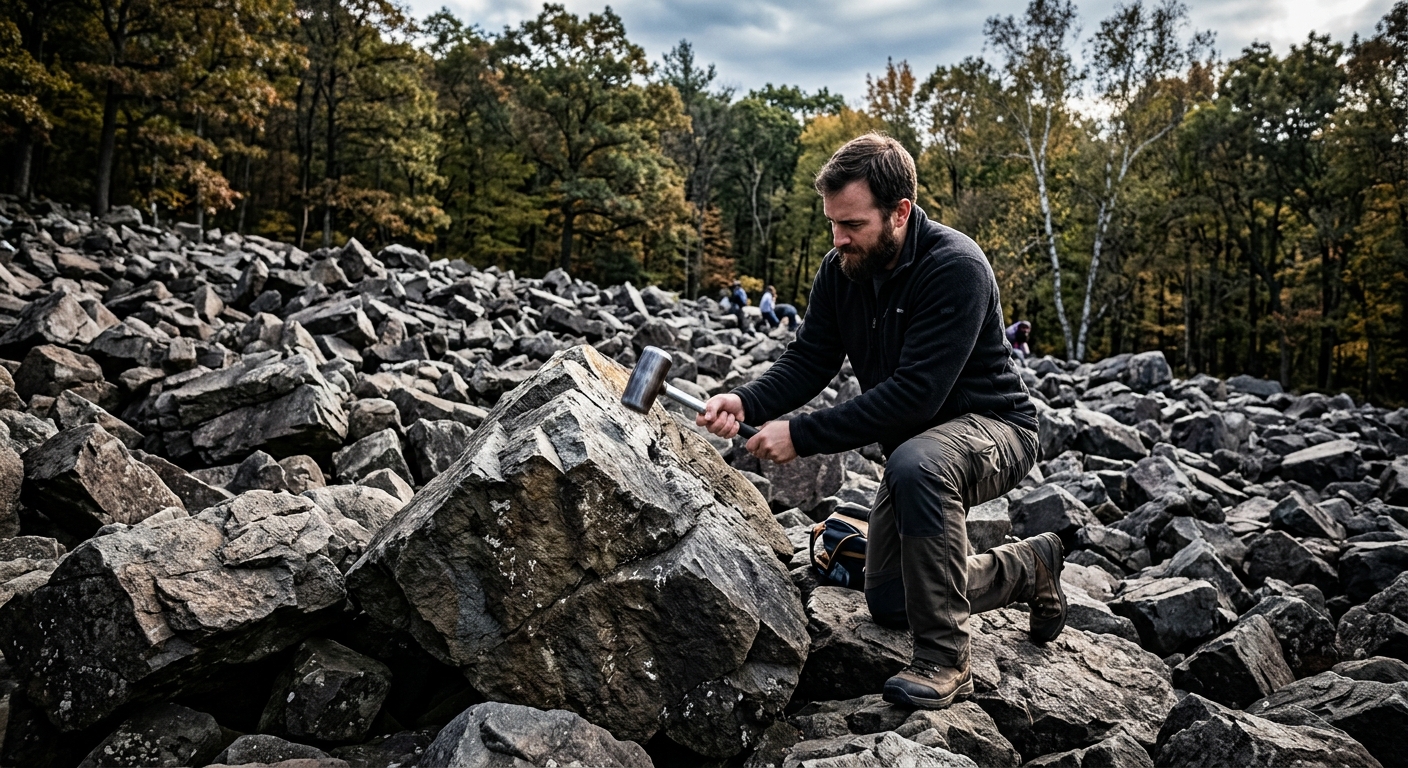
Deep in the forests of Pennsylvania lies one of nature’s most puzzling phenomena: rocks that sing. Known as the Ringing Rocks of Pennsylvania, these mysterious boulders produce clear, bell-like tones when struck with a hammer, creating an otherworldly symphony that has captivated scientists and visitors for over a century.
The Musical Boulder Fields of Bucks County
Located in Upper Black Eddy, Pennsylvania, Ringing Rocks Park spans seven acres of diabase boulder fields that defy conventional understanding. When visitors strike these dark, weathered rocks with metal hammers, they emit pure, resonant tones ranging from high-pitched pings to deep, bell-like chimes. Some rocks produce no sound at all, while others ring with such clarity they could pass for tuned percussion instruments.
The phenomenon is so striking that it inspired the park’s creation in 1890, making it one of America’s earliest geological attractions. Generations of curious explorers have made pilgrimages to this acoustic wonderland, armed with hammers to coax music from stone.
The Geological Puzzle Behind the Music
The ringing rocks are composed primarily of diabase, a type of igneous rock formed when magma cooled slowly beneath the Earth’s surface millions of years ago. However, diabase rocks elsewhere don’t typically produce these musical qualities, making Pennsylvania’s specimens particularly enigmatic.
What Makes These Rocks Ring?
Scientists have proposed several theories to explain this acoustic anomaly:
- Internal Stress Patterns: The rocks may contain unique internal stress configurations that allow them to vibrate like tuning forks when struck
- Crystalline Structure: The specific mineral composition and crystal alignment might create resonant chambers within the rock
- Weathering Effects: Centuries of freeze-thaw cycles may have created microscopic fractures that influence sound production
- Iron Content: High iron content in the diabase might contribute to the acoustic properties
Despite decades of study, no single theory fully explains why these particular rocks sing while chemically identical specimens from other locations remain silent.
The Science of Stone Music
When struck, the ringing rocks vibrate at specific frequencies, much like a bell or xylophone bar. The pitch depends on the size, shape, and internal structure of each boulder. Larger rocks typically produce lower tones, while smaller specimens ring at higher frequencies.
Researchers have discovered that only about 25% of the rocks in the field produce clear tones. The remaining boulders either create dull thuds or no discernible sound at all. This selectivity adds another layer to the mystery, suggesting that the acoustic properties depend on precise, poorly understood conditions.
Acoustic Analysis Reveals Hidden Complexity
Modern acoustic analysis has revealed that the ringing rocks produce remarkably pure tones with minimal harmonic distortion. Some specimens ring for several seconds after being struck, demonstrating exceptional resonance qualities that would be envied by musical instrument makers.
The frequency range spans from around 100 Hz to over 1,000 Hz, covering nearly three octaves. This broad spectrum allows visitors to create simple melodies by striking different rocks in sequence.
A Global Phenomenon with Local Mysteries
Pennsylvania isn’t the only location where rocks ring. Similar phenomena have been documented in:
- Montana’s Glacier National Park
- Australia’s Flinders Ranges
- Various locations in India and Africa
- Parts of England and Wales
However, each location presents its own unique characteristics and challenges to scientific understanding. The Pennsylvania site remains among the most accessible and well-studied examples of this geological oddity.
Theories and Ongoing Research
Recent research has focused on the microscopic structure of the ringing rocks. Advanced imaging techniques reveal complex patterns of mineral alignment and microscopic void spaces that may function as acoustic resonators. Some scientists theorize that the combination of iron-rich minerals and specific cooling patterns during the rock’s formation created ideal conditions for sound production.
The Role of Environmental Factors
Environmental conditions also play a crucial role in the rocks’ acoustic properties. Humidity, temperature, and even barometric pressure can affect the quality and intensity of the sounds produced. Many visitors report that the rocks ring more clearly on dry, cool days than during humid summer weather.
Cultural Impact and Visitor Experience
The Ringing Rocks have inspired local folklore, scientific curiosity, and artistic endeavors. Native American legends speak of the rocks as sacred sites where spirits communicate through stone. Modern musicians have incorporated the boulder field into compositions, treating the entire landscape as a massive natural instrument.
Today, visitors to Ringing Rocks Park can experience this acoustic wonder firsthand. The park provides hammers for public use, allowing everyone to participate in the geological symphony. However, officials remind visitors to strike responsibly to preserve these natural instruments for future generations.
The Enduring Mystery
Despite modern scientific tools and methods, the Ringing Rocks of Pennsylvania continue to guard their secrets. Each new study reveals additional complexity rather than simple answers, reinforcing the rocks’ status as one of geology’s most charming puzzles.
As we continue to explore and understand our planet’s hidden wonders, these musical stones remind us that Earth still holds countless mysteries waiting to be discovered. Whether the result of unique geological processes, specific mineral compositions, or factors yet unknown, the ringing rocks stand as testament to the surprising and delightful complexity of our natural world.
The next time you hear music, remember that somewhere in Pennsylvania, nature has been composing its own symphony in stone for millions of years, waiting patiently for someone with a hammer to conduct the performance.






this is super cool, though i gotta say the real hidden orchestra is actually happening all around those rocks if you listen close enough – the vibrations from those stones probably attract all sorts of arthropods, including spiders that use ground vibrations to hunt and communicate. spider silk is honestly one of nature’s most underrated achievements for transmitting those exact kinds of vibrations, and some hunting spiders can literally “hear” through the ground better than we can. would love to know if anyone’s documented what the local arachnid community thinks of these musical boulders.
Log in or register to replyThis is such a cool observation, Stan – you’re thinking about resonance in a way that goes beyond just the rock itself. I’m curious though, imagine if those bell-like frequencies are actually *repelling* certain arthropods while attracting others, the way some insects navigate by vibration detection. I wonder if anyone’s actually measured what frequencies these rocks produce and compared that to arthropod sensory ranges? That seems like it could be a testable bridge between the geology and the ecology happening around them.
Log in or register to replyQuinn, you’re onto something really interesting here – it’s basically like asking if the rocks are acting as cleaner fish for the local arthropod community, sorting out who belongs in that acoustic niche and who doesn’t. If those frequencies are genuinely repelling certain species while attracting others, you’d have a natural sorting mechanism that could shape the entire arthropod community structure around those boulder fields. The testable part is key too, someone definitely should measure what frequencies get produced and cross reference with known arthropod hearing ranges, seems like a perfect jumping off point for actual research.
Log in or register to reply