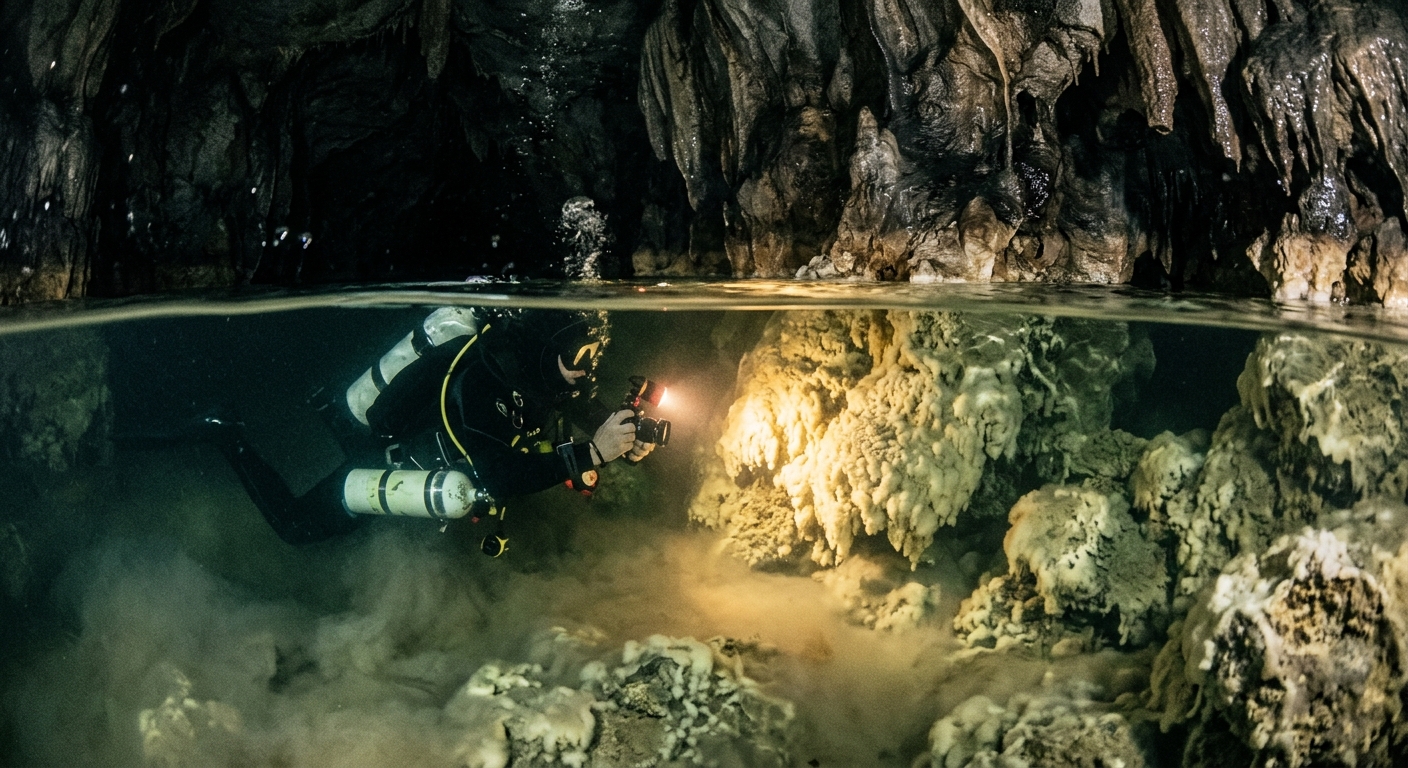
Deep beneath the Romanian countryside lies one of Earth’s most extraordinary biological mysteries. The Movile Cave, sealed from the outside world for 5.5 million years, harbors an ecosystem so alien it might as well exist on another planet. What makes this subterranean world truly mind-boggling? Its air is poisonous to humans, yet it supports 48 unique species that exist nowhere else on Earth.
A Cave Discovered by Pure Chance
In 1986, Romanian workers were searching for new ground to build a power plant when they stumbled upon something that would revolutionize our understanding of life on Earth. What appeared to be solid limestone suddenly gave way, revealing a hidden cave system that had been completely cut off from the surface world since before humans even existed.
The moment scientists lowered equipment into the cave, they knew they had found something extraordinary. The air readings were unlike anything they had ever encountered in a natural environment on our planet.
An Atmosphere That Could Kill You
The air inside Movile Cave reads like a recipe for death. The atmosphere contains:
- 100 times more carbon dioxide than surface air (2-3.5% compared to 0.04%)
- Toxic levels of hydrogen sulfide that would kill humans within minutes
- Zero sunlight for millions of years
- Methane and ammonia in concentrations that would be lethal
- Only 7-10% oxygen compared to 21% on the surface
For humans, spending just a few minutes in this environment without protective equipment would mean certain death. The toxic cocktail of gases would overwhelm our respiratory system almost instantly. Yet somehow, this poisonous underground world teems with life.
Life Finds a Way: The Impossible Ecosystem
What scientists discovered in Movile Cave challenged everything we thought we knew about the requirements for complex ecosystems. In this lightless, toxic environment, 48 species have not just survived but thrived, and incredibly, 33 of these species are completely new to science.
The Foundation of Life Without Sunlight
Every ecosystem on Earth’s surface depends ultimately on photosynthesis, the process by which plants convert sunlight into energy. But in Movile Cave, there has been no sunlight for 5.5 million years. So how does life exist at all?
The answer lies in a process called chemosynthesis. Specialized bacteria in the cave have evolved to feed on hydrogen sulfide and other chemicals seeping from the rocks. These bacteria form thick, foam-like mats on the cave walls and water surface, creating the foundation of this alien food web.
Meet the Cave’s Bizarre Inhabitants
The Blind Hunters
Among the cave’s most fascinating residents are spiders that have completely lost their ability to see. After millions of years in absolute darkness, these arachnids have evolved enhanced senses of touch and vibration that make them incredibly efficient hunters in their lightless world.
The Transparent Water Scorpions
The cave’s aquatic areas host water scorpions that have become almost completely transparent. These ghostly predators glide through the toxic waters with an otherworldly grace, hunting prey that exists nowhere else on Earth.
The Giant Centipedes
Perhaps most intimidating are the cave’s centipedes, which have grown larger than their surface relatives. With enhanced appendages for detecting prey in the darkness, these arthropods rule as apex predators in their toxic domain.
A Window Into Evolution’s Creativity
Movile Cave represents one of the longest-running natural experiments in evolution on our planet. Cut off from the outside world for millions of years, the species trapped inside have undergone extraordinary adaptations:
- Loss of pigmentation: Many species have become pale or completely colorless
- Enhanced sensory organs: Creatures have developed elongated antennae and legs for navigation
- Metabolic adaptations: Species have evolved to thrive in low-oxygen, high-toxicity conditions
- Unique feeding strategies: The entire ecosystem has restructured around chemosynthetic bacteria
Why This Cave Matters for Science
The Movile Cave ecosystem provides crucial insights into several important scientific questions. It shows us how life might exist on other planets with harsh atmospheric conditions, demonstrates the incredible adaptability of evolution, and reveals that complex ecosystems can exist in environments we previously thought uninhabitable.
Researchers studying the cave have made groundbreaking discoveries about extremophile bacteria, which could have applications in biotechnology and medicine. The unique metabolic pathways these organisms have developed might hold keys to new antibiotics or industrial processes.
Protecting Earth’s Most Unique Ecosystem
Today, access to Movile Cave is strictly limited to protect its irreplaceable ecosystem. Only a handful of researchers have ever been allowed inside, and each visit requires extensive safety equipment and protocols. The introduction of surface microbes could potentially devastate this ancient ecosystem, so preservation efforts are critical.
The cave serves as a powerful reminder that our planet still holds incredible secrets. In an age when we think we have explored every corner of Earth, Movile Cave proves that alien worlds might exist right beneath our feet, sustained by poisonous air that would kill us but supporting life forms that evolution crafted in complete isolation.
This toxic underground realm challenges our understanding of life’s limits and continues to reveal new insights about the incredible diversity and adaptability of life on our remarkable planet.


This cave is absolutely mesmerizing to think about, especially since it’s operating on chemosynthesis rather than the sun’s energy like almost every other ecosystem we know. What really gets me though is how Movile represents this perfect counterargument to light pollution disasters, you know? Here we have life thriving in absolute darkness using chemical energy, while up on the surface we’re literally erasing entire species of bioluminescent organisms (like our poor fireflies) by drowning them in artificial light they never evolved to handle. It’s like nature’s showing us two opposite problems: down there, darkness creates magic through sulfur-based chemistry, and up here, we’re killing the magic that lives in the dark.
Log in or register to replyhonestly this cave hits different for me ngl, the fact that life found a way to thrive in literal hydrogen sulfide and methane without any sunlight is like… thats basically what we’d expect to find at 4000+ meters down in the ocean and nobody talks about it nearly enough. the deep sea has been doing this for eons but people get way more excited about a cave than they do about the abyssal zones where bioluminescence lights up entire ecosystems in complete darkness. either way its amazingly humbling stuff, your looking at millions of years of isolation creating these mind bending adaptations and i could talk about it for hours lol
Log in or register to replyThis is such a cool example of chemosynthesis in action! I’m curious if anyone’s studied what kinds of arthropods are thriving in there, because caves like Movile are actually incredible habitats for bat research too – some species have adapted to hunt in total darkness using echolocation so sophisticated it makes our best sonar look primitive. The cave ecosystem Dave mentioned reminds me of how bats navigate those extreme environments without relying on vision at all, which honestly gets overlooked when people are obsessing over the cave’s toxic chemistry. Movile’s basically proof that life finds solutions we can barely comprehend yet!
Log in or register to reply