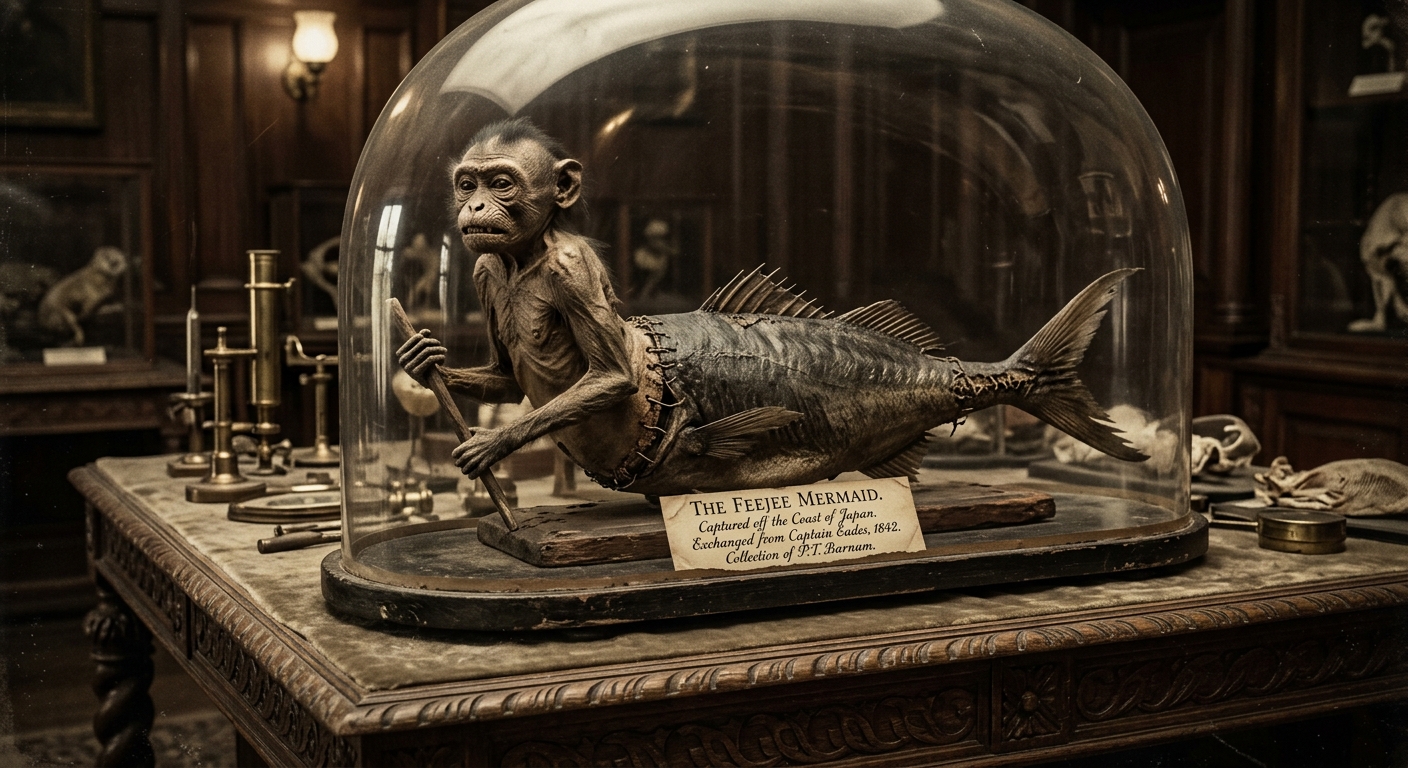
In 1842, a curious creature arrived at the American Museum in New York City that would spark a global phenomenon lasting nearly two centuries. Visitors lined up around the block to glimpse what appeared to be the preserved remains of a real mermaid, complete with a human-like torso and a fish tail. But this wasn’t the beautiful, ethereal being of fairy tales. Instead, it was a grotesque, mummified creature that would become one of history’s most successful hoaxes: the Fiji Mermaid.
The Birth of a Legendary Hoax
The story begins with P.T. Barnum, the master showman who would later create the famous Ringling Bros. and Barnum & Bailey Circus. In 1842, Barnum was struggling to attract visitors to his American Museum. He needed something extraordinary, something that would capture the public’s imagination and fill his coffers. That’s when he acquired what he claimed was a genuine mermaid specimen from the Fiji Islands.
The creature was actually a masterful piece of taxidermy, created by Japanese fishermen who had sewn together the upper body of a monkey with the tail of a fish. These “ningyo” (human-fish) had been created for centuries in Japan, often for religious purposes or as curiosities. But Barnum transformed this cultural artifact into the sensation of the century.
The Marketing Genius Behind the Myth
Barnum didn’t just display the creature; he orchestrated an elaborate marketing campaign that would make modern advertisers jealous. He planted stories in newspapers across the country, describing the discovery of mermaid remains and the scientific excitement surrounding them. He created detailed backstories about how the specimen was obtained from Japanese sailors and authenticated by leading naturalists.
The showman even hired actors to pose as distinguished scientists who would vouch for the creature’s authenticity. He distributed pamphlets filled with “evidence” and testimonials, and most cleverly, he commissioned beautiful illustrations of elegant mermaids that bore no resemblance to the grotesque specimen on display. These images set expectations that drew crowds, even though the reality was far different from the fantasy.
The Public’s Reaction
Despite its obviously artificial appearance, the Fiji Mermaid became a sensation. Thousands of visitors paid to see the creature, and newspapers across the country ran stories about it. The exhibition was so successful that Barnum created multiple copies and sent them on tour across America and Europe. Even when skeptics pointed out the obvious signs of fabrication, public fascination remained undiminished.
The Science Behind the Deception
Modern analysis of surviving Fiji Mermaid specimens reveals the ingenious craftsmanship behind the hoax. The creators typically used the torso and head of a juvenile orangutan or other primate, which provided appropriately human-like proportions and facial features. The fish portion was usually taken from a large salmon or similar species, with the junction carefully concealed using papier-mâché, wire, and other materials.
The entire construction was then treated with preservatives and aged to give it an ancient, weathered appearance. Hair was often added to make the creature appear more human, and glass eyes were sometimes inserted to enhance the illusion. The result was convincing enough to fool casual observers, especially in the dim lighting conditions typical of 19th-century museums and sideshows.
The Global Mermaid Phenomenon
The success of Barnum’s Fiji Mermaid launched a worldwide obsession with mermaids that continues to this day. Within decades of its debut, similar specimens began appearing in museums and exhibitions across the globe. Entrepreneurs in various countries created their own versions, each with elaborate origin stories and scientific “documentation.”
Cultural Impact and Legacy
The Fiji Mermaid phenomenon did more than just entertain audiences; it fundamentally changed how people thought about mermaids and sea creatures. Before Barnum’s hoax, mermaid legends were largely confined to folklore and sailor’s tales. But the apparent physical evidence provided by the Fiji Mermaid gave these stories a new credibility and sparked serious scientific discussions about undiscovered marine life.
This hoax also coincided with the golden age of natural history museums and the public’s growing fascination with exotic specimens from around the world. People were eager to believe in the existence of strange creatures, especially as explorers were regularly discovering new species in remote corners of the Earth.
The Modern Mermaid Obsession
Today’s mermaid phenomenon can trace its roots directly back to Barnum’s creation. From Disney’s “The Little Mermaid” to reality TV shows like “Mermaids: The Body Found,” our culture’s fascination with these mythical beings continues unabated. The basic template established by the Fiji Mermaid remains influential: the idea that mermaids could be real, that evidence might exist, and that science might one day prove their existence.
Modern “mermaid” hoaxes still surface regularly on social media, often using similar tactics to those employed by Barnum nearly 180 years ago. Blurry photographs, expert testimonials, and elaborate backstories continue to capture public attention, proving that the fundamental appeal of the mermaid mystery remains as powerful as ever.
Lessons from the Greatest Showman
The Fiji Mermaid teaches us important lessons about human nature, scientific skepticism, and the power of marketing. Barnum understood that people wanted to believe in magic and mystery, even when confronted with obvious evidence to the contrary. His success lay not in creating a perfect forgery, but in crafting a compelling narrative that allowed people to suspend their disbelief.
The hoax also highlights the importance of critical thinking and scientific methodology. While the Fiji Mermaid was obviously fake to trained naturalists of the time, the lack of widespread scientific education meant that most people lacked the tools to properly evaluate the evidence presented to them.
Perhaps most importantly, the Fiji Mermaid demonstrates the enduring power of wonder in human culture. Even knowing it was a hoax, people continued to be fascinated by the possibility it represented. This same sense of wonder drives modern scientific discovery and exploration, reminding us that while we should be skeptical of extraordinary claims, we should never lose our capacity for amazement at the genuine wonders our world contains.






I find this fascinating, but it makes me think about how different things might’ve been if people had that same openness to wonder directed toward actual marine life instead! Like, we didn’t need fake mermaids when we have humpback whales engaging in what can only be described as complex musical conversations, or belugas that literally mimic human speech sounds. The tragedy is that real cetaceans are SO extraordinary and we’ve spent centuries chasing hoaxes instead of respecting what’s actually out there in the ocean, you know?
Log in or register to replyThis is such a cool example of how humans will believe what they want to believe, and honestly I see the same thing happening with bats right now – people are absolutely convinced they’re blind bloodsuckers out to tangle in your hair when the reality is they’re mostly just hanging out eating insects and pollinating crops. The difference is that unlike the sea monkey hoax, the bat myths actually hurt real animals because people kill them out of fear, so I guess I’m glad we at least have actual evidence on our side instead of a creepy sewn-together specimen!
Log in or register to replyomg the fiji mermaid is such a perfect example of how a halfway convincing fake can just spiral into collective belief lol. but honestly i think theres something deeper going on – like humans didnt *just* want to beleive, they already had these vague stories about mermaids from sailors spotting manatees or giant squid in teh distance, you know? barnum just weaponized what was already there. its actually pretty facinating how every “mermaid sighting” probably has some real animal at its core, whether thats a seal or a grouper or whatever, and then our brains just… fill in the mythology gaps tbh.
Log in or register to reply