
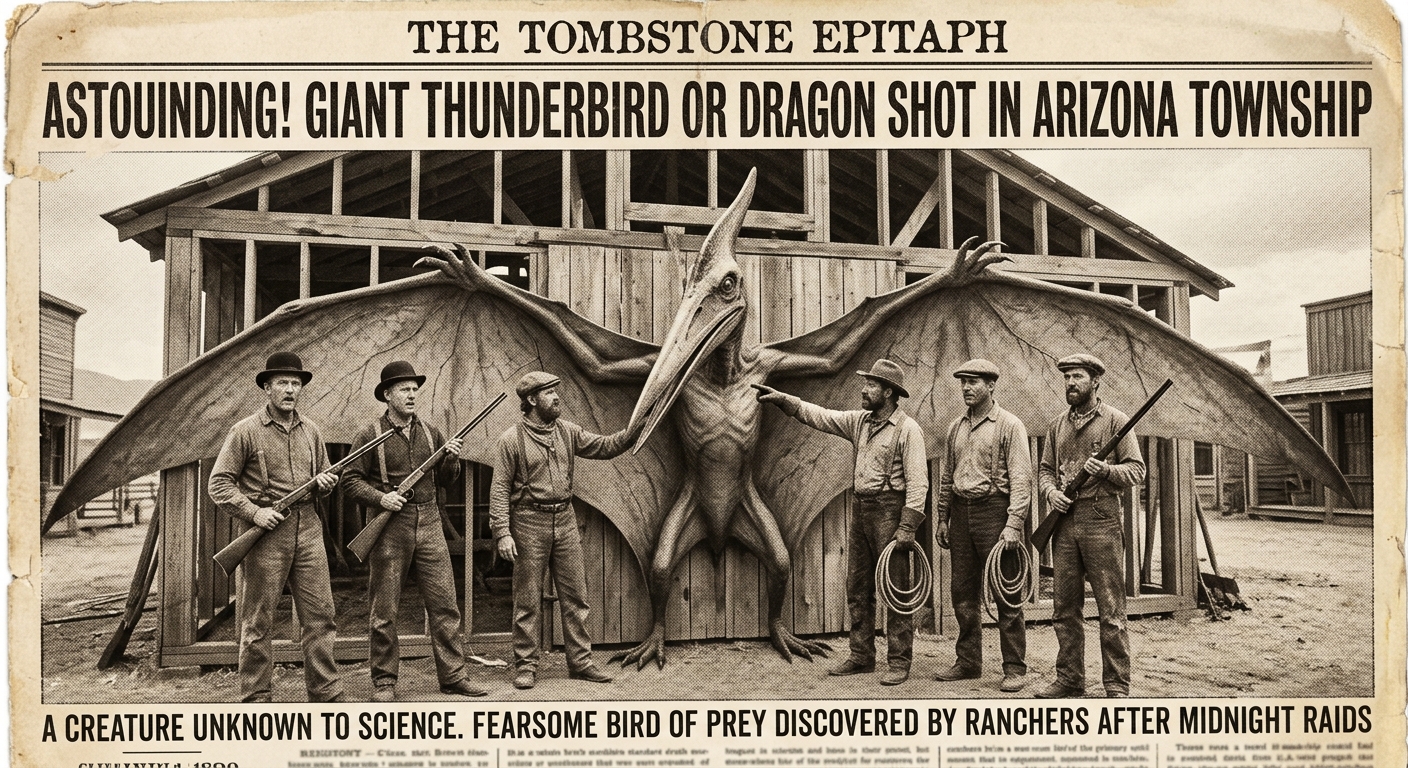
In the annals of cryptozoology and unexplained phenomena, few mysteries capture the imagination quite like the legendary Thunderbird photograph. This enigmatic image, allegedly showing the carcass of a massive bird-like creature, has sparked decades of debate, investigation, and frustration among researchers and enthusiasts alike. What makes this case truly extraordinary isn’t just the creature itself, but the fact that a photograph once published in a newspaper seems to have completely disappeared from existence.
The Legend of the Thunderbird
Before diving into the photographic mystery, it’s essential to understand the cultural and historical context of the Thunderbird itself. In Native American mythology, particularly among Plains tribes, the Thunderbird represents a powerful supernatural being capable of creating thunder and lightning. These magnificent creatures were described as enormous birds with wingspans stretching 20 feet or more, possessing the strength to carry off large animals and even humans.
The legend wasn’t confined to ancient folklore. Throughout the 19th and early 20th centuries, numerous settlers, cowboys, and frontiersmen reported encounters with gigantic birds across the American Southwest. These accounts described creatures far larger than any known bird species, with some witnesses claiming wingspans of 30 feet or more.
The Mysterious Photograph Emerges
The story of the Thunderbird photograph centers around an alleged incident in the late 1800s, most commonly dated to 1886, though some versions place it in the 1890s. According to the tale, two cowboys in Arizona Territory encountered and killed an enormous bird-like creature that had been terrorizing livestock in the area. The beast was described as having leathery, bat-like wings, a long neck, and a featherless body resembling something between a bird and a pterodactyl.
After their successful hunt, the men supposedly dragged the creature back to town where it was displayed spread-winged against a barn wall. The wingspan was reportedly so enormous that the creature stretched across the entire width of the building. Most crucially, a photographer was summoned to document this incredible discovery, and the resulting image was allegedly published in a local newspaper.
The Vanishing Act Begins
Here’s where the story takes its most perplexing turn. Countless people claim to remember seeing this photograph published in various newspapers, magazines, and books over the decades. The descriptions are remarkably consistent: a large bird-like creature pinned or nailed to a wooden wall with several men standing nearby for scale, dramatically illustrating the massive size of the beast.
However, despite numerous investigations, searches through newspaper archives, and the efforts of dedicated researchers, no one has been able to locate this photograph. It’s as if the image simply vanished from every archive, collection, and repository where it supposedly once existed.
The Great Archive Hunt
The search for the Thunderbird photograph has become something of a holy grail for cryptozoology enthusiasts and mystery researchers. Professional archivists, newspaper historians, and amateur investigators have scoured collections across the American Southwest, looking for any trace of the elusive image.
Researchers have examined:
- Newspaper archives from Arizona, New Mexico, Texas, and surrounding territories
- Historical society collections and local museums
- Private photograph collections and estate sales
- Early photography studio records and glass plate collections
- Territorial government documents and correspondence
The systematic nature of these searches makes the photograph’s absence even more mysterious. Professional archivists note that while some historical documents do get lost over time, the complete disappearance of a photograph that so many people remember is highly unusual.
Theories Behind the Disappearance
The Mandela Effect Explanation
Some researchers propose that the Thunderbird photograph represents a classic example of the Mandela Effect, the phenomenon where large groups of people remember something that never actually existed. According to this theory, the detailed memories of the photograph might be the result of conflated images, stories, or artistic representations that somehow became embedded in collective memory as a real photograph.
Deliberate Suppression
Another theory suggests that the photograph was deliberately removed from archives and collections. Proponents of this idea argue that government agencies, scientific institutions, or other organizations might have had reasons to suppress evidence of such a creature. However, critics point out that such coordination would require an impossibly vast conspiracy spanning multiple states and decades.
Natural Loss and Degradation
A more mundane explanation involves the natural loss of historical materials over time. Early photographs were often printed on fragile materials that degraded easily. Newspaper archives from the frontier period are notoriously incomplete, with many small-town publications lost to fires, floods, and simple neglect.
Modern Investigations and Technology
The digital age has brought new tools to the search for the Thunderbird photograph. Online databases, digitized newspaper archives, and advanced search algorithms have made it possible to examine vast collections of historical materials with unprecedented speed and thoroughness.
Despite these technological advantages, the photograph remains elusive. Some investigators have found similar images of large birds or pterosaur-like creatures, but none match the specific details remembered by those who claim to have seen the original Thunderbird photograph.
The Living Mystery
What makes the Thunderbird photograph case truly fascinating is how it continues to evolve. New witnesses periodically come forward claiming to remember the image, often providing consistent details about its appearance and the circumstances of the creature’s capture. These accounts keep the mystery alive while simultaneously deepening the puzzle of the photograph’s current whereabouts.
The case represents a unique intersection of cryptozoology, historical research, and psychology. Whether the photograph ever existed or not, its legend has become a powerful example of how stories, memories, and mysteries can take on lives of their own.
Today, the search for the Thunderbird photograph continues, driven by dedicated researchers who refuse to accept that such a significant piece of evidence could simply vanish without a trace. Until the image surfaces or is definitively proven never to have existed, it remains one of the most intriguing unsolved mysteries in the world of unexplained phenomena.





This is a fascinating case study in how collective memory can diverge from physical evidence, though I’m curious if anyone’s actually traced back the original newspaper claims systematically? The “giant bird” angle reminds me a bit of how venom researchers have to wade through folklore to find actual species, and it’s wild how a compelling story can calcify in public memory even without supporting documentation. If it ever did exist, I’d be more interested in whether it was a misidentified real animal (condor, large raptor, whatever) versus something truly anomalous, since nature’s already got some genuinely bizarre creatures that don’t need embellishment.
Log in or register to replyI appreciate the mystery here, but as someone who spends a lot of time in archives documenting species changes over decades, I’d be curious whether anyone’s actually verified these newspaper claims exist at all rather than assuming they do. I’ve seen plenty of ecological folklore that gets repeated so often people swear they saw the original source, but when you dig into microfilm from that era the actual records just aren’t there. Could be worth checking if any of the people claiming to remember the photo can cite a specific newspaper, date, and location, since that kind of detail usually holds up or falls apart pretty quick.
Log in or register to replyThis is such a cool mystery, but I have to say it hits different for me as someone who spends a lot of time documenting actual species changes in ocean archives. The fact that nobody seems to have traced back original newspaper sources is wild, because even degraded photos from old expeditions leave *some* trace. Makes me wonder if this is more about how stories evolve than about a vanished photo, you know? That said, it would be amazing if someone actually did the legwork to verify those newspaper claims like William mentioned.
Log in or register to reply