
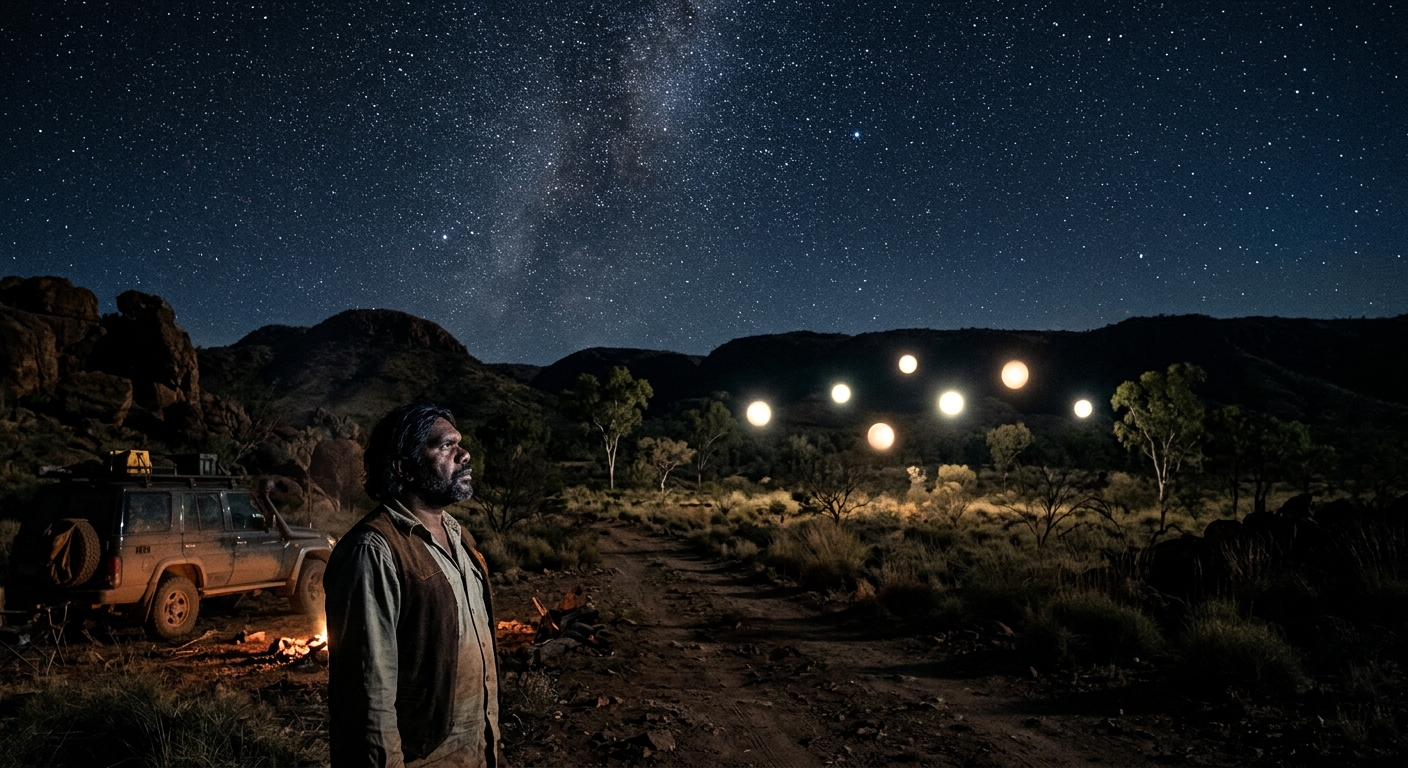
Deep in the Australian Outback, where red earth stretches endlessly toward distant horizons, travelers have reported something that defies explanation. For over a century, witnesses have described mysterious lights dancing across the landscape near the remote town of Boulia in Queensland. These aren’t stars or vehicle headlights or any other easily dismissed phenomenon. These are the Min Min Lights, and they’ve become one of Australia’s most enduring mysteries.
The Legend Born from Real Encounters
The Min Min Lights take their name from the Min Min Hotel, which once stood about 100 kilometers west of Boulia. The hotel was demolished in the 1930s, but long before its destruction, staff and guests reported strange lights appearing in the distance. These weren’t ordinary lights. Witnesses described glowing orbs that seemed to follow people, hovering about a meter off the ground and maintaining a constant distance from observers.
What makes these sightings particularly compelling is their consistency across decades and the credibility of many witnesses. Stockmen, police officers, geologists, and even skeptical scientists have all reported encounters with these mysterious lights. The descriptions remain remarkably similar: a bright, usually white or yellow light that appears to float above the ground, sometimes following vehicles or people for kilometers before simply vanishing.
Characteristics That Baffle Scientists
The Min Min Lights exhibit several peculiar characteristics that make them difficult to explain through conventional means:
- Persistence: The lights can follow observers for extended periods, sometimes for hours
- Intelligence: They appear to respond to human presence, approaching when called or retreating when approached
- Consistency: Reports describe similar behavior patterns across different decades and witnesses
- Environmental specificity: Sightings are concentrated in a particular geographic region of Queensland
- Seasonal patterns: Many sightings occur during specific weather conditions, particularly on clear, still nights
Scientific Attempts at Explanation
Researchers have proposed numerous theories to explain the Min Min phenomenon, but none have provided a completely satisfactory answer. The most prominent scientific explanation involves atmospheric refraction, where light from distant sources is bent through layers of air at different temperatures, creating a mirage effect.
Professor Jack Pettigrew from the University of Queensland conducted extensive research on the lights in the 1970s and 2000s. He demonstrated that under specific atmospheric conditions, lights from sources many kilometers away could appear as floating orbs through a process called Fata Morgana. This superior mirage effect can bend light over vast distances, making distant car headlights or house lights appear to hover mysteriously in the outback.
The Refraction Theory’s Limitations
While Pettigrew’s research provided a plausible explanation for some sightings, it doesn’t account for all reported characteristics of the Min Min Lights. The theory struggles to explain:
- Why the lights appear to respond intelligently to human behavior
- How they can follow moving vehicles while maintaining consistent distance
- Reports from the early 20th century when artificial light sources were extremely rare in the region
- Sightings that occur when no known light sources exist in the direction of the phenomenon
Alternative Theories and Explanations
Beyond atmospheric refraction, scientists have proposed several other explanations for the Min Min Lights phenomenon. Some researchers suggest the lights could be caused by naturally occurring electrical phenomena, similar to ball lightning. The geology of the region, rich in certain minerals, might create conditions for unusual electromagnetic activity.
Another theory involves bioluminescence from unknown organisms or chemical reactions in the soil. The Australian Outback contains numerous mineral deposits that could potentially create phosphorescent effects under specific conditions. However, no definitive evidence has been found to support this hypothesis.
The Piezoelectric Effect
Some scientists have explored whether geological stress could generate lights through the piezoelectric effect, where pressure on certain crystals creates electrical charges. The theory suggests that tectonic stress on quartz-bearing rocks might produce visible electrical discharges. While this phenomenon has been documented in laboratory conditions, field evidence remains elusive.
Modern Investigations and Technology
Contemporary researchers have employed sophisticated equipment to study the Min Min Lights, including infrared cameras, electromagnetic field detectors, and atmospheric monitoring devices. These investigations have yielded intriguing but inconclusive results.
In recent years, several research teams have documented unusual electromagnetic activity in the region during reported sightings. However, establishing a direct connection between these readings and the visual phenomena remains challenging. The remote location makes continuous monitoring difficult, and the unpredictable nature of the sightings complicates systematic study.
Citizen Science and Documentation
The proliferation of smartphones and digital cameras has led to increased documentation attempts, though capturing clear images or video of the lights proves surprisingly difficult. Many witnesses report that the phenomena don’t appear clearly on camera, or that electronic devices malfunction during sightings.
Cultural Impact and Tourism
The Min Min Lights have become an integral part of Australian folklore and local culture. The town of Boulia has embraced the mystery, hosting an annual Min Min Festival and establishing the Min Min Encounter Centre, which displays reports and theories about the phenomenon.
Tourism related to the lights provides economic benefits to the remote region, with visitors traveling thousands of kilometers hoping to witness the mysterious phenomena. Local guides offer Min Min Light tours, though sightings cannot be guaranteed, adding to the phenomenon’s mystique.
The Ongoing Mystery
Despite decades of investigation and numerous theories, the Min Min Lights remain unexplained. The phenomenon represents a fascinating intersection of folklore, science, and human perception. Whether the lights result from atmospheric conditions, geological processes, or something entirely unknown, they continue to capture imaginations and challenge scientific understanding.
The persistence of reports across generations, combined with the failure of any single theory to account for all observed characteristics, ensures that the Min Min Lights will remain one of Australia’s most intriguing mysteries. For scientists, they represent an ongoing challenge to our understanding of natural phenomena. For visitors to the Outback, they offer the tantalizing possibility of witnessing something truly extraordinary in one of Earth’s most remote and mysterious landscapes.


oh man this is so cool, ive been wanting to document something like this on iNaturalist but obvi ghost lights are trickier than a rare beetle lol. has anyone tried systematically photographing these with consistent camera settings and gps coordinates? like thats kind of the backbone of what makes crowdsourced observations actually useful for science, and id bet if enough people logged sightings with details about conditions, time, direction faced etc you might start seeing patterns the old anecdotal reports missed. curious if theres a local naturalist group out there already tracking these or if thats something worth setting up
Log in or register to replyBen, I love where your head’s at with systematic documentation, but I gotta say, even with perfect iNaturalist-style data I’m skeptical we’d crack Min Min the way we’re approaching it. The thing is, we’ve gotten so good at understanding predator behavior and ecosystem effects through long-term observation (looking at you, Lamar Valley wolves and what they’ve done to riparian zones) that I wonder if we’re missing something about *why* an animal might produce bioluminescence in that specific region. What if we’re not just looking for the wrong explanations, but literally looking in the wrong places or at the wrong times because we don’t understand the ecological trigger?
Log in or register to replyhonestly what gets me about Min Min Lights is wondering whether we’re even asking the right questions, like we keep trying to explain them through physics but what if some animal is producing these in a way we haven’t considered yet? I keep thinking about bioluminescent organisms and how little we understand about animal signaling in remote ecosystems, plus Ben’s idea about systematic documentation is solid but I wonder if traditional camera setups would even capture what’s happening if it’s outside our usual visual spectrum?
Log in or register to reply