
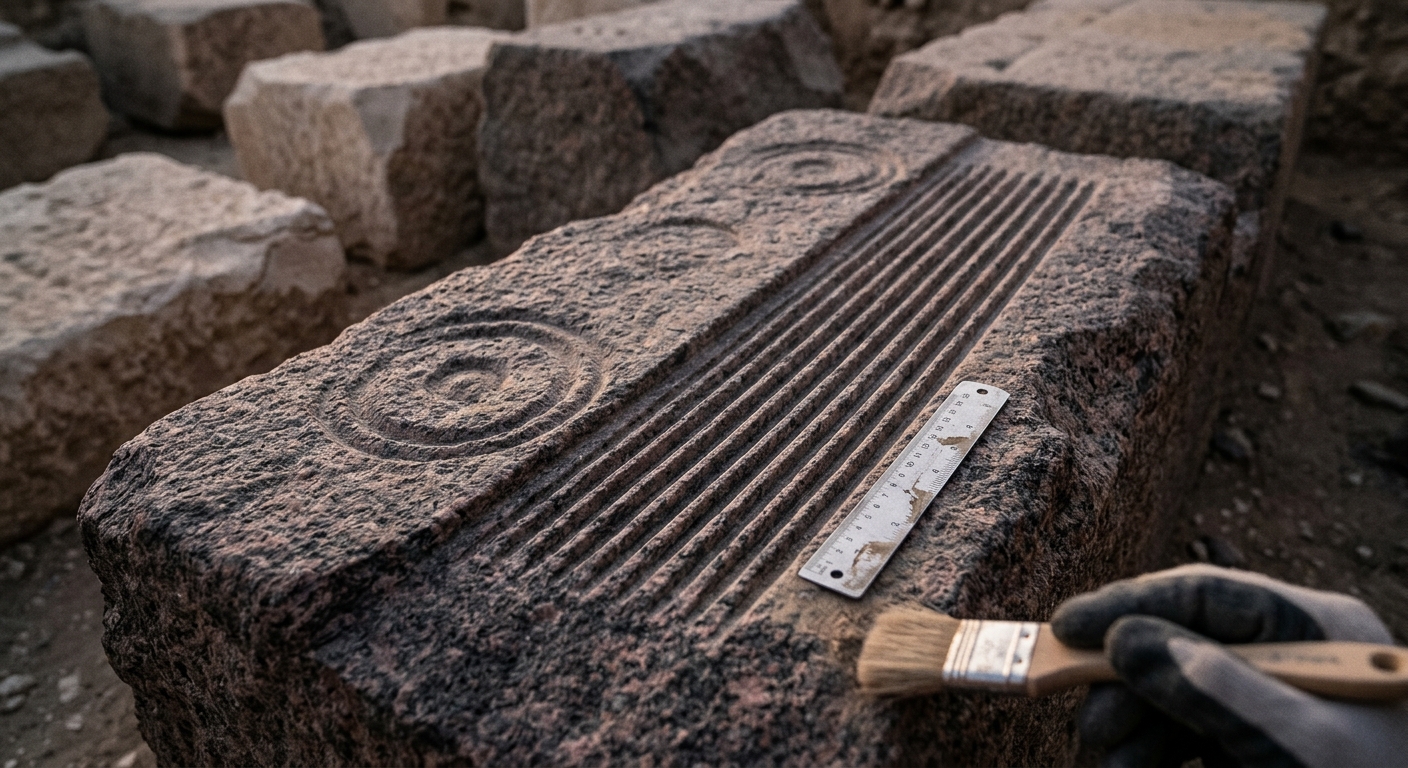
Standing before the Great Pyramid of Giza, visitors often wonder about the massive limestone blocks that form this ancient wonder. Each stone weighs between 2.5 and 15 tons, cut with precision that would challenge modern stonemasons. Yet according to archaeological evidence, the ancient Egyptians accomplished this monumental feat using tools that, by all logical reasoning, should have been utterly inadequate for the task: copper chisels.
The Tool Mystery That Baffles Engineers
Copper ranks as one of the softest metals known to humanity, registering only 2.5 to 3 on the Mohs hardness scale. Limestone, the primary material of the Great Pyramid, scores between 3 and 4 on the same scale. This means copper tools should theoretically be too soft to effectively cut limestone, much less carve it with the precision found in Egyptian monuments.
Modern metallurgists have long scratched their heads at this apparent impossibility. Dr. Denys Stocks, an experimental archaeologist who has spent decades studying ancient Egyptian construction techniques, describes it as “trying to cut butter with a softer piece of butter.” Yet somehow, the Egyptians not only managed this feat but did so while constructing monuments that have stood for over 4,500 years.
Archaeological Evidence of the ‘Wrong’ Tools
Excavations around the Giza plateau have yielded numerous copper tools dating to the pyramid’s construction period (approximately 2580-2560 BCE). These discoveries include:
- Copper chisels with distinctive wear patterns consistent with stone cutting
- Copper saws with tooth marks suggesting use on hard materials
- Copper adzes bearing limestone residue
- Tool fragments found embedded in pyramid stones themselves
Perhaps most remarkably, archaeologists have discovered copper tools still lodged in the pyramid’s internal passages, apparently abandoned by workers during construction. Chemical analysis of these tools confirms they contain no iron or other hardening alloys that might explain their effectiveness.
Solving the Copper Paradox
Recent experimental archaeology has begun to unravel this ancient mystery. The key lies not in the tools themselves, but in how the Egyptians used them. Through painstaking recreation experiments, researchers have discovered that the ancient builders employed several ingenious techniques that made copper tools surprisingly effective.
The Quartz Sand Secret
The breakthrough came when researchers realized that Egyptian copper tools were never used alone. Instead, workers combined them with quartz sand as an abrasive medium. Quartz, rating 7 on the Mohs hardness scale, easily cuts through limestone. The copper tools served not as cutting implements but as guides and pressure applicators for the abrasive sand.
Dr. Mark Lehner of Ancient Egypt Research Associates conducted experiments showing that a copper saw, when used with wet quartz sand, could cut through limestone at a rate of one inch per hour. While slow by modern standards, this pace would have been entirely feasible for a project spanning decades with thousands of workers.
Work Hardening and Tool Maintenance
Ancient metalworkers also understood the principle of work hardening, though they wouldn’t have known it by that name. Repeated hammering and use of copper tools increases their surface hardness significantly. Egyptian copper chisels show evidence of deliberate work hardening through controlled deformation.
Additionally, the Egyptians developed sophisticated tool maintenance systems. Archaeological evidence suggests that dulled tools were regularly re-sharpened and re-hardened. Tool maintenance workshops near the pyramid construction sites have yielded thousands of copper fragments, indicating constant tool repair and replacement.
The Precision Question
Even accepting that copper tools could cut limestone, how did the Egyptians achieve such remarkable precision? The Great Pyramid’s base measurements are accurate to within just 2 centimeters across a 230-meter span. Many blocks fit together so tightly that a knife blade cannot slide between them.
Advanced Measuring Techniques
Recent analysis suggests the Egyptians employed measuring techniques far more sophisticated than previously imagined. They used:
- Cubit rods marked with incredibly precise graduations
- Plumb bobs and levels for ensuring perfect alignment
- Geometric principles for maintaining square corners and precise angles
- Standardized templates for reproducing identical cuts
Experimental archaeologist Denys Stocks successfully recreated Egyptian stone-cutting techniques using only copper tools and period-appropriate methods. His experiments demonstrated that skilled craftsmen could achieve precision cuts by using copper tools as guides for string lines and by employing careful measuring and marking systems.
Beyond the Pyramid: Other ‘Impossible’ Achievements
The Great Pyramid represents just one example of ancient Egyptians accomplishing seemingly impossible feats with primitive tools. Other archaeological mysteries include:
Granite Obelisks and Sarcophagi
Egyptian craftsmen regularly carved granite, one of the hardest stones on Earth, using the same copper tools. The unfinished obelisk at Aswan, weighing over 1,100 tons, shows clear evidence of being shaped by copper tools and abrasives. Microscopic analysis of the cutting marks confirms this seemingly impossible achievement.
Precision Drilling
Perhaps most mysterious are the precision drill holes found throughout Egyptian stonework. Some holes in granite show spiral marks suggesting drill rates that modern engineers considered impossible with ancient technology. Recent experiments using copper tubes, sand, and weighted drilling systems have successfully recreated these “impossible” holes.
Modern Lessons from Ancient Innovation
The Egyptian mastery of copper tools offers profound insights into human ingenuity and problem-solving. Rather than being limited by their technology, the ancient builders found ways to maximize their tools’ effectiveness through clever technique and patient application.
This challenges our modern assumption that technological advancement always means harder, faster, stronger tools. Sometimes, the most elegant solutions involve working with limitations rather than against them. The Egyptians transformed a fundamental disadvantage into a precise, controlled system for creating monuments that have outlasted civilizations.
The Enduring Mystery
While modern experiments have demonstrated that copper tools could theoretically accomplish the work attributed to them, many questions remain. The sheer scale and speed of pyramid construction still challenges our understanding of ancient capabilities. Recent estimates suggest that workers placed a 2.5-ton block every two to three minutes during peak construction periods.
Whether through lost techniques, superior organization, or methods we haven’t yet discovered, the ancient Egyptians achieved what many consider impossible with tools that should not have been up to the task. Their legacy stands as a testament to human ingenuity, proving that sometimes the greatest limitations inspire the most brilliant solutions.
The next time you see a copper penny, remember: this humble metal once carved eternity into stone, creating monuments that continue to inspire wonder 4,500 years after the last chisel strike echoed across the Giza plateau.




honestly this reminds me of how cave systems are carved out over millennia by water that seems impossibly weak against solid rock, but persistence and understanding your material’s actual properties changes everything. the egyptians probably had similar knowledge about their tools and stone that we’re only now rediscovering through experiments – makes you wonder what other “impossible” engineering feats were just people working smarter within their constraints instead of harder against them, kind of like how blind cave fish evolved to navigate total darkness when sight would actually be a waste of energy.
Log in or register to replyThis makes me wonder what we’re missing about how the ancient Egyptians *perceived* and understood their materials, you know? Like, we keep asking “how did they do it with soft copper” but maybe the real question is whether their tactile and kinesthetic knowledge of stone and metal was just fundamentally different from ours, accumulated through generations of hands-on experimentation. I’d love to know if there’s any evidence about their approach to problem-solving with tools, because I suspect understanding *how they thought about the problem* might be as important as the technique itself.
Log in or register to replyThis is fascinating stuff, honestly. I’ve picked up enough copper ore samples around old mining sites to know how soft that metal really is, so the fact that they managed to work limestone at the scale of the pyramids with those tools speaks volumes about their understanding of material properties and technique. I’d love to know more about whether they were using abrasive compounds like quartz sand to do the actual cutting, since that’s pretty much how you’d have to approach it from a geological standpoint. The ingenuity of ancient engineers never ceases to amaze me, especially when you think about how they were essentially working with the constraints of their available geology.
Log in or register to reply