
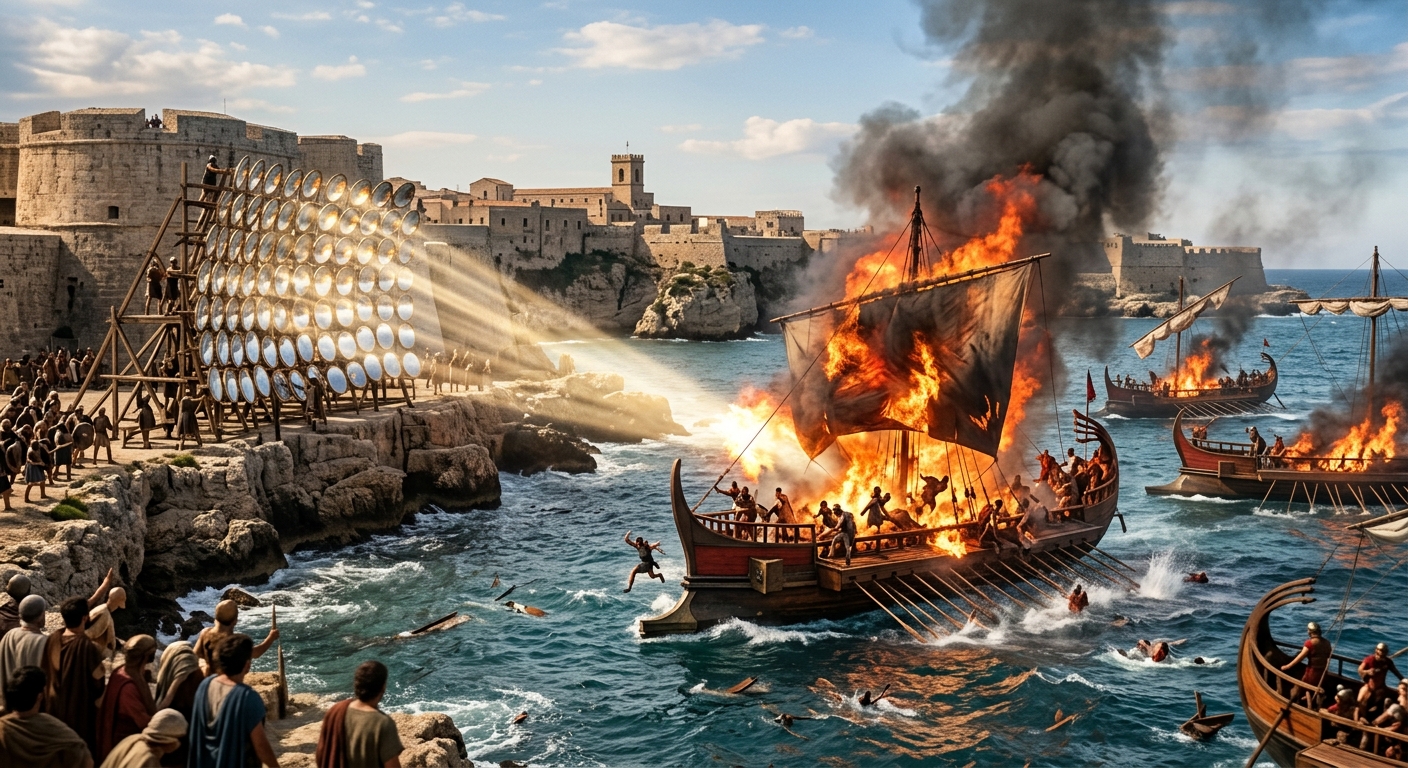
Picture this: enemy ships approaching your coastal city, sails billowing in the Mediterranean breeze. Suddenly, without warning, their wooden hulls burst into flames as if touched by the gods themselves. This wasn’t divine intervention, but rather one of history’s most ingenious applications of physics and engineering. Welcome to the world of ancient Greek solar weapons, where mathematics met warfare in the most spectacular way imaginable.
The Legend of Archimedes’ Death Ray
The year was 214 BCE, and the Roman fleet was laying siege to Syracuse, the jewel of ancient Sicily. According to historical accounts by writers like Lucian and Anthemius, the brilliant mathematician Archimedes devised a weapon so advanced that it seemed like magic to those who witnessed it. Using an array of polished bronze mirrors, he supposedly focused the sun’s rays into concentrated beams capable of igniting Roman ships from a distance.
But was this merely the stuff of legend, or did ancient Greek engineers actually master the physics of parabolic reflection centuries before the Renaissance? The answer lies in understanding both the mathematical principles they discovered and the remarkable technological capabilities of ancient Greek civilization.
The Science Behind Solar Concentration
The concept behind Archimedes’ alleged weapon is rooted in the physics of parabolic reflection. When parallel rays of sunlight strike a parabolic mirror, they converge at a single focal point, concentrating the sun’s energy into an incredibly intense beam. This principle is the same one used in modern solar power plants and satellite dishes.
Here’s how the physics works:
- Parallel light rays from the sun strike the curved mirror surface
- Parabolic geometry ensures all rays reflect toward the same focal point
- Energy concentration creates temperatures potentially exceeding 1000°F (538°C)
- Sustained focus on flammable materials like wood, rope, or canvas can cause ignition
The ancient Greeks possessed sophisticated knowledge of geometry and optics. Euclid’s “Optics” (circa 300 BCE) described the laws of reflection, while Apollonius of Perga (circa 262-190 BCE) wrote extensively about conic sections, including parabolas. This mathematical foundation provided the theoretical framework necessary for such a weapon.
Bronze Mirror Technology
Archaeological evidence reveals that ancient Greeks were master metalworkers, capable of creating highly polished bronze mirrors with remarkable reflective properties. These weren’t the flat mirrors we’re accustomed to today, but carefully crafted curved surfaces that could manipulate light with precision.
Bronze mirrors from this period show evidence of:
- Complex alloy compositions optimized for reflectivity
- Sophisticated polishing techniques achieving near-mirror finishes
- Standardized manufacturing processes for consistent quality
- Various sizes and curvatures for different applications
Modern Experiments and Historical Evidence
The debate over whether Archimedes’ death ray actually worked has raged for centuries. In 2005, students at MIT conducted a fascinating experiment using 127 one-foot-square mirrors to focus sunlight on a wooden ship model. While they succeeded in creating smoke and small fires, the results suggested that the weapon would have been impractical under real battle conditions.
However, other researchers have achieved more promising results. In 1973, Greek engineer Ioannis Sakkas used 70 bronze-coated mirrors to ignite a wooden boat at 160 feet. More recently, the television show “MythBusters” conducted multiple tests with varying degrees of success, ultimately concluding that while technically possible, the weapon would have required perfect conditions and considerable time to be effective.
Historical Accounts and Skepticism
Interestingly, the earliest accounts of the siege of Syracuse by historians like Polybius and Livy make no mention of burning mirrors. The death ray stories appear in later sources, leading some scholars to question their authenticity. However, absence of evidence isn’t evidence of absence, and ancient military secrets were often closely guarded.
Some historians argue that the mirror weapon stories might be conflated with other innovative siege defenses Archimedes definitely created, including:
- Giant mechanical claws that could lift and sink ships
- Catapults with adjustable range mechanisms
- Innovative fortification designs
- Early forms of chemical warfare using burning materials
Beyond Warfare: Practical Applications
Whether or not the death ray existed, ancient Greeks certainly used concentrated solar energy for practical purposes. Archaeological sites have revealed evidence of solar furnaces used for metallurgy, where parabolic mirrors helped achieve the high temperatures necessary for advanced metalworking.
The temple of the sun god Helios at Rhodes reportedly featured massive mirrors that could light ceremonial fires, demonstrating both technological prowess and religious devotion. These applications show that the underlying technology was well understood and widely implemented.
Legacy of Ancient Solar Technology
Regardless of its military effectiveness, the concept of Archimedes’ death ray represents a remarkable fusion of theoretical mathematics and practical engineering. It demonstrates how ancient civilizations could conceive and potentially implement technologies that seem surprisingly modern.
Today’s concentrated solar power plants use essentially the same principles, focusing sunlight with arrays of mirrors to generate electricity. The ancient Greeks may have been pioneers in a technology that’s now helping address climate change, proving once again that sometimes the oldest ideas are the most revolutionary.
The story of ancient Greek solar weapons reminds us that innovation isn’t just about having advanced materials or computers. Sometimes, it’s about understanding fundamental principles of physics and having the creativity to apply them in unexpected ways. Whether Archimedes actually set Roman ships ablaze or not, the very fact that such a weapon was conceivable speaks to the remarkable scientific sophistication of ancient Greek civilization.




This is a cool piece of engineering history, but I have to say it reminds me of how bats get treated in the media – everyone wants to focus on the dramatic weapon aspect when the real story is about the sophisticated problem-solving! Those mirror arrays are genuinely impressive from a physics standpoint regardless of whether they actually worked as “death rays.” Speaking of which, if ancient Greeks had known how many insects bats eat (we’re talking hundreds per night!), maybe they would’ve weaponized bat conservation instead of mirrors, ha. Anyway, great read!
Log in or register to replyok this is such a cool parallel you’re making, the way we mythologize the dramatic part instead of appreciating the actual science and ingenuity behind it. its like how ppl are obsessed with venus flytraps (Dionaea muscipula) being “carnivorous killers” when theyre actually just incredibly specialized plants responding to their nutrient poor environment in the most elegant way possible. the real story of those mirrors and the math involved is way more fascinating than “death ray” imo, same with how bats are these amazing ecologists doing crucial pollination work but everyone just wants the vampire angle lol
Log in or register to replyhonestly you’re hitting on something i think about a lot with prehistoric stuff too, where the dramatic narrative drowns out what’s actually incredible about it. like everyone wants t-rex as a mindless killing machine when the real story, a creature that lived 66 mya with sensory abilities we’re still figuring out, is so much weirder. venus flytraps are a perfect example of that same thing, the actual mechanism is SO much more elegant than the “killer plant” framing, and yeah those mirrors required mathematical sophistication that gets lost when we’re all focused on the “solar weapon” angle. the nutshell version is always sexier but it’s kind of a shame?
Log in or register to reply