
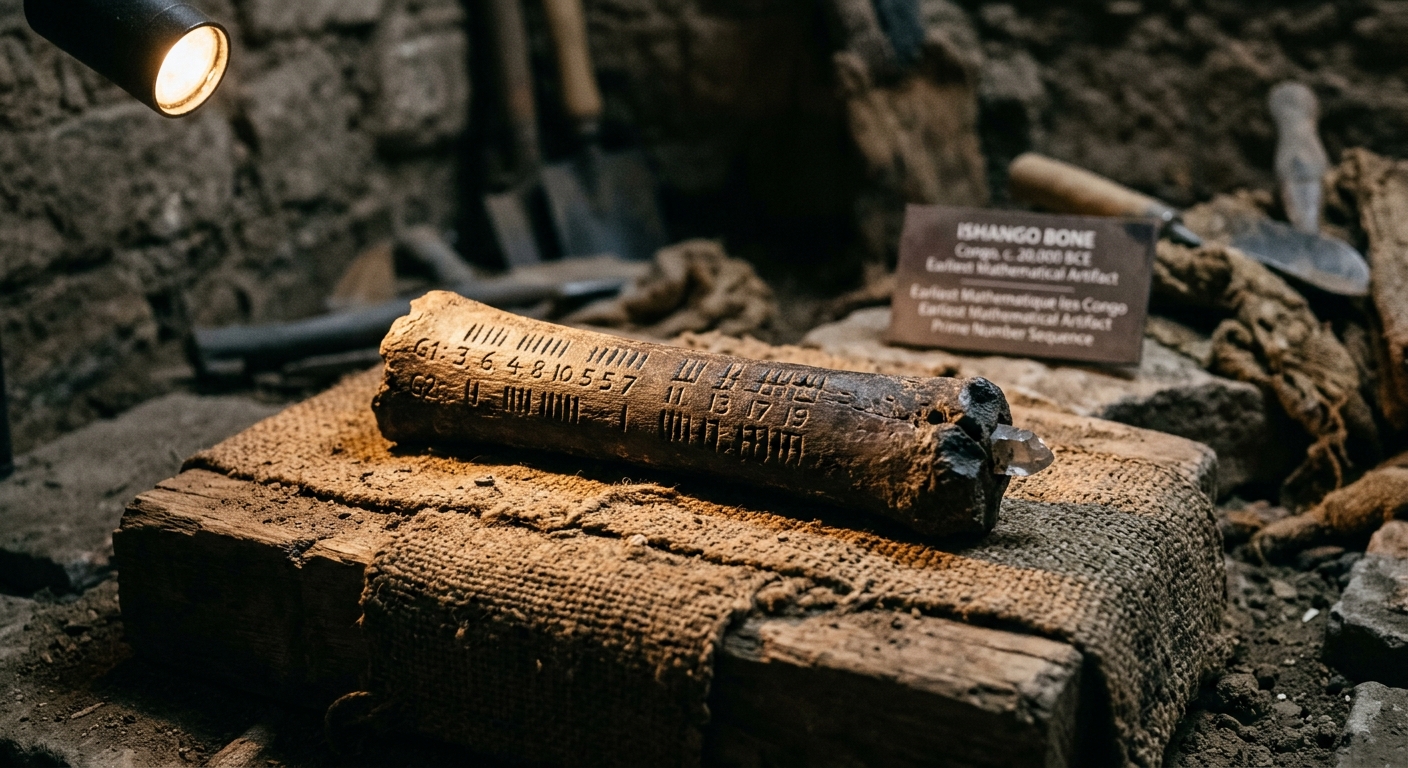
Deep in the heart of Africa, along the shores of what was once a thriving fishing community, archaeologists uncovered something that would forever change our understanding of ancient human intelligence. The Ishango bone, a small baboon fibula etched with mysterious notches, represents one of humanity’s earliest forays into complex mathematics and may be the world’s oldest calculator.
A Remarkable Discovery in the Congo
In 1960, Belgian archaeologist Jean de Heinzelin de Braucourt was excavating at Ishango, a site near the Semliki River in what is now the Democratic Republic of Congo. Among the artifacts he unearthed was an unassuming piece of bone, roughly 10 centimeters long, with a sharp piece of quartz crystal attached to one end. But it wasn’t the crystal tool that would capture the attention of mathematicians worldwide, it was the series of deliberate notches carved into the bone’s surface.
The bone, dating back approximately 20,000 years to the Upper Paleolithic period, contains three distinct columns of notches arranged in specific patterns. At first glance, these might appear to be simple tally marks, but closer examination reveals something far more sophisticated: evidence of advanced mathematical thinking that predates written history by thousands of years.
Decoding the Mathematical Mystery
The Ishango bone contains 168 notches total, organized into three columns with distinct mathematical relationships. The patterns suggest that our ancestors possessed a remarkable understanding of numerical concepts that we’re only beginning to appreciate.
Column One: The Prime Number Connection
The first column contains what appears to be a sequence focusing on prime numbers: 11, 13, 17, and 19. These are four consecutive prime numbers, and their deliberate inclusion suggests that Paleolithic humans had discovered the concept of prime numbers, mathematical building blocks that wouldn’t be formally studied until ancient Greek civilization.
Column Two: Doubling and Mathematical Operations
The middle column shows groups of 3, 6, 4, 8, 10, 5, 5, and 7 notches. Researchers have noted that these numbers demonstrate an understanding of doubling (3 and 6, 4 and 8, 5 and 10), suggesting that ancient humans were performing basic multiplication operations thousands of years before the development of formal arithmetic.
Column Three: Advanced Numerical Patterns
The third column contains the most complex arrangements, with groupings that some researchers believe represent lunar calculations or even early attempts at creating a base-10 counting system. The precision and intentionality of these markings indicate sophisticated planning and abstract thinking.
Evidence of Advanced Cognitive Abilities
The implications of the Ishango bone extend far beyond simple counting. This artifact provides concrete evidence that humans 20,000 years ago possessed several advanced cognitive abilities:
- Abstract thinking: The ability to conceptualize numbers as entities separate from physical objects
- Pattern recognition: Identifying mathematical relationships between numbers
- Long-term planning: Creating a durable tool for mathematical reference
- Symbolic representation: Using marks to represent numerical concepts
These capabilities suggest that the cognitive revolution in human development occurred much earlier than previously thought, challenging assumptions about when humans developed the intellectual capacity for complex mathematical reasoning.
Multiple Theories About Its Purpose
While the mathematical significance of the Ishango bone is widely accepted, researchers continue to debate its specific purpose. Several compelling theories have emerged:
Lunar Calendar Hypothesis
Some scientists propose that the bone served as a lunar calendar, with the notches representing phases of the moon or menstrual cycles. The total number of notches, 168, is close to six lunar months, supporting this theory.
Arithmetic Tool Theory
Others suggest the bone functioned as a primitive calculator, allowing users to perform addition, subtraction, and multiplication. The systematic arrangement of numbers supports this interpretation.
Numerical Exploration Device
A third theory proposes that the bone represents pure mathematical curiosity, created by someone exploring numerical relationships for their own sake. This would make it humanity’s first mathematical research tool.
Challenging Our View of Prehistoric Intelligence
The Ishango bone forces us to reconsider the intellectual capabilities of our Paleolithic ancestors. Rather than simple hunter-gatherers focused solely on survival, these findings suggest a sophisticated society capable of abstract thought, mathematical reasoning, and symbolic communication.
The discovery aligns with other evidence of advanced Paleolithic cognition, including cave paintings, musical instruments, and complex tool-making techniques. Together, these artifacts paint a picture of humans who were not just surviving but actively exploring and understanding their world through systematic observation and analysis.
Legacy of Ancient Mathematical Thinking
Today, the Ishango bone resides in the Royal Belgian Institute of Natural Sciences in Brussels, where it continues to inspire researchers and mathematicians. Its significance extends beyond archaeology into the realms of cognitive science, mathematics education, and our understanding of human intellectual development.
The bone serves as a reminder that mathematical thinking is not a modern invention but a fundamental aspect of human cognition that has driven our species’ success for tens of thousands of years. From the careful notches carved into this ancient baboon bone to the complex algorithms that power our digital world, mathematics has been humanity’s constant companion in our quest to understand and manipulate the world around us.
As we continue to uncover evidence of our ancestors’ remarkable capabilities, the Ishango bone stands as a testament to the enduring power of human curiosity and the timeless appeal of mathematical discovery. It reminds us that the drive to count, calculate, and comprehend numerical relationships is not just a product of civilization but a defining characteristic of what makes us human.



Great question Beth, and honestly the archaeological debate mirrors something I see all the time with spider behavior – we have to be careful not to project our own pattern-seeking brains onto ambiguous evidence, though that doesn’t make the Ishango bone any less fascinating. What gets me is how pattern recognition itself is such a powerful survival trait (it’s literally how spiders hunt and navigate, reading vibrations in their webs), so maybe the real story isn’t whether those notches are “definitely” math, but that our ancestors were wired like we are now to find meaning in sequences. The humility archaeologists bring to this debate is honestly pretty cool to see, and way more interesting than a simple “yes, they were g
Log in or register to replythis is fascinating but i’m curious about the pushback from the archaeological community on whether those notches actually indicate intentional mathematical sequencing or if we’re pattern matching too hard, kind of like how i sometimes see migrating warblers in cloud formations haha. either way its wild to think about what cognitive capabilities our ancestors had, makes me think about how much knowledge about their environment they must have accumulated, especially around tracking animal movements and seasonal patterns.
Log in or register to replyThe Ishango bone is genuinely mind-blowing to think about, and your point about pattern matching hits different when you’re actually out at 2am watching nocturnal animals – like, you realize how pattern-seeking our brains are whether we’re reading ancient artifacts or trying to spot owls in the darkness. I’d be curious if anyone’s done studies on how light pollution affects our ability to see constellations and patterns in the night sky, since that same cognitive skill our ancestors used for math might’ve been shaped by reading the unpolluted stars they actually had above them.
Log in or register to reply