Imagine a space rock the size of Mount Everest hurtling toward Earth at 40,000 miles per hour. Picture the moment of impact: a flash of light brighter than the sun, followed by destruction so complete that it makes every nuclear weapon ever built look like a firecracker. This isn’t science fiction. This is the story of the Chicxulub asteroid, the cosmic executioner that ended the age of dinosaurs and nearly erased life from our planet 66 million years ago.
A Cosmic Bullet With Unimaginable Power
The Chicxulub impactor wasn’t just any asteroid. This mountain-sized chunk of rock and metal, measuring between 6 and 9 miles in diameter, carried kinetic energy that defies human comprehension. When it slammed into what is now Mexico’s Yucatan Peninsula, it released approximately 100 teratons of TNT equivalent. To put this in perspective, that’s roughly one billion times more powerful than the atomic bomb dropped on Hiroshima.
The numbers are staggering, but they barely capture the true horror of this cosmic catastrophe. In a single instant, more energy was released than all the volcanic eruptions, earthquakes, and hurricanes in human history combined. The impact created a crater 93 miles wide and temporarily punched a hole in Earth’s crust deeper than Mount Everest is tall.
The First Seconds: Hell on Earth
The moment the asteroid struck, several catastrophic events unfolded simultaneously. The impact vaporized both the asteroid and massive amounts of Earth’s crust, creating a fireball that reached temperatures of over 18,000 degrees Fahrenheit. For comparison, the surface of the sun is only about 10,000 degrees Fahrenheit.
Within seconds, this hellish fireball expanded outward at incredible speed, incinerating everything within hundreds of miles. The sheer force of the impact sent shockwaves through the planet’s crust, triggering earthquakes with magnitudes that would make the strongest recorded quakes seem gentle. These seismic waves were so powerful they likely triggered volcanic eruptions on the opposite side of the planet.
A Rain of Fire and Glass
As if the initial blast wasn’t devastating enough, the impact hurled billions of tons of molten rock and vaporized material into space. What goes up must come down, and this debris began falling back to Earth as a global rain of fire. These impact spherules, tiny glass beads formed from molten rock, have been found in geological layers across the planet, serving as a permanent reminder of this cosmic catastrophe.
The falling debris heated Earth’s atmosphere to oven-like temperatures. Any creature caught in the open would have been literally cooked alive. Even underground burrows offered little protection from the searing heat that penetrated deep into the earth.
The Nuclear Winter That Followed
If the immediate effects weren’t apocalyptic enough, the long-term consequences were even more devastating. The impact threw so much dust, ash, and debris into the atmosphere that it blocked out the sun for months, possibly years. This created a global winter that plunged temperatures worldwide.
Plants, the foundation of nearly every food chain, withered and died without sunlight for photosynthesis. The collapse of plant life triggered a domino effect that rippled through every ecosystem on Earth. Herbivorous dinosaurs starved first, followed quickly by the carnivores that depended on them. It was ecological Armageddon on a planetary scale.
Acid Rain and Poisoned Seas
The atmospheric chemistry changes were equally catastrophic. The impact vaporized sulfur-rich rocks, creating massive clouds of sulfur dioxide that combined with water vapor to produce acid rain. These acidic downpours poisoned freshwater sources and made the oceans more acidic, killing marine life and disrupting ocean food chains.
The impact also released massive amounts of carbon dioxide, creating a greenhouse effect that, paradoxically, followed the initial cooling period. This double-whammy of climate change, first freezing then overheating, made recovery nearly impossible for many species.
The Survivors: Life Finds a Way
Remarkably, not everything died. Small mammals, some birds (the dinosaurs’ direct descendants), crocodiles, turtles, and many marine organisms managed to survive. These survivors shared certain characteristics: they were generally small, could hibernate or enter torpor, ate seeds or detritus, or lived in environments that provided some protection from the worst effects.
These humble survivors would inherit the Earth. Small mammals, previously overshadowed by their giant reptilian contemporaries, suddenly found themselves in a world with vast ecological niches to fill. This mass extinction event, while catastrophic, ultimately paved the way for the rise of mammals and, eventually, humans.
Evidence Written in Stone
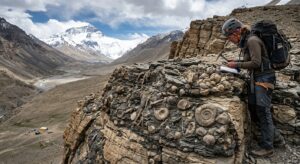
The proof of this cosmic catastrophe is written in Earth’s geological record. The Chicxulub crater, though buried under millions of years of sediment, has been mapped using gravity measurements and drilling cores. Scientists have found a thin layer of clay enriched with iridium, an element rare on Earth but common in asteroids, at the exact geological boundary marking the end of the Cretaceous period.
This iridium layer, found worldwide, serves as Earth’s permanent scar from its brush with cosmic annihilation. Shocked quartz crystals, formed only under extreme pressure, provide additional evidence of the impact’s incredible force.
A Cosmic Perspective
The Chicxulub impact reminds us of Earth’s vulnerability and the thin line between existence and extinction. While such massive impacts are rare, they’re not impossible. Space agencies worldwide now monitor potentially hazardous asteroids, hoping to prevent future cosmic catastrophes.
This ancient disaster also highlights life’s incredible resilience. Despite facing destruction equivalent to a billion nuclear bombs, life not only survived but thrived and diversified. The very fact that you’re reading this is testament to life’s remarkable ability to endure, adapt, and overcome even the most seemingly insurmountable challenges our universe can throw at us.