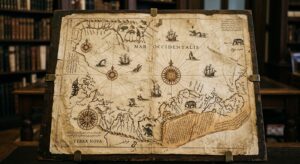
Deep within Yale University’s Beinecke Rare Book Library sits one of history’s most tantalizing mysteries: a 240-page manuscript written in an unknown script, filled with bizarre illustrations that seem to depict plants that don’t exist, astronomical diagrams that make no sense, and naked figures bathing in green pools connected by an elaborate network of tubes. Welcome to the Voynich Manuscript – a 600-year-old puzzle that has driven cryptographers, linguists, and historians to the brink of madness.
The Discovery That Started a Century-Long Obsession
In 1912, Polish book dealer Wilfrid Voynich stumbled upon what would become his namesake while rummaging through a collection of manuscripts at the Villa Mondragone in Italy. What he found defied all logic: a medieval codex written entirely in an unknown language or code, accompanied by illustrations so strange they seemed to come from another world entirely.
The manuscript immediately captivated Voynich, who believed he had discovered a lost work by the famous 13th-century scholar Roger Bacon. Little did he know that he had just unleashed one of the most enduring intellectual challenges of the modern era – a mystery that would consume the minds of brilliant scholars for over a century without yielding a single definitive answer.
What Makes This Book So Mind-Bendingly Strange?
The Voynich Manuscript isn’t just unreadable – it’s aggressively bizarre in ways that challenge our understanding of medieval knowledge and artistic expression. The book appears to be divided into several distinct sections, each more puzzling than the last:
The Botanical Section
Nearly half the manuscript consists of detailed illustrations of plants, drawn with the precision of a scientific textbook. Here’s the catch: none of these plants exist. Botanists have pored over every page, comparing the drawings to known medieval flora, extinct species, and even plants from distant continents that Europeans wouldn’t encounter for centuries. The result? Nothing. These aren’t stylized versions of real plants – they appear to be completely fictional species, drawn with an attention to detail that suggests deep botanical knowledge.
The Astronomical Mysteries
The astronomical section features circular diagrams filled with stars, zodiac symbols, and celestial bodies. But again, nothing quite makes sense. The star charts don’t match any known constellations, and the zodiac imagery combines familiar elements with completely foreign symbols in ways that suggest either advanced astronomical knowledge or pure fantasy.
The Biological Enigma
Perhaps most bizarre of all are the “biological” sections, featuring hundreds of small, naked human figures – primarily women – bathing in pools of green and blue liquid. These pools are connected by an intricate network of tubes and channels, creating what looks like a complex hydraulic system. The purpose and meaning of these illustrations remain completely opaque to modern scholars.
The Language That Isn’t a Language
The text itself presents perhaps the greatest puzzle of all. The Voynich Manuscript contains approximately 37,000 words written in what appears to be an unknown alphabet consisting of 19-28 distinct characters, depending on how you count variations. But statistical analysis reveals something deeply unsettling about this “language.”
The text shows patterns that are both language-like and completely alien. Words follow consistent patterns – certain characters appear more frequently at the beginning of words, others at the end, just like in natural languages. But the vocabulary is strangely limited, with far fewer unique words than you’d expect in a genuine language of this length.
Even more mysteriously, different pages and sections use noticeably different “dialects” of this unknown script, as if multiple authors were involved or the language itself evolved over time. Some researchers have dubbed these variations “Voynichese A” and “Voynichese B,” but their relationship to each other remains a complete mystery.
The Brilliant Minds It Has Broken
The Voynich Manuscript has claimed some impressive intellectual victims over the decades. World War II codebreakers who had successfully cracked enemy encryption schemes threw themselves at the manuscript and came away empty-handed. Renowned cryptographer William Friedman, who broke Japanese diplomatic codes during the war, spent decades trying to decode the text and died without success.
Computer analysis in the modern era has yielded equally frustrating results. Advanced statistical methods, artificial intelligence, and machine learning algorithms have all been deployed against the manuscript’s secrets. While these tools have revealed fascinating patterns in the text, they’ve failed to produce anything resembling a coherent translation.
Theories That Range from Plausible to Absolutely Wild
Over the centuries, the manuscript has inspired theories that span the spectrum from reasonable scholarly hypotheses to complete flights of fancy:
- Lost Medical Knowledge: Some believe it’s an encoded medical or pharmaceutical text, possibly containing lost remedies or anatomical knowledge
- Alien Origin: The completely foreign nature of everything in the manuscript has led some to suggest extraterrestrial authorship
- Elaborate Hoax: Perhaps it’s an incredibly sophisticated piece of medieval nonsense, created to fool buyers
- Women’s Secret Knowledge: The prevalence of female figures has inspired theories about hidden feminine wisdom or midwifery practices
- Artificial Language: It might be an early attempt at creating a completely artificial language for philosophical or mystical purposes
Modern Technology Meets Ancient Mystery
Recent advances in carbon dating and spectral analysis have confirmed that the manuscript is genuinely medieval, dating to the early 15th century. The parchment, inks, and artistic techniques are all consistent with European manuscripts of that period. This rules out the theory that Voynich himself created it as a modern hoax, but it makes the mystery even deeper.
AI researchers have made intriguing progress in identifying patterns within the text, with some algorithms suggesting that the underlying structure might be based on a real language – possibly Latin or another European tongue – that has been heavily encoded or modified. However, these findings remain highly speculative and haven’t led to any actual translation.
Why This Mystery Matters
The Voynich Manuscript represents more than just an interesting puzzle – it’s a window into the vast gaps in our knowledge about medieval intellectual life. Its very existence suggests that there were streams of thought, knowledge, and artistic expression in the medieval world that we’ve completely lost track of.
Whether it proves to be an elaborate hoax, a work of genius, or something else entirely, the manuscript has already achieved something remarkable: it has forced us to question our assumptions about what was possible in the medieval world and reminded us that there are still profound mysteries lurking in plain sight.
As the manuscript enters its second century of intensive study, one thing remains certain: somewhere in those cryptic symbols and impossible illustrations lies a story that could fundamentally change our understanding of medieval knowledge, creativity, and perhaps human consciousness itself. The question isn’t whether someone will eventually crack the code – it’s what earth-shattering secrets they’ll find when they do.