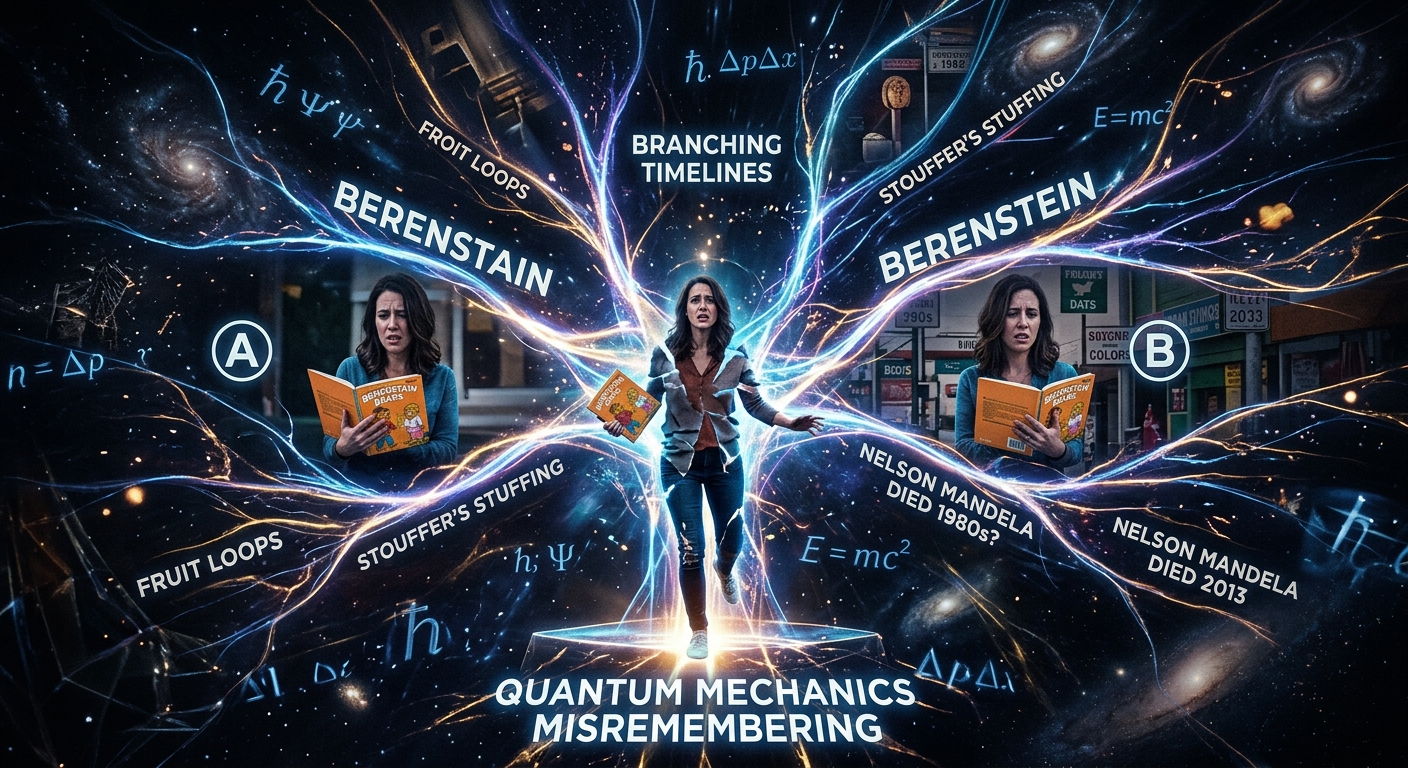
Remember the Berenstain Bears? If you’re like millions of people, you probably recall them as the “Berenstein” Bears. What about Nelson Mandela’s death? Many swear he died in prison in the 1980s, not in 2013 as president of South Africa. These aren’t just simple memory lapses: they’re examples of the Mandela Effect, where large groups of people share identical “false” memories that seem impossibly vivid and detailed.
While skeptics dismiss these phenomena as mere psychological quirks, a growing number of physicists are taking the Mandela Effect seriously as potential evidence of quantum mechanics operating on a macroscopic scale. What they’re discovering could fundamentally change our understanding of reality itself.
What Is the Mandela Effect, Really?
Named after the widespread false memory of Nelson Mandela’s death, the Mandela Effect describes situations where large groups of people remember historical facts, movie quotes, or product names differently than documented reality. Unlike individual false memories, these collective misrememberings share uncanny consistency across different demographics and geographical locations.
Some of the most famous examples include:
- “Mirror, mirror on the wall” versus “Magic mirror on the wall” from Snow White
- The Monopoly man having a monocle (he never did)
- “Life is like a box of chocolates” versus “Life was like a box of chocolates” from Forrest Gump
- The location of New Zealand relative to Australia
- Whether Curious George ever had a tail
Traditional psychology explains these as confabulation, suggestion, or simple misremembering. But the consistency and specificity of these false memories have caught the attention of quantum physicists who see patterns that mirror well-established quantum phenomena.
The Quantum Connection: Many Worlds Theory
Dr. Shane Robinson, a theoretical physicist at Stanford, has been studying correlations between Mandela Effect reports and quantum mechanical principles. His research suggests that what we call “false memories” might actually be residual memories from parallel universes as described by the Many Worlds Interpretation of quantum mechanics.
“When we observe quantum superposition collapse at the subatomic level, we assume the effect stops there,” Robinson explains. “But quantum coherence might extend far beyond what we previously thought possible, potentially allowing consciousness to retain traces of information from parallel quantum states.”
The Many Worlds Theory, first proposed by physicist Hugh Everett III in 1957, suggests that every quantum measurement splits reality into multiple parallel universes. In one universe, Schrödinger’s cat is alive; in another, it’s dead. Both realities exist simultaneously until observation collapses the wave function in our particular branch of reality.
Quantum Coherence and Consciousness
Recent breakthroughs in quantum biology have revealed that quantum effects persist much longer and at much larger scales than previously believed. Photosynthesis in plants, navigation in birds, and even some aspects of human consciousness appear to utilize quantum coherence.
Dr. Anirban Bandyopadhyay of the National Institute for Materials Science in Japan has demonstrated that microtubules in brain cells can maintain quantum coherence for surprisingly long periods. This research builds on the controversial Orchestrated Objective Reduction theory proposed by physicist Roger Penrose and anesthesiologist Stuart Hameroff, which suggests consciousness itself emerges from quantum processes in the brain.
If consciousness operates partially in the quantum realm, it’s theoretically possible that our minds occasionally retain “quantum memories” from parallel timelines where the Berenstein Bears existed, or where Nelson Mandela died decades earlier than in our current reality.
The CERN Connection: Reality-Altering Experiments?
Intriguingly, many Mandela Effect researchers have noted that reports of these phenomena seemed to increase dramatically around 2008-2012, coinciding with the Large Hadron Collider’s first high-energy experiments at CERN. While this correlation could be purely coincidental, some physicists are investigating whether high-energy particle collisions might affect the stability of quantum reality on a larger scale.
Dr. Elena Vasiliev, a quantum field theorist at MIT, notes: “We’re smashing particles together at energies that haven’t existed since the first moments after the Big Bang. The idea that this might have subtle effects on the structure of spacetime itself isn’t as far-fetched as it initially sounds.”
CERN scientists themselves have acknowledged some puzzling anomalies in their data that seem to suggest brief violations of causality, though they maintain these are likely measurement errors or unknown physics rather than evidence of reality manipulation.
Quantum Decoherence and Timeline Convergence
Another quantum explanation for the Mandela Effect involves the concept of quantum decoherence. As quantum systems interact with their environment, they lose their quantum properties and become classical. But what if this process isn’t instantaneous or complete?
Theoretical models suggest that under certain conditions, quantum superpositions of macroscopic states could persist for extended periods before finally decoherent into a single, definitive timeline. During these transition periods, multiple versions of reality might exist simultaneously, with human consciousness occasionally accessing information from the “losing” timelines before they fully decohere.
This could explain why Mandela Effects seem to “update” over time, with some people remembering the transition from one version of reality to another. It might also explain why certain individuals seem more susceptible to these experiences than others, if quantum sensitivity varies among different brains.
The Measurement Problem Meets Memory
The quantum measurement problem asks: at what point does a quantum superposition collapse into a definite state? Some interpretations suggest that consciousness itself plays a role in this collapse. If true, then human observation and memory might actually participate in determining which version of reality becomes “real.”
This creates a fascinating feedback loop: our collective memories might not just record reality but actively participate in selecting which timeline becomes dominant. The Mandela Effect could represent moments where this selection process is incomplete or conflicted, leaving residual traces of alternative timelines in our collective consciousness.
Skepticism and Alternative Explanations
Not all scientists are convinced by quantum explanations for the Mandela Effect. Cognitive psychologist Dr. Lisa Feldman Barrett argues that these phenomena are better explained by the constructive nature of human memory itself.
“Memory isn’t a recording device,” Barrett explains. “Every time we recall something, we reconstruct it based on current knowledge and expectations. The consistency of false memories across populations likely reflects shared cultural inputs and similar cognitive processing patterns, not parallel universes.”
However, quantum researchers counter that psychological explanations alone cannot account for the specific patterns observed in Mandela Effect cases, particularly the way these false memories seem to cluster around certain types of information and time periods.
Implications for Our Understanding of Reality
Whether or not quantum physics truly explains the Mandela Effect, the phenomenon has opened new avenues for research into consciousness, memory, and the nature of reality itself. It challenges our assumptions about the relationship between observation and existence, suggesting that the boundary between subjective experience and objective reality might be far more fluid than we imagined.
As our understanding of quantum mechanics continues to evolve, the Mandela Effect serves as a compelling reminder that there’s still much we don’t know about how consciousness, memory, and physical reality interact. Whether we’re glimpsing parallel universes or simply witnessing the quirks of human cognition, these phenomena continue to push the boundaries of scientific inquiry into the deepest mysteries of existence.
The next time you could swear you remember something differently than recorded history, consider the possibility that your memory might not be wrong after all: it might just be quantum.






This is fascinating stuff but I gotta say, the quantum explanation feels like it’s doing some heavy lifting when there are simpler answers already on the table, like what Patricia mentioned about our brains prioritizing patterns. That said, I can’t help but think about how wolves reintroduced to Yellowstone created these massive, cascading ecosystem changes that nobody predicted perfectly, and we have *multiple* detailed studies showing what actually happened – yet people still misremember the timeline of events or think the wolves impacted things differently than they did. Our brains are just built to reshape memories to match what we think should have happened, not what did. Way more elegant than parallel universes, honestly.
Log in or register to replyOkay so I’m genuinely curious about the quantum angle here, but can we talk about how we’re way more likely to misremember things because our brains are literally optimized for pattern recognition over precision? Like, our entire sensory system filters out 99% of information just to function, kind of like how we ignore trillions of diatoms in the ocean even though they’re producing half our oxygen. I feel like before we invoke parallel universes, we should maybe rule out the simpler explanation that human memory is just… messy?
Log in or register to replyI really appreciate Patricia and Wren bringing up the cognitive mechanics here, because this actually connects to something I’ve noticed tracking phenological data for years – our brains are *primed* to spot patterns and fill in gaps based on what we expect to see rather than what’s actually there. I’ve caught myself misremembering the exact bloom dates of plants I monitor regularly because my mind defaults to “should be around this time based on the pattern” rather than checking my notes. Quantum explanations require a lot of extraordinary evidence that just isn’t there yet, whereas we already have solid behavioral psychology explaining false memories without needing parallel universes.
Log in or register to reply