A Supervolcano Hiding in Plain Sight
Beneath the geysers, hot springs, and pristine wilderness of Yellowstone National Park lurks one of the most dangerous geological features on Earth. The Yellowstone Caldera, stretching across 34 by 45 miles of northwestern Wyoming, represents a supervolcanic system so powerful that when it erupts, it doesn’t just affect the local area: it changes the entire planet.
What makes this geological giant particularly terrifying is its track record. Over the past 2.1 million years, the Yellowstone supervolcano has erupted three times, and each eruption was so catastrophic that it reshaped North American geography and affected global climate patterns for years afterward.
The First Apocalypse: The Huckleberry Ridge Eruption
The oldest and most powerful eruption occurred approximately 2.1 million years ago, known scientifically as the Huckleberry Ridge Tuff eruption. This cataclysmic event expelled an estimated 585 cubic miles of material into the atmosphere, making it one of the largest known volcanic eruptions in Earth’s history.
To put this volume into perspective, imagine a cube of volcanic material stretching nearly 84 miles on each side. The eruption was so violent that it created a caldera approximately 50 miles across, and volcanic ash from this single event has been found as far away as the Gulf of Mexico and California.
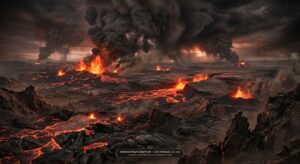
The environmental impact was devastating. The massive ash cloud blocked sunlight across vast regions of North America, causing what scientists believe was a significant drop in global temperatures. This volcanic winter would have lasted for years, fundamentally altering ecosystems and likely driving numerous species extinctions across the continent.
The Second Catastrophe: Mesa Falls
Roughly 1.3 million years ago, Yellowstone struck again with the Mesa Falls eruption. While smaller than its predecessor, this eruption still ejected an estimated 67 cubic miles of material into the atmosphere. The ash and pyroclastic flows from this eruption traveled hundreds of miles in every direction, burying vast areas of what is now the western United States under layers of volcanic debris.
Archaeological evidence suggests that this eruption significantly impacted early human migration patterns across the globe. The climatic effects of the Mesa Falls eruption coincided with a period of global cooling that may have influenced the evolution and movement of early hominid species in Africa and Asia.
Understanding Volcanic Explosivity
To understand the true scale of these eruptions, scientists use the Volcanic Explosivity Index (VEI), which ranges from 0 to 8. Both the Huckleberry Ridge and Mesa Falls eruptions registered as VEI 8 events, the maximum rating on the scale. For comparison:
- The 1980 Mount St. Helens eruption was a VEI 5
- The 1815 Mount Tambora eruption, which caused the “Year Without a Summer,” was a VEI 7
- Yellowstone’s eruptions were VEI 8, representing explosions 10 times more powerful than Tambora
The Most Recent Disaster: Lava Creek
The most recent eruption, known as the Lava Creek eruption, occurred approximately 640,000 years ago. While the “smallest” of the three major eruptions, it still expelled around 240 cubic miles of material and created the current Yellowstone Caldera that visitors see today.
This eruption was particularly notable for its pyroclastic flows, which are superheated clouds of gas, ash, and rock that can travel at speeds exceeding 100 miles per hour. These flows carved out valleys and deposited layers of volcanic material that are still visible throughout the Yellowstone region today.
The ash from the Lava Creek eruption blanketed most of North America, with deposits found from Canada to Mexico and from the Pacific Coast to the Mississippi River. In some areas, the ash accumulated to depths of several feet, completely transforming the landscape and ecosystem.
Global Climate Chaos
Each of these three eruptions caused what scientists call “volcanic winters.” The massive quantities of ash and sulfur compounds ejected into the stratosphere created a planetary sunshade effect, reflecting solar radiation back into space and causing global temperatures to plummet.
During these volcanic winters, average global temperatures dropped by several degrees Celsius, enough to trigger widespread crop failures, ecosystem collapse, and mass extinctions. The sulfur compounds created acid rain that further devastated plant and animal life across vast regions.
The Domino Effect on Life
The impacts of these super-eruptions extended far beyond immediate destruction:
- Massive die-offs of vegetation due to ash burial and reduced sunlight
- Collapse of food chains as herbivores lost their food sources
- Acid rain that poisoned water sources across continents
- Respiratory problems for surviving animals from fine ash particles
- Long-term climate shifts that persisted for decades after each eruption
What the Future Holds
Scientists continuously monitor the Yellowstone supervolcano using an extensive network of seismometers, GPS stations, and thermal sensors. Current data suggests that while the magma chamber beneath Yellowstone remains active, there are no immediate signs of an impending eruption.
The average interval between major Yellowstone eruptions has been roughly 600,000 to 800,000 years, and since the last eruption occurred 640,000 years ago, some wonder if we’re approaching another active period. However, volcanic systems don’t operate on precise schedules, and predicting supervolcanic eruptions remains one of geology’s greatest challenges.
What we do know is that when Yellowstone does erupt again, it will likely be as catastrophic as its previous performances. Modern civilization, with its global interconnectedness and dependence on agriculture, would face unprecedented challenges from a supervolcanic winter.
Living With a Sleeping Giant
The Yellowstone Caldera serves as a humbling reminder of the immense geological forces that shape our planet. While the beautiful geysers and hot springs that millions of visitors enjoy each year are powered by the same magma system that has caused such devastation in the past, the supervolcano also represents one of Earth’s most spectacular natural phenomena.
Understanding Yellowstone’s explosive history helps scientists better prepare for future volcanic events worldwide and provides crucial insights into how supervolcanic eruptions have shaped the evolution of life on Earth. The sleeping giant beneath Yellowstone may be quiet for now, but its three catastrophic eruptions remind us that our planet is far more dynamic and powerful than we often realize.