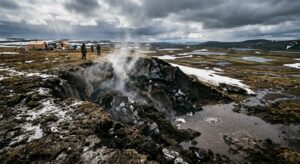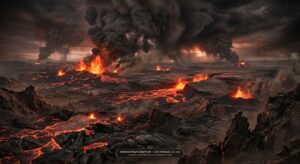
Beneath the stunning geysers and pristine wilderness of Yellowstone National Park lurks one of Earth’s most terrifying secrets: a supervolcano so massive that its eruption could plunge the world into volcanic winter and potentially end human civilization as we know it. This isn’t science fiction, it’s geological reality, and the monster has awakened before.
What Makes Yellowstone a Supervolcano?
The term ‘supervolcano’ might sound like Hollywood hyperbole, but it’s a legitimate scientific classification for volcanic systems capable of producing eruptions with a Volcanic Explosivity Index (VEI) of 8 or higher. To put this in perspective, Mount St. Helens registered a VEI of 5, while the devastating 1815 eruption of Mount Tambora reached VEI 7.
Yellowstone’s caldera spans approximately 34 by 45 miles, making it one of the largest active volcanic systems on Earth. Unlike the classic cone-shaped volcanoes most people imagine, Yellowstone is what scientists call a caldera system. The ‘mountain’ is actually a massive depression created by previous catastrophic eruptions that caused the ground to collapse into the emptied magma chamber below.
The Magma Chamber: A Underground Ocean of Molten Rock
Recent studies using seismic imaging have revealed that Yellowstone’s magma chamber is far larger than previously thought. The primary chamber sits roughly 5-10 miles beneath the surface and contains an estimated 200-600 cubic kilometers of molten rock. Below that lies an even more massive reservoir extending down to about 28 miles deep, containing partially molten rock that could potentially feed future eruptions.
This underground furnace is fueled by what geologists call the Yellowstone Hotspot, a plume of superheated material rising from deep within the Earth’s mantle. This hotspot has been burning a trail across North America for millions of years as the continent slowly drifted overhead.
A History Written in Ash: Previous Eruptions
Yellowstone has erupted catastrophically three times in recorded geological history, and each event reshaped the continent:
- 2.1 million years ago (Huckleberry Ridge eruption): This monster eruption ejected 2,450 cubic kilometers of material, making it one of the largest known volcanic eruptions in Earth’s history.
- 1.3 million years ago (Mesa Falls eruption): Though smaller than its predecessor, this eruption still expelled 280 cubic kilometers of ash and debris.
- 640,000 years ago (Lava Creek eruption): The most recent supervolcanic eruption created the current Yellowstone Caldera and ejected 1,000 cubic kilometers of material.
To understand the scale of these eruptions, consider that the 1980 Mount St. Helens eruption displaced just 2.8 cubic kilometers of material. The Lava Creek eruption was nearly 400 times larger.
Evidence in the Rocks
Geologists have found ash deposits from these ancient Yellowstone eruptions as far away as Mexico, the Atlantic Coast, and the Arctic Ocean. The Lava Creek eruption alone deposited ash layers over 1,500 miles away from the source. In some areas near Yellowstone, these ancient ash layers are still over 100 feet thick.
Apocalypse Scenario: What Would Happen if Yellowstone Erupted Today?
A full-scale Yellowstone eruption would unfold in stages, each more devastating than the last. Computer models and geological evidence from past eruptions paint a terrifying picture of what scientists call a ‘civilization-ending event.’
The First Hours: Pyroclastic Hell
The eruption would begin with a series of massive explosions as pressurized magma finally breaches the surface. Pyroclastic flows, which are superheated clouds of gas, ash, and rock moving at speeds up to 450 mph, would incinerate everything within a 40-mile radius. These flows can maintain temperatures over 1,800°F and would make the immediate Yellowstone region completely uninhabitable.
Anyone within this zone would have virtually no chance of survival, regardless of shelter or preparation.
The First Days: Ashfall Apocalypse
Within hours, prevailing winds would begin carrying massive ash clouds eastward across the United States. Cities like Denver, Kansas City, and Chicago would find themselves buried under several feet of volcanic ash within days. The ash would contaminate water supplies, collapse buildings under its weight, and create a choking, abrasive dust that would make breathing nearly impossible without protection.
Modern infrastructure would begin failing almost immediately. The fine volcanic ash would clog air filters, destroy engines, and shut down power plants. Air travel across the continent would cease entirely.
The First Months: Nuclear Winter Effect
Perhaps most devastating would be the climate impact. Massive quantities of sulfur dioxide ejected into the stratosphere would create sulfuric acid aerosols that reflect sunlight back into space. Global temperatures could drop by 3-5°C, creating a volcanic winter that could last for years.
This dramatic cooling would devastate global agriculture. Growing seasons would be shortened or eliminated entirely in many regions. The resulting crop failures could trigger worldwide famine, potentially affecting billions of people.
Monitoring the Sleeping Giant
Given the catastrophic potential, Yellowstone is one of the most closely monitored volcanic systems on Earth. The Yellowstone Volcano Observatory employs a sophisticated network of instruments to track any signs of awakening.
Seismic Surveillance
Over 50 seismic stations continuously monitor earthquake activity throughout the Yellowstone region. The area experiences 1,000-3,000 small earthquakes per year, most too small to feel but crucial for understanding what’s happening deep underground. Scientists look for specific patterns that might indicate magma movement or pressure changes.
Ground Deformation Studies
Using GPS stations and satellite radar, researchers track minute changes in ground elevation. Parts of the Yellowstone caldera have risen and fallen by several inches over the past decades. While dramatic, scientists emphasize that such changes are normal for large volcanic systems and don’t necessarily indicate an impending eruption.
Gas Monitoring
The composition and quantity of gases emanating from Yellowstone’s thermal features provide another window into the underground system. Changes in gas chemistry could potentially signal increased magma activity deep below.
Should We Be Worried?
Despite its fearsome potential, scientists stress that a catastrophic Yellowstone eruption is not imminent. The geological evidence suggests major eruptions occur roughly every 600,000-800,000 years, and we’re currently about 640,000 years past the last one. However, volcanic systems don’t operate on precise schedules.
More importantly, scientists believe they would detect clear warning signs years or even decades before a major eruption. These might include significant ground deformation, dramatic increases in earthquake activity, and changes in the hydrothermal system.
Current monitoring data shows Yellowstone in a relatively quiet state, with no indicators suggesting an eruption in the foreseeable future. The volcano is far more likely to experience smaller eruptions or continue its current pattern of hydrothermal activity.
The Volcano That Changed Our Planet
Whether or not Yellowstone erupts in our lifetime, it stands as a humbling reminder of the tremendous forces at work beneath our feet. This sleeping giant has shaped continents, influenced evolution, and serves as a window into the dynamic processes that continue to sculpt our planet.
While we cannot prevent such eruptions, understanding systems like Yellowstone helps us appreciate both the fragility and resilience of life on Earth. The supervolcano reminds us that we live on a dynamic, ever-changing planet where the ground itself can reshape the course of history.