For decades, the Bermuda Triangle has captured imaginations worldwide, spawning countless theories about alien abductions, lost civilizations, and supernatural phenomena. This mysterious patch of ocean between Florida, Bermuda, and Puerto Rico has allegedly swallowed ships and planes without a trace, leaving behind only questions and wild speculation.
But here’s the twist that conspiracy theorists don’t want you to know: modern science has thoroughly debunked the Bermuda Triangle mystery, revealing explanations so mundane they’re almost disappointing. The truth behind this legendary enigma lies not in extraterrestrial intervention or underwater cities, but in perfectly natural phenomena that occur in oceans worldwide.
The Birth of a Legend
The Bermuda Triangle myth didn’t emerge overnight. It began taking shape in the 1950s when writer Vincent Gaddis coined the term “Bermuda Triangle” in a magazine article. The legend gained serious momentum in 1974 with Charles Berlitz’s bestselling book “The Bermuda Triangle,” which presented a collection of mysterious disappearances as evidence of paranormal activity.
Berlitz’s book featured dramatic accounts of vanishing aircraft and vessels, including the famous Flight 19 incident of 1945, where five Navy torpedo bombers disappeared during a training mission. The author suggested these incidents were connected and pointed to supernatural causes, conveniently omitting crucial details that would later prove significant.
The story captured public imagination so powerfully that it spawned documentaries, movies, and thousands of articles. Soon, every maritime accident in the region was attributed to the Triangle’s mysterious powers, regardless of whether adequate explanations existed.
What the Statistics Actually Reveal
When researchers began examining maritime and aviation records objectively, they discovered something remarkable: the Bermuda Triangle isn’t statistically more dangerous than any other heavily traveled stretch of ocean. The U.S. Coast Guard, which maintains comprehensive records of maritime incidents, found no evidence supporting claims of unusual disappearances in the region.
Lloyd’s of London, the world’s leading maritime insurance company, doesn’t charge higher premiums for ships traveling through the Bermuda Triangle. If the area were genuinely more hazardous, insurance companies would certainly know about it and price their policies accordingly.
The National Transportation Safety Board and Federal Aviation Administration databases show that aircraft incidents in the Triangle occur at rates consistent with other busy air corridors. When you consider that this region sees heavy traffic from multiple international airports and busy shipping lanes, the number of incidents is actually remarkably low.
The Real Culprits Behind the Mystery
Extreme Weather Patterns
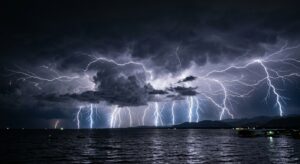
The Bermuda Triangle sits in one of the most meteorologically active regions on Earth. This area experiences rapid weather changes that can catch pilots and sailors off guard. Sudden thunderstorms can develop with little warning, bringing dangerous conditions including:
- Microbursts that can down aircraft instantly
- Waterspouts and tornadoes over open water
- Hurricane-force winds that appear seemingly from nowhere
- Dense fog that reduces visibility to near zero
The Gulf Stream, a powerful ocean current that flows through the Triangle, can quickly disperse debris from accidents, making rescue and recovery operations extremely difficult. This current moves at speeds up to 5.6 miles per hour and can carry wreckage hundreds of miles from crash sites within days.
Unique Geological Features
The ocean floor in the Bermuda Triangle region contains some of the deepest underwater trenches in the Atlantic, including the Puerto Rico Trench, which plunges to depths exceeding 27,000 feet. When aircraft or ships sink in these areas, they’re essentially lost forever in an underwater abyss that makes recovery nearly impossible.
Underwater limestone formations create complex topography that affects local weather patterns and ocean currents. These geological features can generate unexpected turbulence both above and below the water’s surface.
Human Error and Mechanical Failure
Investigation of specific incidents reveals that most disappearances have mundane explanations. The famous Flight 19 case, often cited as the Triangle’s most mysterious incident, was actually caused by navigation equipment failure combined with pilot error. Radio transcripts show the flight leader became disoriented and led his squadron further out to sea instead of returning to base.
Many other incidents involved:
- Inexperienced pilots flying in challenging conditions
- Mechanical failures in aging aircraft or vessels
- Navigation errors in pre-GPS era
- Fuel miscalculations leading to emergency situations
The Power of Selective Reporting
One reason the Bermuda Triangle legend persisted is selective reporting and confirmation bias. Writers and documentary makers focused exclusively on unexplained incidents while ignoring thousands of safe passages through the region. They also embellished stories, omitted crucial details, and sometimes included incidents that occurred hundreds of miles away from the Triangle.
When researchers examined the original sources for many famous Triangle stories, they found significant discrepancies. Some incidents never happened at all, while others were dramatically misrepresented to support the mystery narrative.
Modern Technology Destroys the Mystery
Today’s advanced navigation systems, weather tracking technology, and emergency communication equipment have essentially eliminated the conditions that created the Bermuda Triangle legend. GPS satellites provide precise positioning data, while Doppler radar gives pilots and mariners advance warning of dangerous weather.
Satellite tracking means aircraft and ships are monitored continuously, making mysterious disappearances virtually impossible. When incidents do occur, rescue teams can respond quickly and investigators can determine causes with scientific precision.
Why We Love Mysteries More Than Facts
The persistence of Bermuda Triangle beliefs despite overwhelming scientific evidence reveals something fascinating about human psychology. We’re naturally drawn to mysterious explanations over mundane ones, preferring exciting stories about alien encounters to boring accounts of navigation errors and bad weather.
This cognitive bias, called the “availability heuristic,” makes us overestimate the probability of dramatic events while underestimating common causes. It’s the same reason people fear shark attacks more than bee stings, despite bees being statistically more dangerous.
The Bermuda Triangle serves as a perfect example of how myths can persist in the modern world, even when science provides clear explanations. Sometimes the most mind-blowing fact about our planet isn’t supernatural phenomena, but rather how our own minds can transform ordinary events into extraordinary mysteries.