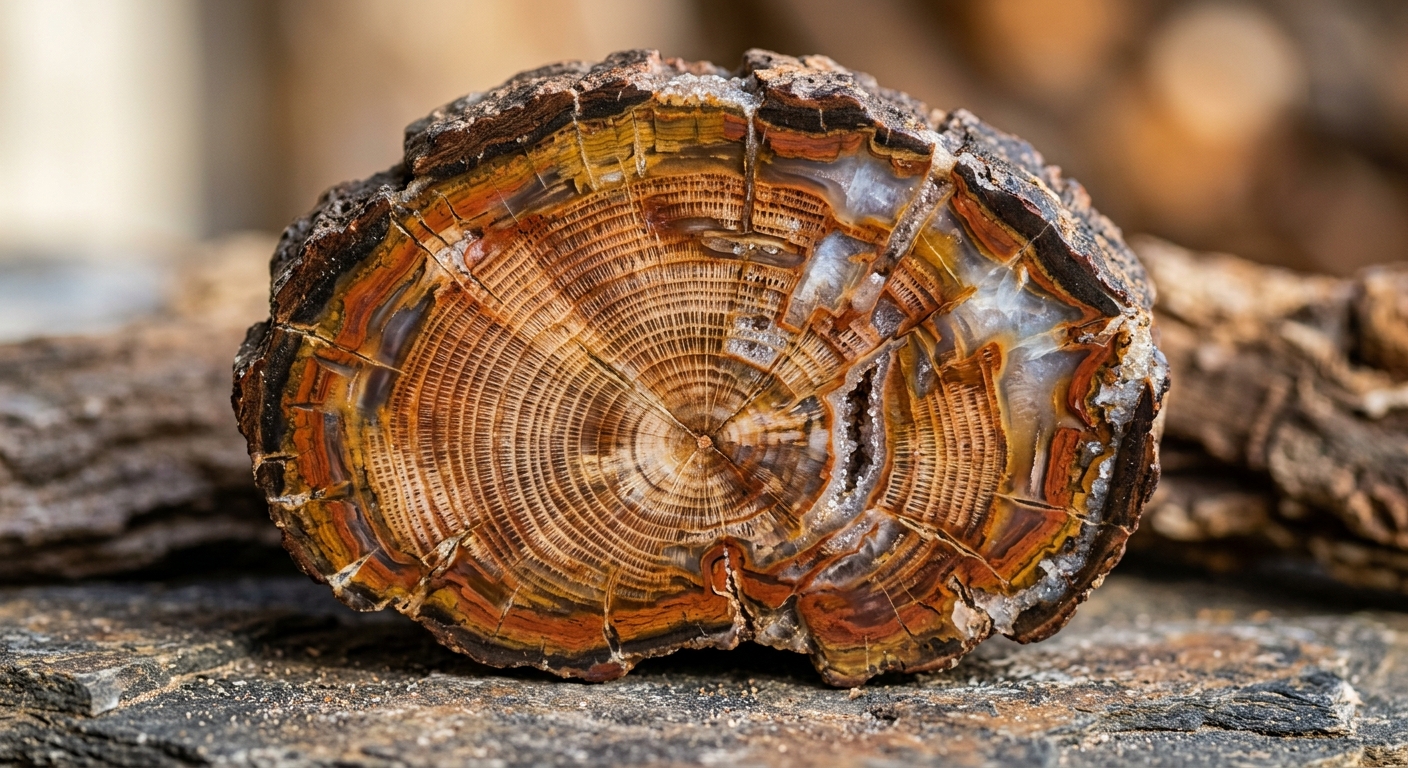
Imagine walking through an ancient forest where towering trees stretch toward the sky, their bark rough beneath your fingers, their branches swaying in the wind. Now imagine returning to that exact spot 200 million years later to find those same trees still standing, but transformed into something extraordinary: solid stone that has preserved every ring, every grain, every intricate detail of the original wood. This is the remarkable phenomenon of petrified wood, nature’s most stunning magic trick that turns living timber into eternal stone sculptures.
The Alchemy of Time: How Wood Becomes Stone
Petrified wood represents one of nature’s most fascinating preservation processes, where organic plant material undergoes a complete molecular makeover while maintaining its original structure. The transformation begins when trees are rapidly buried under sediment, volcanic ash, or other materials that cut off oxygen supply and halt the normal decay process.
What happens next sounds like science fiction but follows precise chemical laws. Mineral-rich groundwater seeps through the buried wood, carrying dissolved silica, calcite, pyrite, or other minerals. In a process called permineralization, these minerals slowly replace the organic compounds in the wood’s cellular structure. The key word here is “slowly” because this transformation typically takes thousands to millions of years.
The most common mineral involved in petrification is silica, particularly in the form of quartz. As the silica-laden water flows through the wood’s pores, vessels, and cell walls, it deposits microscopic crystals that gradually replace the cellulose and lignin that originally gave the wood its structure. The result is a perfect stone replica that maintains the wood’s original appearance down to the cellular level.
Nature’s Perfect Memory: Preserving Life’s Blueprint
What makes petrified wood truly mind-blowing is not just that it exists, but how perfectly it preserves the original tree’s details. Under a microscope, petrified wood reveals:
- Individual wood cells preserved in stunning detail
- Growth rings that tell the story of good and bad growing seasons
- Bark patterns and textures identical to the living tree
- Insect bore holes and other evidence of ancient ecosystems
- Even the wood grain that would have been visible to the naked eye millions of years ago
This level of preservation allows scientists to study ancient forests as if they had a time machine. They can determine not only what species of trees existed millions of years ago but also what the climate was like, what insects lived on them, and how these ancient ecosystems functioned.
A Rainbow Trapped in Stone
Perhaps the most visually stunning aspect of petrified wood is its incredible range of colors. While living wood is typically brown or tan, petrified wood can display an artist’s palette of hues that would make a rainbow jealous. These colors result from different trace minerals present during the petrification process:
- Red, orange, and yellow: Iron oxide (rust) creates warm, fiery tones
- Blue and green: Copper compounds produce these cooler shades
- Purple and lavender: Manganese creates these regal colors
- Black: Carbon or pyrite results in dramatic dark specimens
- White and clear: Pure quartz creates pristine, crystalline appearances
The concentration and combination of these minerals can create petrified wood specimens that look more like precious gemstones than ancient timber, with some pieces displaying multiple colors in swirling patterns that seem almost too beautiful to be natural.
Ancient Forests Frozen in Time
The most famous collection of petrified wood lies in Arizona’s Petrified Forest National Park, where entire logs up to 200 feet long lie scattered across the desert landscape like fallen giants from a stone age fairy tale. These specimens date back to the Late Triassic period, roughly 225 million years ago, when the area was a lush, tropical forest populated by early dinosaurs.
But Arizona isn’t the only place where these stone trees can be found. Petrified forests exist on every continent, each telling its own story of ancient climates and ecosystems. The Petrified Forest of Lesvos in Greece preserves a 20-million-year-old subtropical forest, while Argentina’s Jaramillo Petrified Forest contains specimens from the Jurassic period.
The Science of Ancient Climates
Petrified wood serves as an invaluable climate record, providing insights into Earth’s environmental history that span millions of years. By analyzing growth rings in petrified specimens, scientists can determine:
- Ancient rainfall patterns and seasonal variations
- Temperature fluctuations over geological time
- The effects of ancient volcanic eruptions on plant growth
- Long-term climate trends that predate human civilization
This information helps researchers understand how Earth’s climate has changed naturally over time and provides crucial context for understanding modern climate change.
The Modern Mystery: Why Doesn’t It Happen Today?
One of the most intriguing aspects of petrified wood is that the conditions necessary for its formation rarely occur in today’s world. The process requires a very specific set of circumstances: rapid burial, the right chemical conditions, and the absence of bacteria that would normally decompose the wood.
Most petrified wood specimens formed during periods of intense geological activity, such as volcanic eruptions or major flooding events that could rapidly bury entire forests. In today’s more geologically stable world, wood typically decays long before these preservation conditions can occur, making petrified wood a window into Earth’s more turbulent past.
Living History You Can Touch
Perhaps what makes petrified wood most fascinating is that it bridges the gap between the living and the geological worlds. When you touch a piece of petrified wood, you’re literally making contact with a tree that may have lived before dinosaurs walked the Earth. The stone beneath your fingers once photosynthesized sunlight, grew new leaves each spring, and provided shelter for ancient creatures we can only imagine.
This tangible connection to deep time makes petrified wood more than just a geological curiosity; it’s a reminder of the incredible spans of time over which our planet has been hosting life, and the remarkable processes that can preserve that life for us to discover millions of years later. In a world where wood rots and trees fall, petrified wood stands as eternal proof that sometimes, nature finds a way to make the temporary permanent, creating stone memories of forests that time forgot.