
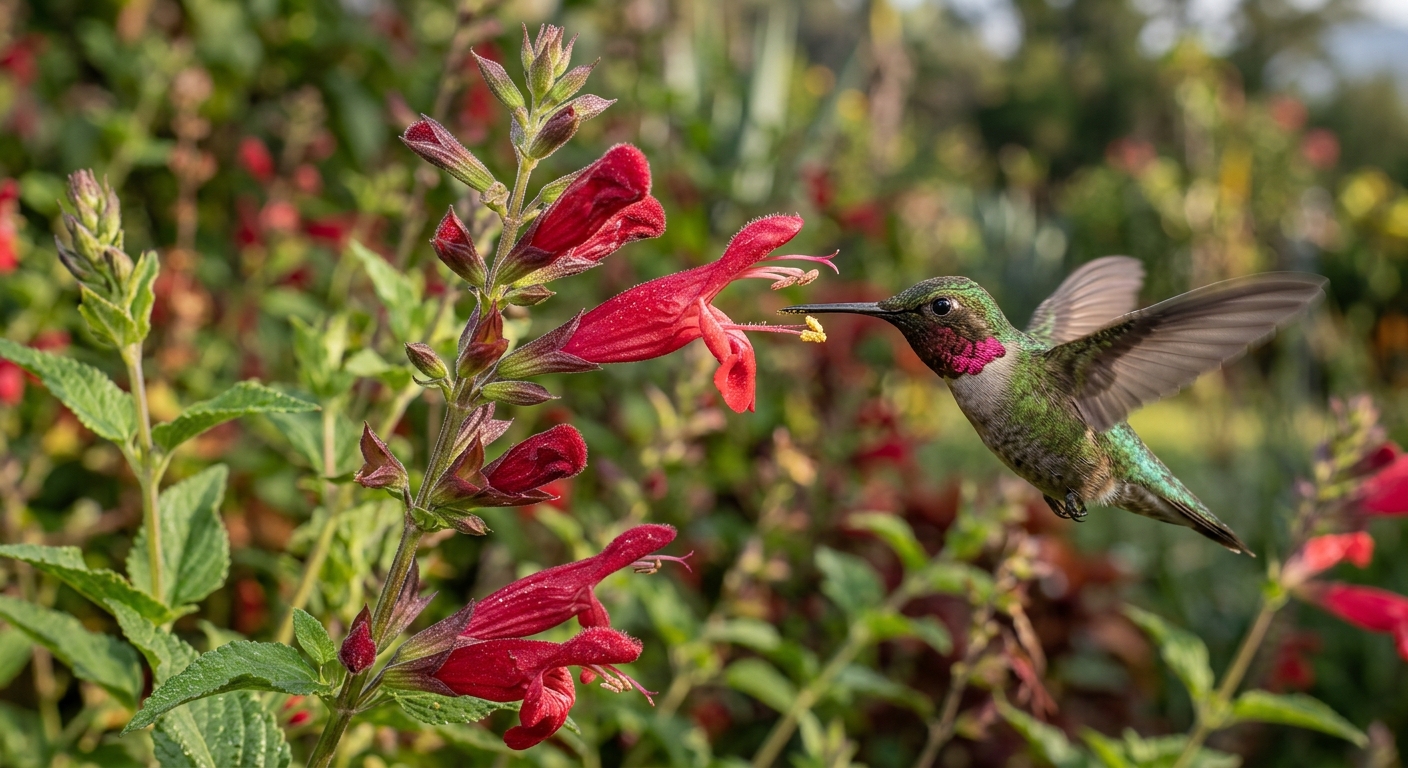
In the vast tapestry of nature’s relationships, few partnerships are as precisely choreographed as the one between the hummingbird sage and its tiny, iridescent visitors. While most flowers passively wait for any pollinator to stumble upon their offerings, Salvia spathacea has evolved one of the most exclusive access policies in the plant kingdom: its blooms literally refuse to open unless a hummingbird is present.
A Lock That Only One Key Can Open
The hummingbird sage, native to California and Baja Mexico, has taken the concept of specialized pollination to an extraordinary extreme. Unlike flowers that remain constantly open, hoping to attract whatever pollinator might pass by, this remarkable plant has evolved a mechanical trigger system that responds exclusively to the unique flight patterns and feeding behavior of hummingbirds.
The flower’s crimson blooms remain tightly sealed until the precise moment a hummingbird approaches. As the bird hovers in front of the flower, preparing to feed, the plant somehow detects its presence and begins the opening process. The petals unfurl like a biological time-lock, revealing the nectar-rich interior just as the hummingbird extends its needle-like bill.
The Science Behind the Magic
Researchers have discovered that this incredible phenomenon relies on a combination of environmental cues that hummingbirds uniquely provide. The mechanism involves several factors working in perfect synchronization:
Vibration Sensitivity
The rapid wingbeats of hummingbirds, which can reach up to 80 beats per second, create distinctive vibrations in the air. The hummingbird sage has evolved specialized cells in its flower structure that can detect these specific frequency patterns. This vibration acts as the primary trigger for the opening mechanism.
Air Pressure Changes
When a hummingbird hovers, it creates unique air pressure patterns around the flower. The plant’s petals contain pressure-sensitive cells that respond to these minute atmospheric changes, contributing to the opening sequence.
Heat Detection
Hummingbirds maintain a higher body temperature than most other potential visitors. The sage flowers can detect the specific thermal signature of an approaching hummingbird, adding another layer of security to their exclusive access system.
Evolutionary Masterpiece
This extraordinary adaptation represents millions of years of co-evolution between plant and pollinator. The hummingbird sage hasn’t always possessed this remarkable ability. Through countless generations, natural selection favored plants that could ensure their pollen reached the most effective carriers.
Hummingbirds proved to be exceptional pollinators for several reasons:
- High fidelity: They tend to visit flowers of the same species in sequence, ensuring cross-pollination between sage plants
- Frequent visits: Their high metabolism requires constant feeding, leading to multiple pollination events throughout the day
- Precision feeding: Their hovering ability and long bills allow for deep nectar access without damaging the flower
- Long-distance travel: They can carry pollen across significant distances, promoting genetic diversity
The Pollination Performance
When a hummingbird successfully triggers the opening mechanism, what follows is one of nature’s most elegant dances. As the flower unfolds, it reveals not just nectar, but also strategically positioned stamens that will dust the bird’s head and throat with pollen as it feeds.
The timing is crucial and precise. The flower remains open for exactly the duration of a typical hummingbird feeding session, usually between 10 to 30 seconds. Once the bird departs, the petals gradually close again, protecting the remaining nectar and preventing less efficient pollinators from accessing the flower’s resources.
Conservation Concerns
This highly specialized relationship, while evolutionarily advantageous, also creates vulnerabilities. The hummingbird sage’s reproductive success is entirely dependent on the presence of its hummingbird partners. Climate change, habitat loss, and declining hummingbird populations directly threaten the plant’s ability to reproduce.
In areas where hummingbird populations have declined, researchers have observed hummingbird sage plants producing fewer seeds and showing reduced genetic diversity. Some populations have begun to show slight modifications in their trigger sensitivity, potentially adapting to work with other hovering insects as backup pollinators.
Other Nature’s Exclusive Clubs
The hummingbird sage isn’t entirely alone in its exclusive approach to pollination. Several other plants have evolved similarly restrictive relationships:
- Certain orchids that only open for specific species of bees
- Night-blooming cacti that respond exclusively to bat echolocation
- Alpine flowers that time their opening to the flight patterns of high-altitude butterflies
However, none display quite the same level of mechanical sophistication as the hummingbird sage’s detection and response system.
Witnessing the Wonder
For those lucky enough to observe this phenomenon in person, the experience is nothing short of magical. Visitors to California’s coastal regions and chaparral areas during blooming season (typically spring and early summer) can witness this remarkable interaction firsthand.
The best viewing opportunities occur in the early morning and late afternoon when hummingbird activity peaks. Patient observers might watch seemingly dormant red buds suddenly spring to life as an Anna’s or Allen’s hummingbird approaches, creating a moment of perfect biological synchronicity that few will ever forget.
This extraordinary relationship between the hummingbird sage and its aerial partners reminds us that nature’s partnerships often operate with a precision and complexity that continues to astound scientists. In a world where most interactions seem random, the hummingbird sage has created its own VIP list with just one name on it, proving that in nature, sometimes exclusivity leads to the most beautiful relationships of all.

oh this is such a great example of convergent evolution actually, like flowers and corals both independently evolved these super specific recognition systems to filter for the “right” partners, but i gotta gently push back on the cleaner shrimp comparison steve – those are mutualistic partnerships where both parties actively benefit, whereas hummingbird sage’s mechanism is really more about the flower being picky about pollinator reliability, the hummingbird gets nectar sure but the flower is doing all the heavy lifting evolutionarily to exclude less effective pollinators. carla you hit on something important tho, these hyper-specialized relationships are beautiful but also genuinely fragile when the environment shifts, its one of those cases
Log in or register to replyThis is so cool, and honestly it reminds me of how specific some coral species are with their spawning partners and symbionts. I’ve watched entire reef sections depend on these hyper-specialized relationships, which is both beautiful and terrifying when conditions shift even slightly. Have you looked into whether climate change is affecting the hummingbird sage’s timing, or is the bird’s behavior keeping pace with flowering? I’m curious because we’re seeing devastating mismatches in coral breeding cycles and it makes me wonder how fragile these “perfect partnerships” really are.
Log in or register to replyThis is such a perfect example of what I’m always talking about, Carla – that hummingbird sage and those corals are basically nature’s cleaner shrimp situations, right? Like, the shrimp gets a meal and the fish gets cleaned, everyone wins, but when one partner disappears the whole system collapses. The terrifying part you mentioned is real though, because these hyper-specific relationships are evolutionary masterpieces until environmental change makes them evolutionary dead ends. I think we focus so much on competition that we forget most of Earth’s stability actually comes from these intricate mutual dependencies, even if they do make ecosystems more fragile in the short term.
Log in or register to reply