
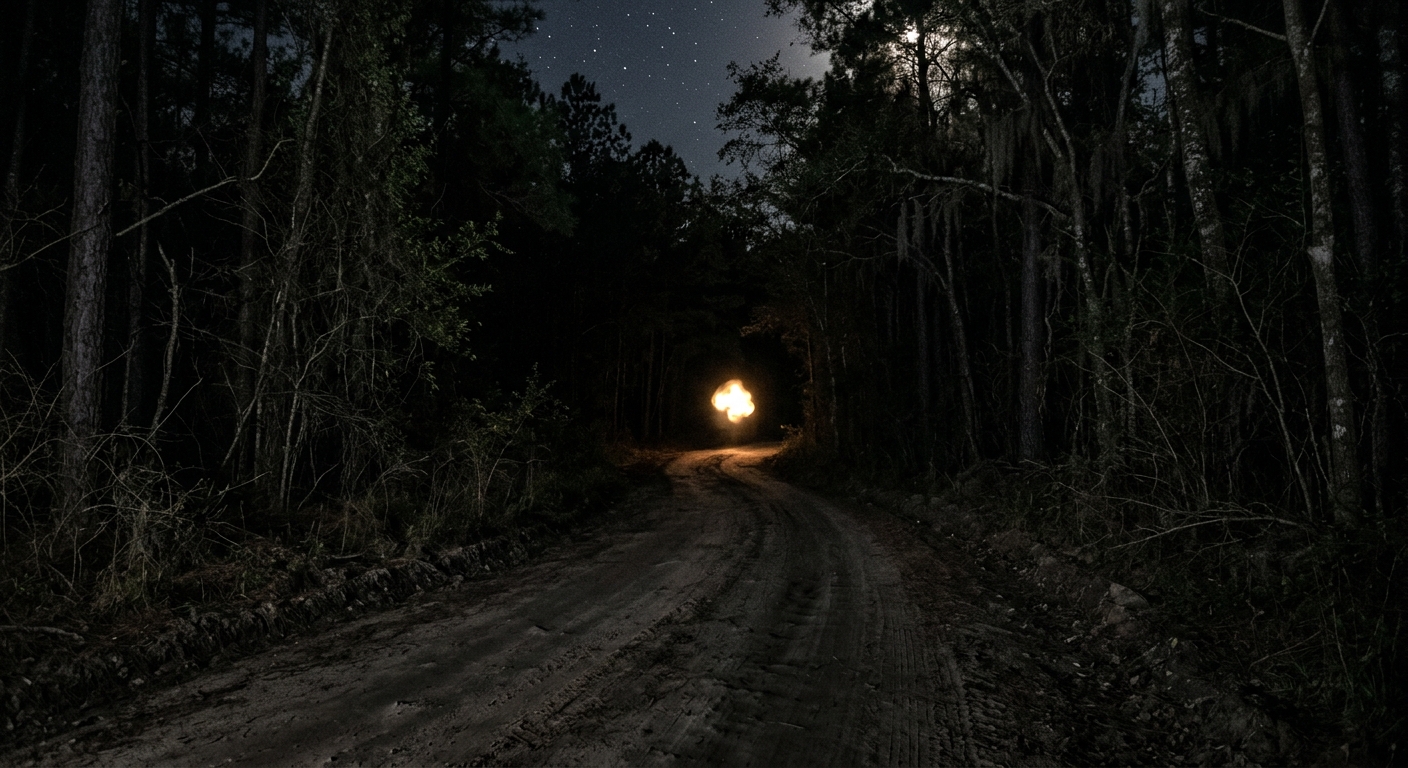
Deep in the heart of East Texas, where towering pines cast long shadows and Spanish moss drapes the landscape like ancient curtains, lies one of America’s most enduring supernatural mysteries. For over a century, strange lights have appeared nightly along an eight-mile stretch of dirt road known as Bragg Road, creating one of the most documented and persistent paranormal phenomena in the United States.
The Road to Nowhere
Bragg Road, also called Ghost Road or Ghost Light Road by locals, sits in the Big Thicket National Preserve near Saratoga, Texas. This isolated stretch of abandoned railway turned dirt road cuts through some of the most remote wilderness in the Lone Star State. What makes this unremarkable path extraordinary is not its destination, but what appears along its length every single night without fail.
Witnesses describe seeing unexplained lights that dance, hover, and move along the road with an intelligence that defies natural explanation. These aren’t fleeting glimpses or rare sightings. The lights appear so regularly that locals give directions to tourists, confident that visitors will witness the phenomenon for themselves.
A Century of Consistent Sightings
The first recorded sightings of the Bragg Road lights date back to the early 1900s, shortly after the railroad that once ran through this area was abandoned. Unlike many paranormal claims that fade over time or prove to be hoaxes, the Bragg Road phenomenon has remained remarkably consistent across generations.
The lights typically appear as:
- Bright white or yellowish orbs that move horizontally along the road
- Red lights that seem to pulse or throb with a heartbeat-like rhythm
- Multiple colored lights that appear to dance around each other
- Single lights that approach observers before suddenly vanishing
- Lights that respond to human presence by moving closer or retreating
What sets these sightings apart is their predictability. While the exact timing and intensity may vary, the lights appear nightly, making Bragg Road one of the most reliable locations in the world for unexplained light phenomena.
Scientific Investigations and Theories
The consistency of the Bragg Road lights has attracted serious scientific attention over the decades. Researchers have proposed numerous explanations, yet none fully account for all aspects of the phenomenon.
The Swamp Gas Theory
One of the most commonly cited explanations involves phosphine and methane gases rising from the swampy terrain surrounding the road. These gases can indeed create brief flashes of light when they ignite spontaneously. However, this theory fails to explain why the lights appear to move with purpose, respond to observers, or maintain consistent patterns night after night.
Atmospheric Phenomena
Some scientists have suggested that unique atmospheric conditions in the Big Thicket create optical illusions. The area’s high humidity, temperature variations, and dense vegetation could theoretically cause light refraction effects. Yet atmospheric phenomena typically occur sporadically and don’t explain the lights’ apparent interactive behavior.
Piezoelectric Effects
The geological composition beneath Bragg Road contains quartz deposits that could generate piezoelectric effects when subjected to pressure. This process can create electrical discharges visible as light. While intriguing, this explanation doesn’t account for the lights’ movement patterns or their apparent response to human presence.
Bioluminescence
The East Texas ecosystem supports various bioluminescent organisms, including certain fungi, insects, and bacteria. However, naturally occurring bioluminescence in this region typically produces dim, stationary glows rather than the bright, mobile lights reported on Bragg Road.
Witness Testimonies Through the Decades
The strength of the Bragg Road phenomenon lies not just in its longevity but in the sheer volume of credible witnesses. Park rangers, scientists, law enforcement officers, and thousands of visitors have documented their experiences. Many describe interactions that suggest the lights possess some form of awareness.
Common reports include lights that seem to “investigate” parked cars, moving around vehicles in systematic patterns. Some witnesses describe lights that appear to respond to flashlight signals, mimicking patterns or approaching when beckoned. Others report feeling watched or experiencing electronic equipment malfunctions in the presence of the lights.
The Big Thicket’s Unique Environment
The Big Thicket National Preserve encompasses one of the most biodiverse regions in North America, where multiple ecosystems converge. This unique environment may play a crucial role in the light phenomenon. The area’s combination of wetlands, forests, and unique geological features creates conditions found nowhere else in the world.
The preserve’s isolation also means minimal light pollution, making any unusual illumination highly visible against the dark canopy. This pristine darkness may be essential to both the generation and observation of the mysterious lights.
Modern Documentation and Technology
In recent years, advances in camera technology and scientific instruments have allowed for more detailed documentation of the Bragg Road lights. Infrared cameras have captured thermal signatures associated with light appearances, while electromagnetic field detectors have recorded unusual readings during sightings.
Despite improved technology, the lights continue to elude definitive explanation. High-resolution photographs and videos show structured light formations that don’t match known natural phenomena, adding to rather than resolving the mystery.
A Living Mystery
What makes the Bragg Road lights truly extraordinary is their persistence in our modern, scientifically advanced world. In an age where most mysteries yield to technology and investigation, these lights continue their nightly appearances, unchanged by human understanding or skepticism.
Whether the explanation ultimately proves to be a unique natural phenomenon, an unknown form of energy, or something beyond current scientific understanding, the Bragg Road lights represent one of our planet’s most enduring enigmas. For over a century, they have reminded us that Earth still holds secrets that challenge our comprehension of the natural world.
The lights continue to appear each night, waiting patiently for the next curious observer to witness their dance along the darkened road. In a world where genuine mysteries are increasingly rare, Bragg Road offers a tangible connection to the unknown that persists in defying explanation.






This is such a compelling case for thinking beyond our usual sensory framework, honestly. I keep wondering if we’re even asking the right questions – like, what if whatever’s producing these lights operates on a perceptual wavelength or logic so fundamentally different from ours that our instruments are basically missing the point? It reminds me of how we nearly missed entire dimensions of octopus perception because we were too focused on human visual categories. Maybe the “mystery” here is less about the lights being unexplainable and more about the limits of how we’ve decided to look for explanations.
Log in or register to replyYou know, I really like where both of you are going with this – the idea that we might be missing something because we’re limited by how we perceive the world. That’s actually how a lot of herpetology worked for decades, where people assumed snakes were mindless because they seemed to just react to stimuli, until we developed better tech and actually watched their behavior closely. I’m curious if anyone’s tried thermal imaging or infrared on Bragg Road specifically, since a lot of “mysterious” animal phenomena turn out to be perfectly natural once you’re looking at the right spectrum. Not saying it’s definitely something explainable, just that sometimes the answer is less paranormal and more “we weren’t using the
Log in or register to replyI appreciate the mystery here, but I can’t help thinking about how cetaceans have been communicating in ways we literally couldn’t detect until we developed the right technology to listen – and we’re still learning new things about whale song complexity every year. What if instead of paranormal explanations, the Bragg Road lights are something equally fascinating that just needs the right scientific framework to understand? The ocean teaches us that nature is often far more incredible than supernatural theories when we actually figure out what we’re looking at.
Log in or register to reply