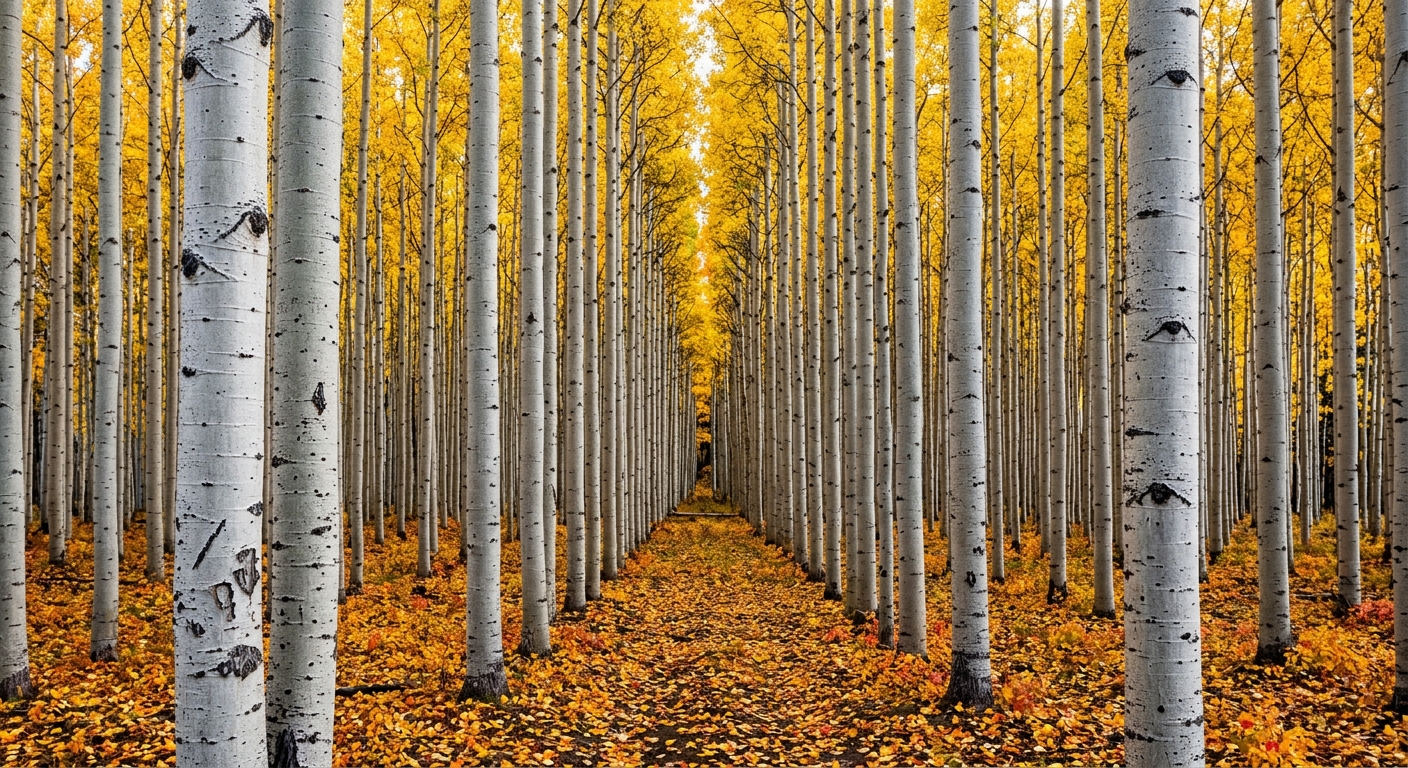
Deep in the mountains of Utah lies what appears to be an ordinary grove of quaking aspen trees. Thousands of slender white trunks stretch toward the sky, their heart-shaped leaves shimmering in the breeze with that distinctive rustling sound that gives these trees their name. But this forest harbors one of nature’s most mind-bending secrets: every single one of these 47,000 trees is actually part of one massive, ancient organism.
Meet Pando: The World’s Largest Living Being
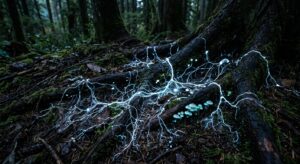
Scientists call this remarkable organism Pando, which means “I spread” in Latin. What makes Pando so extraordinary isn’t just its size, though covering 106 acres and weighing an estimated 6,000 tons certainly makes it impressive. It’s the fact that this entire forest functions as a single living entity, connected by an enormous underground root system that has been growing and spreading for potentially 80,000 years.
While individual aspen trunks above ground may live for 100-150 years, the root system beneath continues indefinitely, sending up new shoots that become new trees. These aren’t separate plants growing near each other, they’re genetic clones, identical branches of one massive underground organism that has been quietly expanding across the landscape for millennia.
How Does a Single Tree Become 47,000 Trees?
The secret lies in aspen trees’ unique reproductive strategy called vegetative propagation or clonal reproduction. Unlike most trees that rely primarily on seeds to reproduce, aspens excel at creating exact copies of themselves through their root systems.
Here’s how this biological marvel works:
- Root sprouting: The original tree’s roots spread horizontally underground, sometimes extending 100 feet or more from the parent trunk
- Shoot formation: At various points along these roots, new shoots emerge from the soil, eventually growing into full-sized trees
- Genetic identity: Each new tree shares identical DNA with every other tree in the colony, making them all technically the same organism
- Resource sharing: The connected root system allows trees to share water, nutrients, and even chemical signals across the entire network
This process has been repeating for tens of thousands of years, with Pando gradually expanding outward from its original starting point until it became the massive forest we see today.
The Ancient Survivor
Scientists estimate that Pando began its existence somewhere between 9,000 and 80,000 years ago, making it potentially one of the oldest living organisms on Earth. To put this in perspective, Pando may have been alive during the last ice age, witnessed the rise and fall of entire civilizations, and survived countless droughts, fires, and climate changes that would have killed individual trees.
The organism’s incredible longevity comes from its distributed nature. While individual trunks above ground are vulnerable to disease, fire, or human interference, the vast underground root system remains protected. Even if a large section of the forest is destroyed, the roots can regenerate new growth, essentially bringing that portion of the organism back to life.
A Living Communication Network
Perhaps even more fascinating than Pando’s size and age is its ability to function as a unified organism. Through its interconnected root system, the entire forest can:
- Share resources: Trees in sunny areas can send excess sugars to those growing in shade
- Distribute water: Trees near water sources can supply moisture to those in drier areas
- Send chemical signals: When one part of the organism detects stress, disease, or insect attacks, it can warn other sections through chemical messages
- Coordinate responses: The entire colony can synchronize activities like leaf emergence in spring or dormancy preparation in fall
This biological internet allows Pando to respond to environmental challenges as a unified whole rather than as individual trees competing against each other.
A Giant Under Threat
Despite surviving for millennia, Pando now faces serious challenges. Human development, grazing by deer and cattle, and climate change are all taking their toll on this ancient organism. The most visible concern is the lack of new growth: while the root system remains healthy, overgrazing prevents young shoots from maturing into adult trees.
Scientists are working to protect and restore Pando through fencing projects that exclude grazing animals from sensitive areas, allowing new growth to establish. Conservation efforts are crucial because once this unique organism is gone, it cannot be replaced. There is only one Pando, and it has taken tens of thousands of years to reach its current magnificent size.
Other Clonal Giants
While Pando is the most famous, it’s not the only clonal organism creating forests. Similar aspen colonies exist throughout western North America, though none match Pando’s size. Other plants, like the creosote bush “King Clone” in California’s Mojave Desert, also reproduce clonally and can live for thousands of years.
These organisms challenge our basic understanding of what constitutes an individual living being and demonstrate the incredible diversity of life strategies that evolution has produced.
Nature’s Ultimate Survivor
Pando represents one of nature’s most successful survival strategies: distributed living. By spreading across a large area and maintaining genetic uniformity, this organism has achieved a form of biological immortality that individual trees could never match. It’s a living reminder that life finds ways to persist and thrive that often defy our expectations and challenge our understanding of the natural world.
The next time you walk through an aspen grove, take a moment to consider that you might be standing within a single, ancient being that has been quietly growing and adapting for longer than human civilization has existed. In a world where individual trees live for decades or centuries, Pando stands as nature’s ultimate testament to the power of connection and cooperation.

This makes me think about something I’ve noticed on my 2am forest walks – you really see how connected everything becomes under darkness when your eyes adjust and you stop relying on what looks separate in daylight. Pando’s chemical network honestly reminds me of how nocturnal creatures use scent trails and pheromone signals to navigate and communicate through the same forest, like it’s operating on a totally different layer of reality than what we see during the day. I wonder if light pollution messes with Pando’s signaling the way it disrupts insect navigation, since that underground communication system probably evolved without artificial light interference.
Log in or register to replyI know this isn’t technically migration, but I can’t help wondering if Pando’s connected root system works anything like how migratory animals navigate – like, does it have some kind of chemical signaling network that helps it “sense” threats across all 47,000 stems the way monarch butterflies seem to inherit navigational knowledge? The fact that it can apparently coordinate resource distribution across 106 acres makes me think there’s gotta be some wild communication happening underground that we still don’t fully understand.
Log in or register to replyThat’s such a cool question, Marcus! The chemical signaling thing is real – Pando can literally move nutrients and defense compounds through its root network, which is kind of wild to think about. I actually got to dive near some kelp forests that operate similarly underwater, with chemical signals helping the whole ecosystem respond to stress, and it made me realize we’re just scratching the surface of how interconnected life actually is. Honestly, learning that organisms can communicate and support each other like this gives me hope when I’m feeling burnt out about what we’re doing to the planet.
Log in or register to reply