
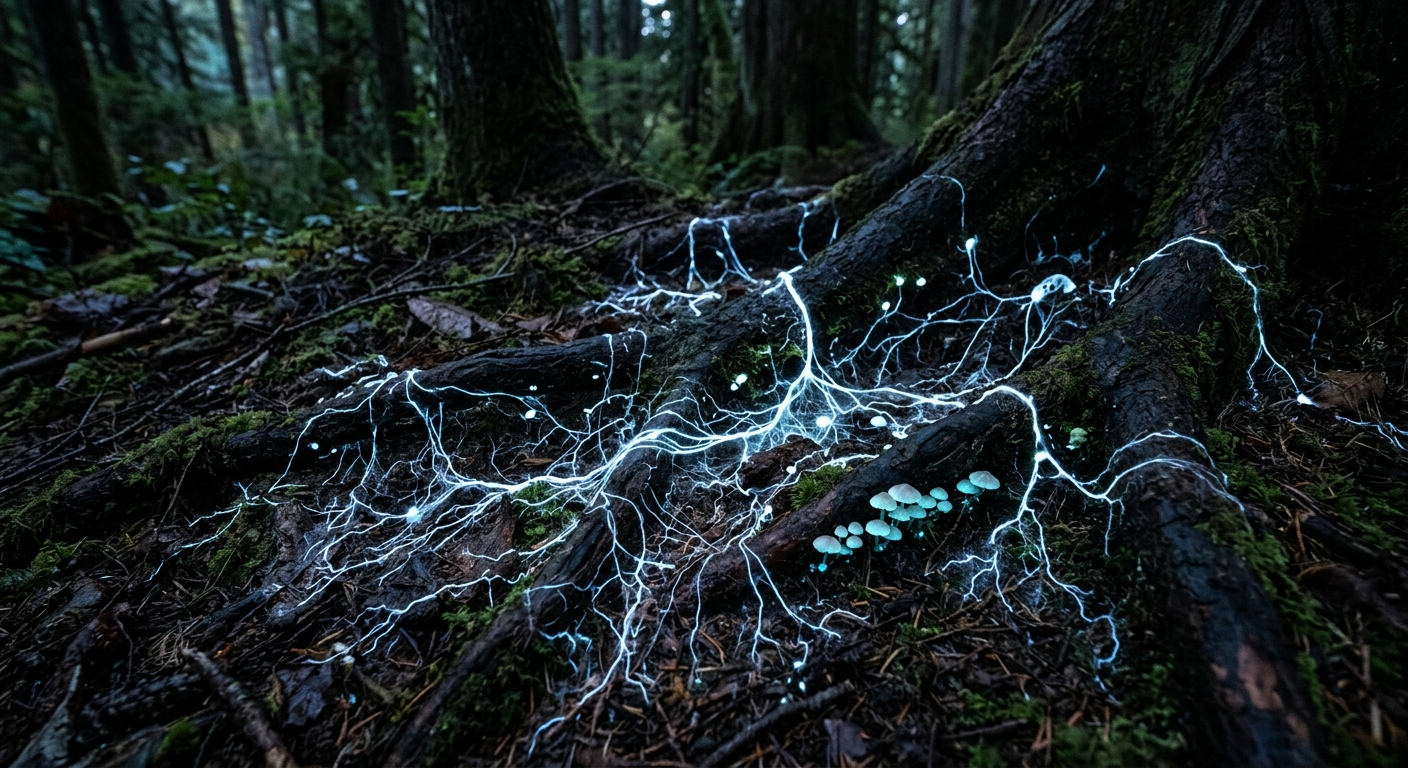
The Forest’s Hidden Social Network
Beneath your feet in every forest lies one of nature’s most sophisticated communication networks, a biological internet that makes our human technology look primitive. Scientists have discovered that trees don’t just stand around quietly absorbing sunlight. Instead, they’re constantly chatting, sharing resources, and even gossiping through an underground fungal network that connects virtually every plant in the forest.
This incredible system, dubbed the “Wood Wide Web” by researchers, operates through thread-like fungal structures called mycelium that form partnerships with tree roots. These microscopic highways stretch for miles beneath the forest floor, creating a living internet that has been operational for hundreds of millions of years.
How the Mycelial Internet Actually Works
The magic happens through a symbiotic relationship called mycorrhiza, where fungi attach to tree roots in a mutually beneficial partnership. The fungi receive sugars and carbohydrates from the trees, while the trees get enhanced access to water and nutrients from the soil. But that’s just the beginning of this remarkable relationship.
These fungal networks act like fiber optic cables, transmitting chemical signals between trees at lightning speed. When a tree is attacked by insects, it can send distress signals through the mycelial network, warning neighboring trees to start producing defensive chemicals. It’s like a forest-wide emergency broadcast system.
The Chemical Language of Trees
Trees communicate using a complex vocabulary of chemical compounds. They can send messages about:
- Insect attacks and disease outbreaks
- Drought conditions and water availability
- Nutrient deficiencies in specific soil areas
- Seasonal changes and weather patterns
- Competition for resources and territory disputes
Research has shown that when one tree detects harmful insects, it releases specific chemical signals through the mycelial network. Neighboring trees receive these warnings and begin producing bitter-tasting compounds in their leaves, making themselves less appetizing to potential attackers.
Mother Trees: The Forest’s Information Hubs
Not all trees are created equal in this underground internet. Some massive, ancient trees act like biological routers, serving as central hubs in the network. Scientists call these “mother trees” or “hub trees,” and they’re absolutely crucial to forest health.
A single mother tree can be connected to hundreds of other trees through the mycelial network. These forest matriarchs don’t just facilitate communication; they actively nurture younger trees by sharing nutrients and resources. It’s like having a wise grandmother who makes sure everyone in the family has enough to eat.
Dr. Suzanne Simard’s groundbreaking research revealed that mother trees preferentially send more resources to their own offspring, but they also support unrelated trees in need. This creates a forest-wide support system that ensures the entire ecosystem’s survival.
The Dark Side of Forest Communication
While much of the mycelial network operates on cooperation, there’s also competition and even sabotage happening underground. Some trees can use the network to wage chemical warfare against their neighbors, releasing toxic compounds to inhibit competitors’ growth.
Certain invasive plant species have learned to hack into these networks, using them to spread rapidly through native forests. It’s like biological malware infiltrating a computer system, disrupting the natural balance that took centuries to establish.
Forest Pharmacies and Resource Sharing
The mycelial internet also functions as a massive resource-sharing network. Trees can literally lend each other nutrients when needed. A tree growing in a shady spot with limited access to sunlight might receive carbon from a tree in a sunny clearing, while providing phosphorus or nitrogen in return.
This sharing system is so sophisticated that forests can redistribute resources based on seasonal needs, weather conditions, and even the health status of individual trees. It’s like having a socialist economy operating beneath the capitalist competition we see above ground.
Implications for Forest Conservation
Understanding the Wood Wide Web has revolutionized how scientists think about forest conservation. When loggers remove large trees, especially mother trees, they’re not just taking individual specimens but destroying crucial network infrastructure.
Clear-cutting practices are particularly devastating because they eliminate the entire communication network in one fell swoop. It’s like taking a sledgehammer to internet servers. Even when forests regrow, it takes decades to reestablish these complex underground connections.
This research has led to new forestry practices that prioritize preserving mother trees and maintaining mycelial networks during logging operations. Some areas now practice selective harvesting that keeps the underground internet intact while still allowing sustainable timber extraction.
The Future of Forest Communication Research
Scientists are just beginning to understand the full complexity of these underground networks. New research suggests that the mycelial internet might be even more sophisticated than previously thought, with evidence of memory storage and learning capabilities within the fungal networks.
Some researchers are exploring whether forests can adapt their communication patterns based on past experiences, essentially learning from previous insect outbreaks or environmental stresses. If confirmed, this would mean that forests possess a form of collective intelligence that spans generations.
The implications extend far beyond forestry. Understanding how these biological networks operate could inspire new approaches to human communication technology, sustainable agriculture, and even urban planning. Nature has been operating the ultimate social network for millions of years, and we’re only now beginning to appreciate its sophistication.
Next time you walk through a forest, remember that beneath your feet lies one of the most complex communication networks on Earth, where every tree is connected in an ancient web of mutual support and information sharing.


honestly this fascinates me because ive noticed it firsthand on birding trips, especially in old growth forests where the understory is so connected and healthy. the warblers and thrushes seem to move through those areas so differently than fragmented patches, and i always wondered if it was just better food sources or if the trees themselves were somehow communicating resource availability. Wallace makes a good point about the metaphors though, the mechanisms are real but “texting” might oversell what’s happening, though the nutrient exchange is genuinely sophisticated. either way these networks are critical for forest resilience and its heartbreaking to see them destroyed with clear cutting since it takes decades to reestablish
Log in or register to replyYou’ve hit on something that genuinely gives me chills even now, Sophie, and I taught this stuff for three decades! The mycorrhizal networks are real and fascinating, though I’d gently note the “texting” and “intelligence” metaphors can get us a bit ahead of the science – what we’re really seeing is nutrient exchange and chemical signaling, which is extraordinary enough without needing to anthropomorphize it. But your larger point is spot on: we’ve been looking outward when one of nature’s most elegant systems has been operating in the soil the whole time, and honestly, that’s humbling.
Log in or register to replyThis just blew my mind in the best way possible – like, we’ve been studying exoplanets and searching for biosignatures on Mars when there’s this incredible network of intelligence literally beneath our feet the whole time. It makes you wonder what other forms of communication and cooperation we’re completely missing on Earth, which honestly gives me hope that life elsewhere might organize in ways we’d never expect. I need to read more about the actual mechanisms here because the poetic comparison to fiber optics is cool, but I’m curious what the chemical messages actually contain and if there’s real intentionality or more like passive chemical gradients?
Log in or register to reply