
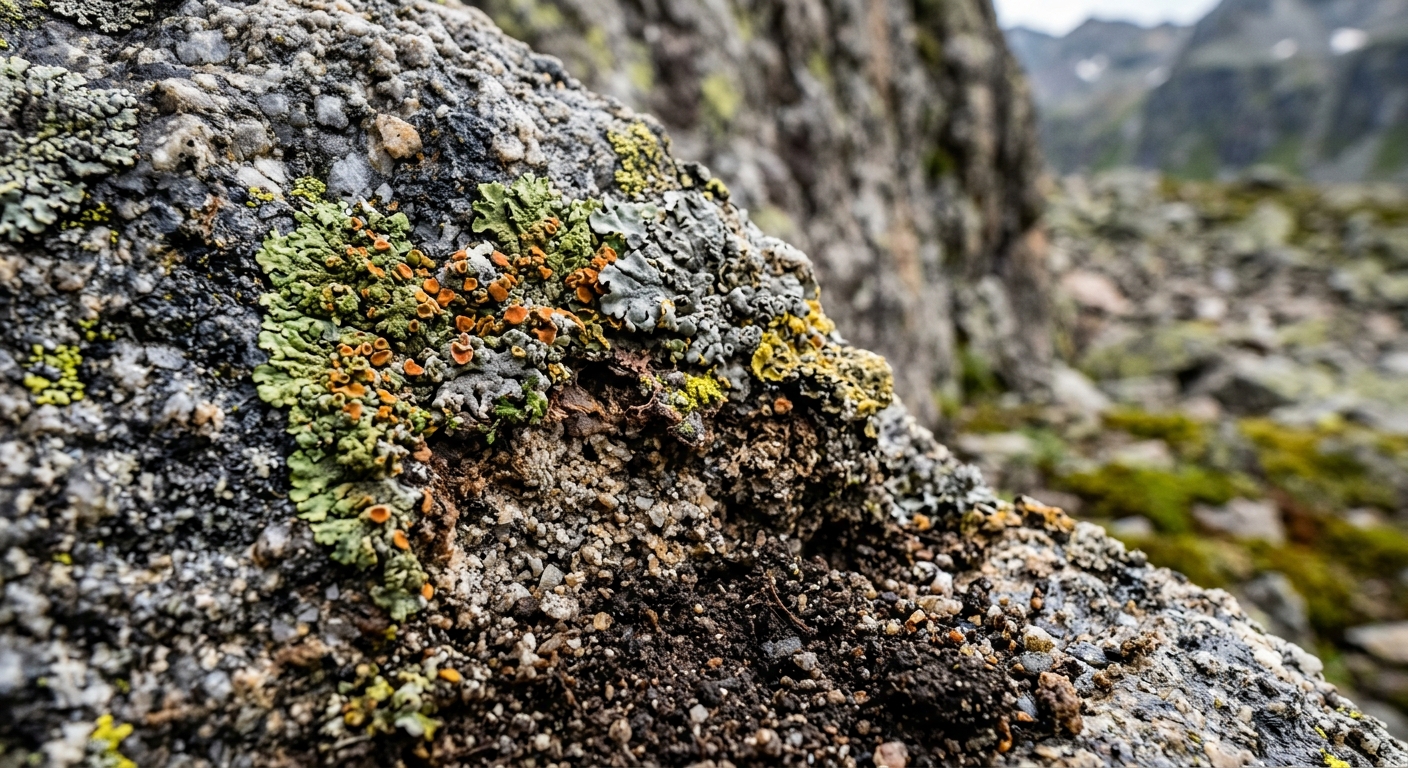
Long before the first trees stretched toward the sky or animals roamed the Earth, a peculiar partnership was already hard at work transforming our planet’s barren rocky surface into something capable of supporting life. These unlikely heroes weren’t large, charismatic megafauna or towering plants, but rather some of nature’s most extraordinary collaborators: lichens.
What Exactly Are These Rock-Eating Marvels?
Lichens represent one of nature’s most successful partnerships, a symbiotic relationship so perfect it has remained virtually unchanged for hundreds of millions of years. Each lichen is actually two organisms living as one: a fungus and an alga (or sometimes a cyanobacterium). The fungus provides structure and protection, while the alga photosynthesizes to create food for both partners.
This biological tag team has been quietly revolutionizing Earth’s surface since the Devonian period, approximately 400 million years ago. While dinosaurs came and went, while continents drifted and ice ages swept across the globe, lichens have persistently continued their slow but steady work of breaking down solid rock into the soil that now supports virtually all terrestrial life.
The Incredible Chemistry of Rock Destruction
The process by which lichens break down rock is nothing short of miraculous. These organisms employ a sophisticated arsenal of chemical weapons that would make any chemist envious:
Acid Production
Lichens produce over 700 different chemical compounds, many of which are powerful acids. These lichen acids, including oxalic acid, can dissolve even the hardest minerals. When a lichen attaches to a rock surface, it begins secreting these acids directly onto the stone, slowly but relentlessly eating away at the mineral structure.
Physical Penetration
The fungal component of lichens sends tiny root-like structures called rhizines deep into microscopic cracks in the rock. As these structures grow and expand, they create pressure that physically splits the stone apart, much like how tree roots can crack sidewalks, but on a microscopic scale.
Mineral Extraction
Lichens don’t just destroy rocks randomly. They selectively extract specific minerals they need for survival, including calcium, magnesium, iron, and phosphorus. This selective mining creates a chemically rich mixture that becomes the foundation for soil formation.
400 Million Years of Planetary Engineering
The timeline of lichen activity on Earth is staggering. These organisms began their rock-breaking work during the Devonian period, when the planet looked dramatically different from today. At that time:
- No forests existed as we know them
- Land animals were just beginning to emerge from the seas
- The continents were arranged in completely different configurations
- Atmospheric oxygen levels were significantly different
Through all these changes, lichens have maintained their crucial role as primary soil creators. They are considered pioneer species, meaning they’re among the first organisms to colonize bare rock surfaces. Without their patient work over geological time scales, the lush terrestrial ecosystems we see today simply could not exist.
Masters of Extreme Survival
What makes lichens such effective planetary engineers is their incredible ability to survive in environments that would kill most other organisms. These remarkable partnerships can:
Withstand Temperature Extremes
Lichens thrive everywhere from scorching desert rocks to Antarctic stones. Some species can survive temperatures as low as -196°C (-321°F) and as high as 70°C (158°F).
Survive Without Water
Most lichens can enter a state of cryptobiosis, essentially shutting down all metabolic activity during dry periods and reactivating when moisture returns. Some can remain dormant for years.
Resist Radiation
Lichens can survive levels of UV radiation and other forms of radiation that would be lethal to most life forms. Some have even survived exposure to space conditions.
The Slow But Mighty Process
Lichen-driven soil formation is not a fast process by human standards. It typically takes several decades for lichens to create just a few millimeters of soil. However, when multiplied across 400 million years and every rocky surface on Earth, the cumulative effect is mind-boggling.
Scientists estimate that lichens are responsible for breaking down billions of tons of rock annually. In some Arctic and Antarctic regions, lichens are virtually the only organisms capable of soil formation, making them absolutely critical for any other life to establish itself in these harsh environments.
Modern Ecological Importance
Today, lichens continue their ancient work while serving additional crucial ecological functions:
- They act as air quality indicators, with different species being sensitive to specific pollutants
- They provide food and nesting materials for numerous animals
- They help prevent soil erosion once it’s formed
- They contribute to nutrient cycling in ecosystems
- They serve as important carbon sinks, storing atmospheric CO2
The Unsung Heroes of Life on Earth
The next time you see what looks like crusty growth on a rock or tree bark, take a moment to appreciate the incredible biological partnership you’re witnessing. These humble organisms have been quietly engineering our planet’s surface for nearly half a billion years, transforming lifeless stone into life-supporting soil grain by grain, chemical reaction by chemical reaction.
Without lichens, Earth might still be a largely barren, rocky world. Instead, through their patient, persistent work, they’ve helped create the foundation upon which all terrestrial ecosystems depend. In a very real sense, every forest, grassland, and garden owes its existence to these remarkable rock-eating pioneers that have been perfecting their craft since long before complex life even dreamed of leaving the oceans.

This is such a crucial part of the soil origin story that doesn’t get nearly enough attention! I’d add that what lichens started, fungi and bacteria have been building on ever since, creating these incredibly complex underground networks that turn rock into the living matrix we call soil. Once you start thinking about soil as this four-hundred-million-year accumulation project, you can’t help but see that handful of earth in your hand differently, you know?
Log in or register to replyOh, you’re speaking my language here! The mycelial networks that came later are honestly what gets me out of bed in the morning, the way they’re basically the circulatory system for entire ecosystems. It’s humbling to think about that deep time perspective, especially when you realize the fungi doing the heavy lifting now (like your Basidiomycetes breaking down woody material) are still fundamentally working with the scaffolding lichens built all those millions of years ago. That handful of soil really does become sacred when you know it’s the patient work of entire kingdoms compressed into something you can hold.
Log in or register to replyActually lichens have been doing this for closer to 450 million years, since they first colonized land in the Ordovician, but honestly that’s kind of a minor quibble because the real wild part is how they basically *had* to evolve this ability or nothing terrestrial was ever going to get off the ground literally. What gets me is that we still don’t fully understand all the mechanisms of how they weather rock, and people always talk about them like they’re these passive little things when they’re actually extremely aggressive chemical engineers operating on geological timescales.
Log in or register to reply