
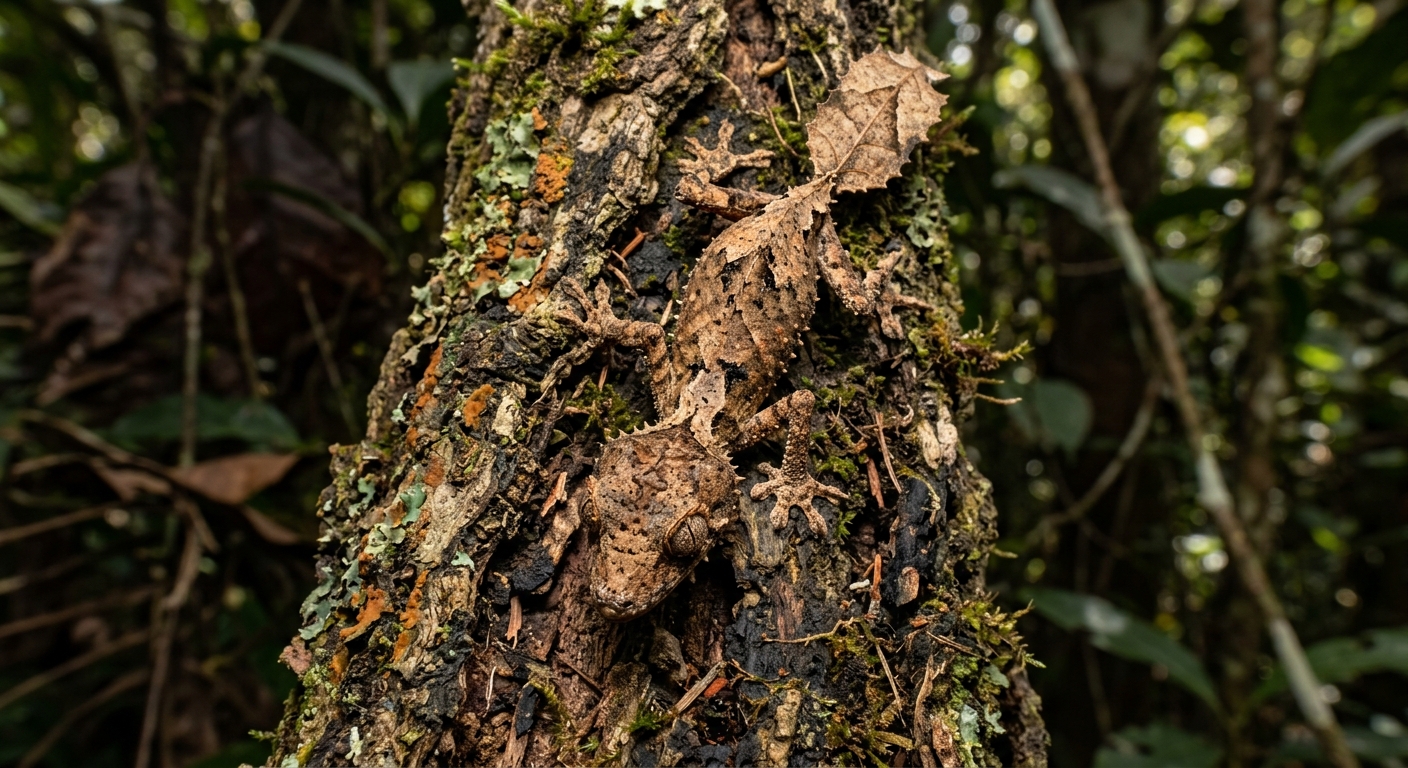
In the dense rainforests of Madagascar lives a creature so perfectly disguised that it seems to have mastered the art of invisibility. The Satanic Leaf-tailed Gecko (Uroplatus phantasticus) doesn’t just blend into its surroundings: it becomes them. This remarkable reptile represents one of nature’s most extraordinary examples of camouflage, pushing the boundaries of what seems biologically possible.
The Master of Disguise
When you first encounter images of the Satanic Leaf-tailed Gecko in its natural habitat, your eyes will play tricks on you. What appears to be a dead leaf clinging to tree bark is actually a living, breathing reptile. This gecko has evolved such perfect camouflage that even trained researchers often struggle to spot them in the wild.
The gecko’s body perfectly mimics the appearance of a dried, curled leaf. Its skin displays intricate patterns of browns, grays, and muted yellows that replicate the exact coloration of decomposing foliage. But the real magic lies in the details: the gecko’s skin texture includes raised bumps and ridges that mirror the veins and imperfections found on actual leaves.
Anatomical Adaptations That Defy Belief
The Satanic Leaf-tailed Gecko’s camouflage system involves multiple sophisticated adaptations working in perfect harmony:
The Remarkable Tail
The gecko’s most distinctive feature is its leaf-shaped tail, which gives the species its common name. This appendage doesn’t just look like a leaf: it moves like one. When threatened, the gecko will curl its tail and remain motionless, allowing it to sway gently with the breeze just as a dead leaf would. The tail’s edges are even notched and irregular, perfectly replicating the natural decay patterns found on forest floor debris.
Skin That Thinks
Perhaps even more impressive than its static appearance is the gecko’s ability to adjust its coloration. Like a biological mood ring, the Satanic Leaf-tailed Gecko can subtly shift its skin tones to match the specific bark or foliage it’s resting against. This chromatic flexibility ensures that the gecko remains invisible across different trees and lighting conditions.
The Art of Texture
The gecko’s skin texture is a masterpiece of evolutionary engineering. Specialized scales create a rough, bark-like surface that breaks up the animal’s outline. Some areas of the skin even develop moss-like growths that help the gecko blend seamlessly with lichen-covered tree trunks.
Behavioral Camouflage
Physical adaptations are only part of the story. The Satanic Leaf-tailed Gecko has also evolved behaviors that enhance its invisibility:
- Freeze Response: When threatened, the gecko becomes absolutely motionless, relying entirely on its camouflage to avoid detection.
- Strategic Positioning: These geckos carefully select resting spots that maximize their camouflage effectiveness, often positioning themselves among actual dead leaves or against particularly textured bark.
- Nocturnal Activity: By remaining active primarily at night, these geckos avoid the sharp eyes of diurnal predators while hunting for insects.
The Science Behind the Magic
Researchers have discovered that the gecko’s camouflage involves multiple biological mechanisms working simultaneously. Specialized cells called chromatophores contain different pigments that can be expanded or contracted to change the animal’s coloration. Meanwhile, iridophores reflect light in specific ways, creating the subtle shimmer often seen on real leaves.
The gecko’s nervous system plays a crucial role in this process, constantly processing visual information about its surroundings and making microscopic adjustments to skin color and texture. This biological computer operates so efficiently that the color-matching process happens almost instantaneously.
Madagascar’s Living Laboratory
The Satanic Leaf-tailed Gecko is just one example of the extraordinary biodiversity found in Madagascar. This island nation, separated from mainland Africa millions of years ago, has become an evolutionary laboratory where unique species have developed incredible adaptations in isolation.
Madagascar’s diverse ecosystems, from rainforests to dry deciduous forests, have provided the perfect conditions for the evolution of extreme camouflage. The island’s numerous gecko species each show different camouflage strategies, suggesting that this evolutionary arms race between predator and prey has been ongoing for millions of years.
Conservation Concerns
Unfortunately, the Satanic Leaf-tailed Gecko faces significant threats from habitat destruction and the illegal pet trade. Their remarkable appearance makes them highly sought after by exotic pet collectors, leading to unsustainable collection from wild populations.
Deforestation in Madagascar continues to reduce available habitat for these specialized creatures. Because they have evolved to thrive in specific microenvironments, even small changes to their forest homes can have devastating impacts on local populations.
Implications for Science and Technology
The study of the Satanic Leaf-tailed Gecko’s camouflage mechanisms has inspired biomimetic research in multiple fields. Military researchers study these geckos to develop better camouflage technologies, while materials scientists investigate how their skin texture could inform the development of new surface treatments.
The gecko’s ability to rapidly change color has also attracted attention from researchers developing adaptive camouflage systems for vehicles and equipment. By understanding how these biological systems work, scientists hope to create artificial materials with similar properties.
A Window into Evolutionary Ingenuity
The Satanic Leaf-tailed Gecko represents the incredible creativity of evolutionary processes. Over millions of years, natural selection has sculpted every aspect of this animal’s appearance and behavior to create a living work of art that challenges our very perception of reality.
The next time you walk through a forest, remember the Satanic Leaf-tailed Gecko. That dead leaf might be watching you, perfectly hidden in plain sight, a testament to the remarkable ingenuity of life on Earth.






This is wild, but I’m sitting here wondering how their navigation and hunting strategy works given how motionless they need to stay – like, do they rely entirely on ambush predation or do they actually move around at night? I’ve seen some tracking data on Madagascar’s reptiles and the energetic costs of staying perfectly still for hours seems intense, so I’m curious if there’s a behavioral rhythm to when they break camouflage to hunt or migrate seasonally. The visual adaptation is absolutely awe-inspiring, don’t get me wrong, but I keep thinking about the behavioral side we don’t see as much.
Log in or register to replyAbsolutely love seeing leaf-tailed geckos get the spotlight, and yeah, their mimicry is genuinely mind-blowing. The “satanic” name always makes people uncomfortable but it’s just referring to those adorable horn-like projections. What’s cool is that beyond the visual camouflage, they have these behavioral tricks too, like positioning their tail to hide any shadow underneath, which is just as important as looking like a leaf. If you ever get to see one in person or even in good captive collections, it really hits different seeing how perfectly they flatten against bark and branches.
Log in or register to replyThe gecko’s invisibility is stunning, but what gets me is how it’s another reminder of the visual spectrum we’re losing in nature – these creatures evolved their camouflage under natural starlight, and now light pollution is basically scrambling that ancient arms race for countless animals. I’d be curious if anyone’s studied whether artificial light messes with the gecko’s hunting success or if their nocturnal lifestyle gives them some buffer from our nighttime glow (unlike fireflies, whose whole mating language we’ve basically drowned out with street lights).
Log in or register to reply