
Imagine an ancient catastrophe so devastating that it wiped entire civilizations from the map, leaving behind only burning cities and cryptic hieroglyphic warnings. Around 1200 BCE, the most advanced societies on Earth collapsed almost simultaneously, and the culprits behind this apocalyptic event remain one of archaeology’s greatest unsolved mysteries.
The Bronze Age Collapse: When Civilization Crumbled
The Late Bronze Age collapse wasn’t just the fall of one empire, it was the systematic destruction of an entire interconnected world. Within a span of roughly 50 years, the Mycenaean Greeks, the Hittite Empire, the Assyrians, and countless city-states across the Mediterranean were either completely destroyed or severely weakened. Trade networks that had flourished for centuries vanished overnight, writing systems disappeared, and populations plummeted so dramatically that it took some regions 400 years to recover.
What makes this collapse even more chilling is its thoroughness. Cities weren’t just conquered and occupied, they were burned to the ground and abandoned. Archaeological evidence shows layers of ash and destruction dating to this period across dozens of sites from Greece to Egypt, from Turkey to the Levant.
Enter the Sea Peoples: Phantoms from the Waves
The only clues we have about the perpetrators come from Egyptian records, particularly from the reigns of Pharaohs Merneptah and Ramesses III. These ancient texts describe mysterious invaders arriving from the sea in massive fleets, bringing with them advanced weaponry and an unstoppable hunger for destruction. The Egyptians called them the “Sea Peoples,” but that’s where the certainty ends and the mystery begins.
According to Egyptian hieroglyphs, the Sea Peoples weren’t just raiders, they were entire populations on the move. Men, women, children, and their belongings traveled in enormous flotillas, suggesting this wasn’t merely a military campaign but a massive migration fueled by desperation or ambition. They brought with them ox-drawn carts, families, and livestock, painting a picture of displaced peoples seeking new homes by force.
The Egyptian Account: A Terrifying Testimony
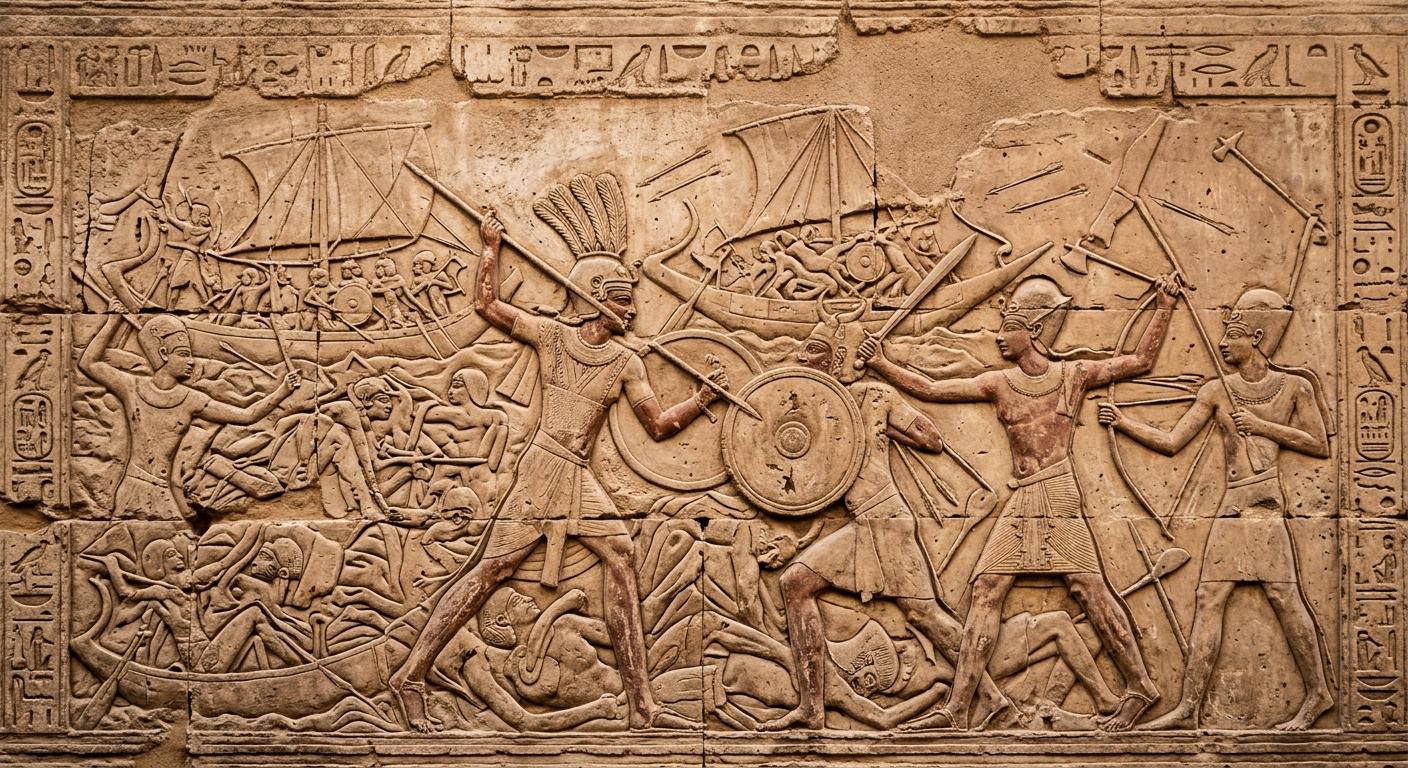
The most detailed description comes from the mortuary temple of Ramesses III at Medinet Habu, where carved reliefs and hieroglyphic texts describe the Sea Peoples’ assault around 1175 BCE:
- They attacked by both land and sea in coordinated strikes
- Their ships featured distinctive curved prows and square sails
- Warriors wore feathered headdresses and carried round shields
- They used advanced bronze weapons and fought in organized formations
- They brought families, suggesting permanent relocation rather than mere raiding
The pharaoh’s scribes wrote: “The foreign countries made a conspiracy in their islands. All at once the lands were removed and scattered in the fray. No land could stand before their arms.” This wasn’t Egyptian propaganda, it was a terrified civilization’s account of facing an unstoppable force.
The Phantom Fleet: Who Were These Mystery Invaders?
The Egyptian records mention several groups within the Sea Peoples confederation, each with names that archaeologists have spent decades trying to decode. The most prominent groups included:
The Peleset and Tjeker
Some scholars believe the Peleset eventually became the Philistines mentioned in biblical accounts, settling in what is now Gaza after their failed invasion of Egypt. The Tjeker may have settled in the Levantine coast, but their ultimate fate remains unknown.
The Denyen and Weshesh
These groups appear in Egyptian records as part of the confederation but vanish from history almost immediately afterward. Some theories connect them to later Mediterranean peoples, but no definitive links have been established.
The Shekelesh and Sherden
Possibly connected to Sicily (Shekelesh) and Sardinia (Sherden) based on name similarities, but again, these connections remain speculative at best.
Theories That Keep Archaeologists Awake at Night
The identity of the Sea Peoples has spawned dozens of theories, each more intriguing than the last. Here are the most compelling possibilities that continue to divide experts:
The Climate Catastrophe Theory
Some researchers propose that severe climate change around 1200 BCE triggered massive droughts and famines, forcing coastal populations to become maritime raiders. This would explain why entire families joined the migrations and why the destruction was so widespread.
The Mycenaean Refugee Hypothesis
As the Mycenaean civilization collapsed, displaced Greeks may have taken to the seas as pirates and mercenaries. Their knowledge of Bronze Age warfare and trade routes could explain their effectiveness in dismantling the very system they once participated in.
The Anatolian Connection
Hittite records mention mysterious peoples from the west causing problems just before their empire’s fall. Some scholars believe these western peoples and the Sea Peoples were the same groups, possibly originating from the Aegean islands or western Anatolia.
The Multi-Cultural Alliance Theory
Perhaps most intriguingly, the Sea Peoples may not have been a single ethnic group at all, but a confederation of displaced peoples, pirates, and opportunistic raiders who joined forces to prey on the weakening Bronze Age kingdoms.
Why This Mystery Matters Today
The Sea Peoples represent more than just an ancient mystery, they embody one of history’s most dramatic examples of how quickly complex civilizations can collapse when faced with the right combination of pressures. Their story offers sobering lessons about societal resilience, the fragility of interconnected systems, and the power of unknown variables to reshape entire regions.
Modern archaeologists continue to uncover new evidence about the Bronze Age collapse, but the Sea Peoples themselves remain frustratingly elusive. No definitive Sea Peoples’ settlements have been identified, no clear linguistic connections established, and no archaeological culture can be confidently attributed to them. They appeared from the waves, changed the course of human history, and vanished back into the mists of time.
The Enduring Enigma
What makes the Sea Peoples particularly fascinating is how thoroughly they’ve evaded identification despite their massive historical impact. These phantom warriors managed to topple empires, redirect the flow of civilization, and disappear so completely that even their ethnic identity remains a mystery over 3,000 years later. In an age when we can sequence ancient DNA and reconstruct prehistoric climates, the Sea Peoples remain one of our planet’s most compelling unsolved mysteries.
Perhaps that’s fitting for a people who emerged from the sea like a force of nature, reshaped the ancient world, and returned to the depths of history as mysteriously as they had come. Their legacy lives on not in monuments or texts, but in the very fact that our modern world emerged from the ashes of the civilizations they destroyed.





honestly this is fascinating but i keep wondering if the sea peoples connection might parallel how we’ve lost entire bird populations and migration routes without fully understanding why, like we’re missing pieces of the historical record the same way habitats just disappear. the bronze age collapse is wild but i’m curious if anyone’s studied whether environmental changes, disease, or resource depletion drove these movements – we know migration patterns shift when ecosystems change, and i’ve noticed that with a bunch of seabird colonies over the decades. great writeup though, mysteries like this make you realize how much we still don’t know about complex systems, whether its ancient civilizations or why a species suddenly vanishes from a region.
Log in or register to replyooh okay so this is actually a really cool historical mystery but i gotta say the “vanished so completely” thing is a bit overstated, like we have a ton of egyptian records of them and genetic evidence suggests they were probably displaced populations from various mediterranean regions who formed confederacies, not like actual phantoms lol. but yeah the “why did they suddenly stop being a major force” question is legit fascinating and might actually have more to do with climate disruption and resource collapse than this framing suggests, which honestly makes it way cooler than the mysterious warrior angle imo
Log in or register to replyI appreciate where you’re going with the habitat loss angle, but I think the Sea Peoples mystery is pretty different from ecological collapse since we’re talking about documented military campaigns and political upheaval versus gradual environmental change. That said, your point about missing pieces of the historical record is really interesting, though I’d be curious what specific parallels you’re drawing beyond “we don’t fully understand both things.” The Sea Peoples situation seems more like we have fragmentary sources rather than a complete absence of data, whereas with bird populations we often have pretty clear cause and effect (habitat destruction, etc.). What makes you see them as parallel mysteries?
Log in or register to reply