
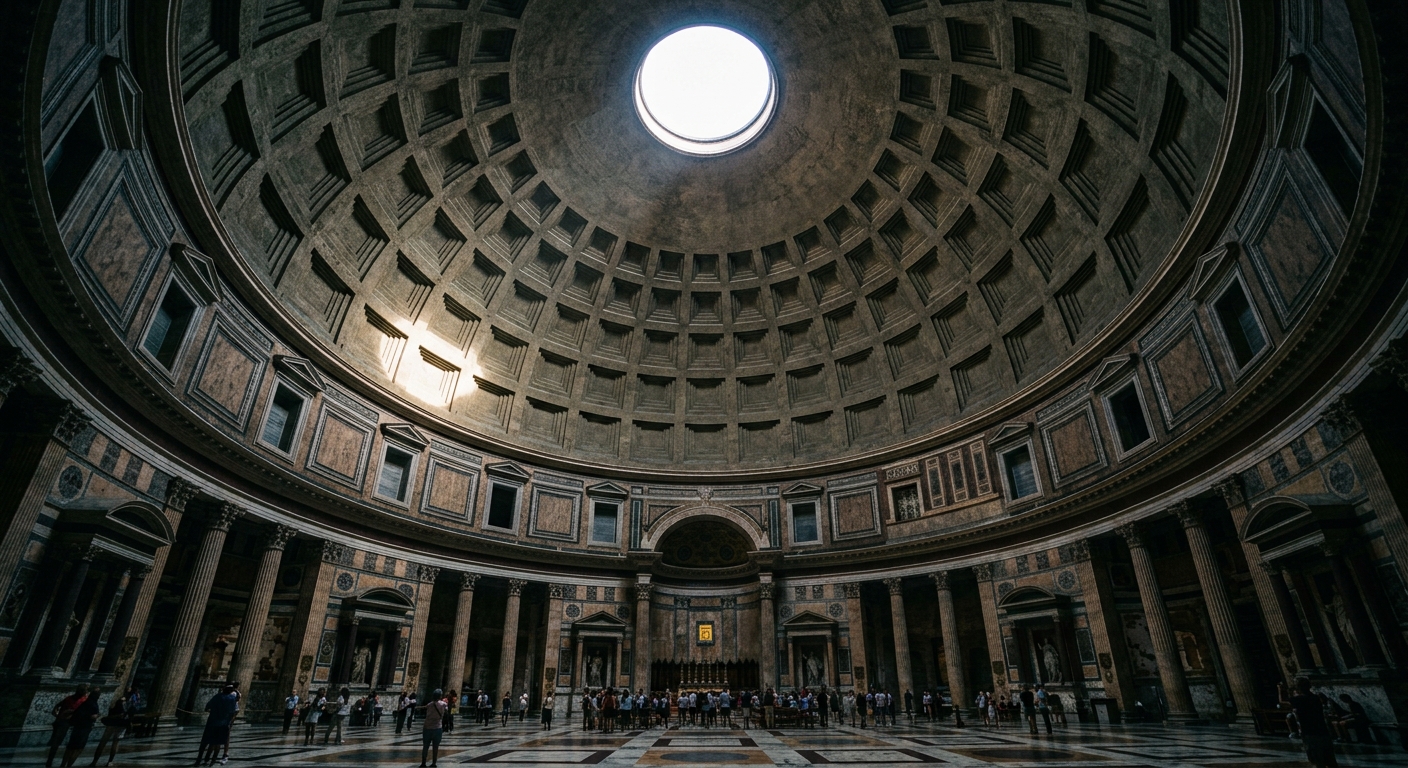
Standing in the heart of Rome, the Pantheon appears deceptively simple from the outside. Yet hidden beneath its classical facade lies one of history’s most astounding engineering achievements: a concrete dome that held the world record for largest unsupported span for an incredible 1,300 years. No structure on Earth could match its 142-foot diameter until the 19th century, leaving generations of architects scratching their heads at how ancient Romans accomplished what seemed impossible.
The Dome That Defied Time
Built around 126 AD during Emperor Hadrian’s reign, the Pantheon’s dome stretches 142 feet (43.3 meters) across its interior. To put this in perspective, imagine a circle large enough to fit a 14-story building lying on its side. The dome’s perfect hemisphere creates an interior space so vast that it wasn’t until 1881, when the Synagogue of Florence was completed, that any structure finally surpassed its diameter.
What makes this achievement even more remarkable is that the Pantheon wasn’t just a temporary marvel. While empires rose and fell, while the Dark Ages consumed Europe’s technological knowledge, and while countless buildings crumbled to dust, this ancient dome continued to soar overhead, mocking humanity’s subsequent attempts to match its grandeur.
The Secret of Roman Super-Concrete
The key to the Pantheon’s enduring dominance lies in Roman concrete technology that was so advanced it bordered on alchemy. Unlike modern concrete, Roman builders used volcanic ash from nearby Mount Vesuvius, creating a material that actually grew stronger over time when exposed to seawater and moisture.
The Ingenious Construction Method
The Romans employed several brilliant techniques that wouldn’t be fully understood until modern engineering analysis:
- Gradual weight reduction: The dome’s thickness decreases from 21 feet at the base to just 4 feet at the top
- Material variation: Heavy travertine and tufa at the bottom transition to lightweight pumice near the summit
- Hidden relief chambers: Invisible voids within the walls reduce weight without compromising strength
- The oculus effect: The 30-foot opening at the top eliminates the dome’s most structurally challenging point
Perhaps most ingeniously, the Romans built the dome using a wooden framework and then removed it once the concrete cured. This temporary support system allowed them to create a perfect hemisphere that distributes weight evenly across its entire surface.
Engineering Genius Hidden in Plain Sight
Modern engineers studying the Pantheon have discovered that its builders possessed an intuitive understanding of structural engineering that rivals computer-aided design. The dome’s geometry creates a compression-only structure, meaning every part of the dome pushes against its neighbors rather than pulling apart. This eliminates the tension forces that cause most masonry structures to fail.
The Mystery of the Missing Cracks
After nearly 2,000 years, the Pantheon shows remarkably few stress cracks. Seismic analysis reveals that the structure actually flexes during earthquakes, allowing it to survive tremors that have toppled newer buildings. The dome’s ability to move as a single unit, rather than break into segments, demonstrates a level of engineering sophistication that wasn’t achieved again until the development of modern reinforced concrete.
1,300 Years of Architectural Humility
The Pantheon’s record-holding streak is particularly impressive when you consider the ambitions of subsequent civilizations. Byzantine builders created magnificent domed churches like Hagia Sophia, but kept their spans considerably smaller. Medieval cathedral builders reached for the heavens with soaring Gothic vaults, yet none dared attempt the Pantheon’s massive diameter.
Renaissance Frustration
Even during the Renaissance, when classical Roman techniques experienced a revival, architects like Brunelleschi had to innovate entirely new construction methods to build large domes. Brunelleschi’s dome for Florence Cathedral, while taller, spans only 115 feet compared to the Pantheon’s 142 feet. It took the genius of Renaissance innovation just to come close to matching Roman achievement.
The Science Behind the Miracle
Recent analysis using ground-penetrating radar and 3D modeling has revealed additional secrets of the Pantheon’s construction. The dome contains a complex network of brick arches embedded within the concrete, creating a hidden skeletal framework that provides additional strength. This technique, called ‘aggregate relieving,’ was so advanced that it wasn’t rediscovered until the 20th century.
Chemical Analysis Reveals Ancient Secrets
Laboratory studies of core samples from the Pantheon have shown that Roman concrete contains unique crystalline structures formed by the volcanic ash. These microscopic formations continue to grow and strengthen the concrete even today, explaining why many Roman structures appear to be in better condition now than when they were first built.
Breaking the Ancient Record
When architects finally surpassed the Pantheon’s diameter in 1881 with the Synagogue of Florence at 144 feet, it marked the end of an era. However, this victory was short-lived. The real revolution came with steel and reinforced concrete construction in the 20th century, which finally allowed builders to create the massive spaces that had eluded architects for over a millennium.
Today, structures like the Georgia Dome span over 840 feet, making the Pantheon seem modest by comparison. Yet no modern building carries the weight of history that comes with holding a world record for thirteen centuries. The Pantheon stands not just as a monument to Roman engineering, but as a humbling reminder that sometimes the ancients achieved perfection on their first attempt.





ok so this isnt really evolution related but i gotta say the pantheon concrete situation is such a wild example of convergent problem-solving, like humans separated by centuries independently figuring out similar solutions to structural challenges. also the way that concrete formulation got lost and then rediscovered is kind of like how species adapt independently to similar environments… sorry im doing the thing again where i bring everything back to biology but seriously the engineering history here is fascinating!
Log in or register to replyYou’re not doing “the thing” wrong at all, this is exactly how I think about it too! The Pantheon concrete is basically a 2000-year-old proof that certain structural solutions are optimal, kind of like how multiple species independently evolved wings because that’s genuinely the best answer to flight. The Romans figured out that volcanic ash (pozzolana) creates stronger, more durable concrete than pure cement, and now we’re rediscovering those exact principles because nature had already solved durability through similar chemical reactions in minerals. Makes me wonder what other “lost” engineering solutions are just organisms doing it better if we looked closer.
Log in or register to replyhonestly this is fascinating but now im wondering if theres something we can learn from this about how animal populations solve survival challenges across different environments, like how apex predators in the serengeti vs the kalahari develop similar hunting strategies despite totally different terrain. the pantheon builders had to work with what they had on hand, kinda like how lions adapted their pride structure differently depending on prey availability and competition, you know? makes me think adaptation isnt always about reinventing the wheel but just understanding the core problem deeply enough
Log in or register to reply