
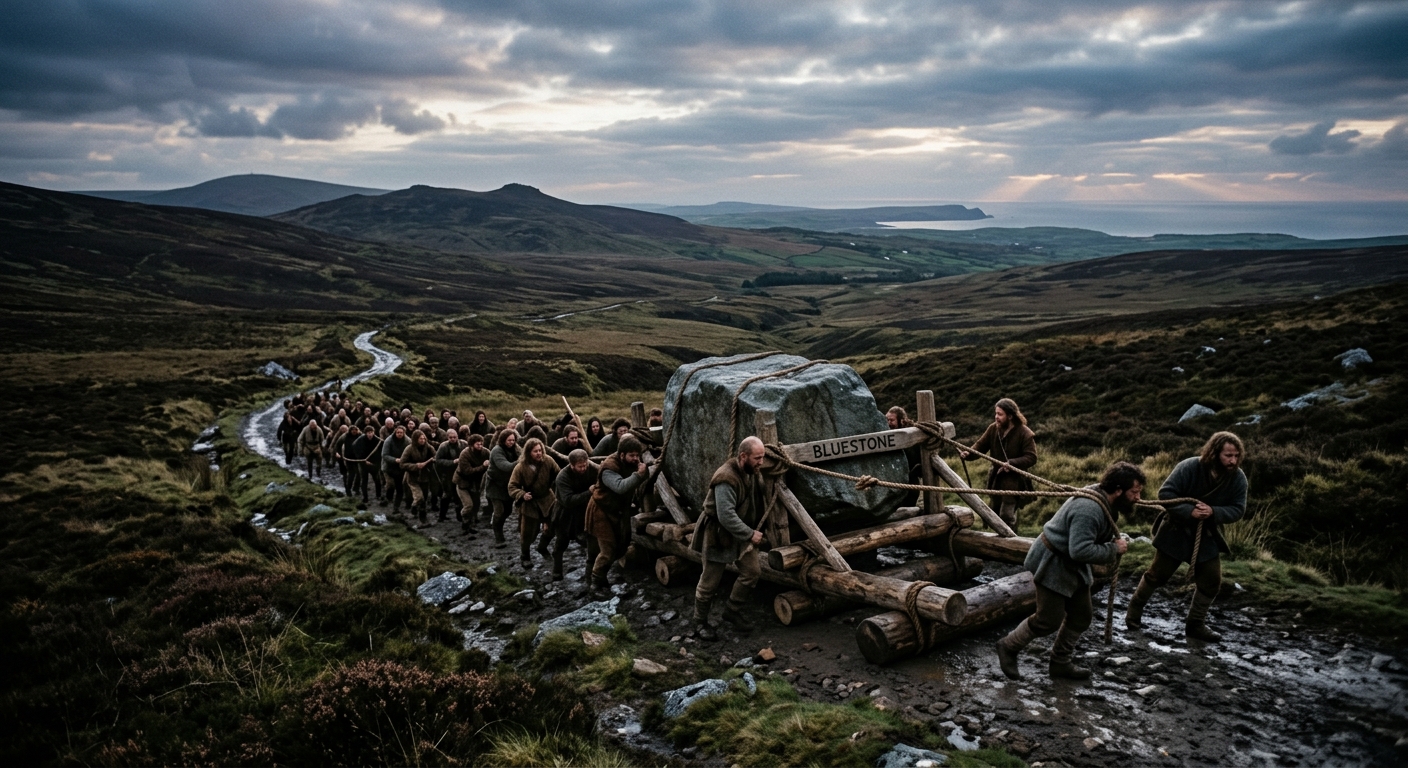
Standing silently on the windswept Salisbury Plain, Stonehenge represents one of humanity’s most perplexing engineering achievements. While most people marvel at the iconic stone circle’s astronomical alignments and mysterious purpose, few realize the truly staggering feat of logistics that brought this monument into existence. The builders of Stonehenge didn’t just arrange massive stones in a circle; they transported approximately 80 colossal bluestones, each weighing up to 4 tons, across a distance of over 150 miles from the remote hills of Wales.
The Welsh Connection: Tracking Stones Across Time
For decades, archaeologists suspected that Stonehenge’s distinctive bluestones originated somewhere in Wales, but pinpointing their exact source proved challenging. These smaller inner stones, which appear blue-gray when wet, stand in stark contrast to the massive sarsen stones that form the outer circle. Through meticulous geological analysis, researchers traced the bluestones to the Preseli Hills in Pembrokeshire, Wales, a rugged landscape of ancient volcanic rock formations.
The identification process involved comparing microscopic mineral compositions and crystal structures. Scientists discovered that different sections of the bluestone circle came from multiple quarries within a relatively small area of the Preseli Hills, suggesting that Stone Age people had intimate knowledge of the local geology and deliberately selected stones from various sources.
The Monumental Challenge of Moving Mountains
Transporting 80 stones weighing 4 tons each across 150 miles of challenging terrain represents an almost incomprehensible logistical undertaking for Neolithic people around 3000 BCE. To put this achievement in perspective, imagine moving a modern automobile without wheels, roads, or mechanical assistance, using only rope, wood, and human muscle power.
Recent archaeological discoveries have revealed evidence of actual quarrying sites in Wales, including Carn Goedog and Craig Rhos-y-felin. These locations show clear signs of systematic stone extraction, with artificial platforms and evidence of controlled splitting techniques. The quarries weren’t random extraction sites but carefully planned operations that required sophisticated understanding of rock formation and fracture patterns.
Decoding Ancient Transportation Methods
How did Neolithic people accomplish this seemingly impossible task? Archaeologists have proposed several transportation theories, each presenting unique challenges and ingenious solutions:
- Rolling on logs: Teams could have placed stones on wooden rollers, constantly moving logs from back to front as the stones advanced. This method would require enormous coordination and hundreds of people.
- Sledge systems: Wooden sledges pulled by large groups could have dragged stones across relatively flat terrain, though steep hills would present major obstacles.
- Water transport: Some researchers propose that builders used rivers and coastal waters, loading stones onto primitive boats or rafts for portions of the journey.
- Combined methods: The most likely scenario involves multiple transportation techniques adapted to different terrains along the route.
The Human Power Behind the Megaliths
Conservative estimates suggest that moving a single 4-ton bluestone would require at least 60 to 100 people working in coordinated teams. Multiplying this by 80 stones reveals the staggering scale of human organization required. This wasn’t a project that could be completed in a single season or by a small community.
The transportation project likely took place over several decades, requiring sustained cooperation between multiple tribal groups across a vast geographical area. Communities would need to provide food, shelter, and replacement workers for what amounted to the ancient world’s largest infrastructure project.
Engineering Without Engineers
Perhaps most remarkable is that these achievements occurred during the Neolithic period, before the invention of the wheel in Britain and long before the development of written language. The knowledge required for quarrying, transportation planning, and logistics was passed down through oral tradition and hands-on experience.
Evidence suggests that builders developed specialized tools for the project, including sophisticated rope systems, wooden levers, and precisely crafted stone hammers. Archaeological excavations have uncovered workshop areas where these tools were manufactured and maintained.
Why Transport Stones So Far?
The obvious question remains: why go to such extraordinary lengths when suitable stones existed much closer to Stonehenge? The answer likely combines practical and spiritual considerations that reveal the complex worldview of Neolithic peoples.
Recent acoustic studies suggest that Preseli bluestones possess unique sound properties. When struck, many produce clear, bell-like tones that vary depending on the specific rock composition. Some researchers theorize that Stonehenge functioned partly as a massive musical instrument, with the Welsh stones chosen specifically for their acoustic qualities.
Cultural and religious significance probably played an equally important role. The Preseli Hills were clearly a sacred landscape for Neolithic peoples, containing numerous stone circles, burial chambers, and ritual sites. Transporting stones from this holy mountain range to Stonehenge may have been essential for transferring spiritual power or ancestral connections to the new monument.
Legacy of the Impossible Builders
The bluestone transportation project represents far more than an impressive feat of ancient engineering. It demonstrates the sophisticated social organization, technical knowledge, and unwavering determination of our Neolithic ancestors. These Stone Age people possessed the vision to conceive an unprecedented project and the skills to execute it across multiple generations.
Modern reconstruction experiments have confirmed that the transportation methods proposed by archaeologists are theoretically possible, though they require extraordinary levels of coordination and effort. When volunteers attempt to move replica stones using primitive techniques, they gain profound appreciation for the achievement of the original builders.
Today, as we marvel at Stonehenge’s enigmatic stone circle, we’re witnessing the result of one of humanity’s earliest mega-projects. Those Welsh bluestones standing in perfect formation represent triumph over seemingly impossible odds, achieved through collective human will, ingenuity, and determination that continues to inspire us 5,000 years later.





ok so this is absolutely wild but i cant help thinking about how parasites pull off similarly impossible feats of manipulation – like seriously, the coordination required here reminds me of how toxoplasma makes rats lose their fear response so they get eaten by cats, except the parasite is basically “programming” the rat’s behavior across its whole lifespan. humans had to organize hundreds of people for decades but some single-celled organism just rewires a mammals entire survival instinct, no meetings required. anyway the megaliths are genuinely impressive and im not trying to diminish that, i just think parasites deserve way more credit for their own engineering achievements and nobody ever talks about them
Log in or register to replyThis is a fascinating post, and I appreciate Sylvia’s point about the soil systems beneath those stones – that’s exactly the kind of long-term ecological thinking we need more of. What strikes me about these megaliths is how they’ve become these stable features that have shaped their landscapes for millennia, kind of like how a restored wetland creates structure that amphibians then depend on for generations. I’ve been monitoring frog populations around some ancient earthworks in our region for about two decades now, and the vernal pools that form in the depressions around them support some incredibly diverse breeding communities. Makes you wonder what unexpected ecological relationships those Stonehenge stones created over the centuries, beyond just the engineering marvel of moving
Log in or register to replyhonestly this is such a cool comparison, and it totally tracks with what fascinates me about coordination in nature – though i’d argue the real invisible engineering miracle happening right under those megaliths is the soil organisms that made those landscapes traversable in the first place! like, the mycorrhizal networks connecting plants across wales probably did more logistical heavy lifting than we give them credit for, binding soil structure so all those workers didn’t sink into mud. the humbler builders, if you will.
Log in or register to reply