
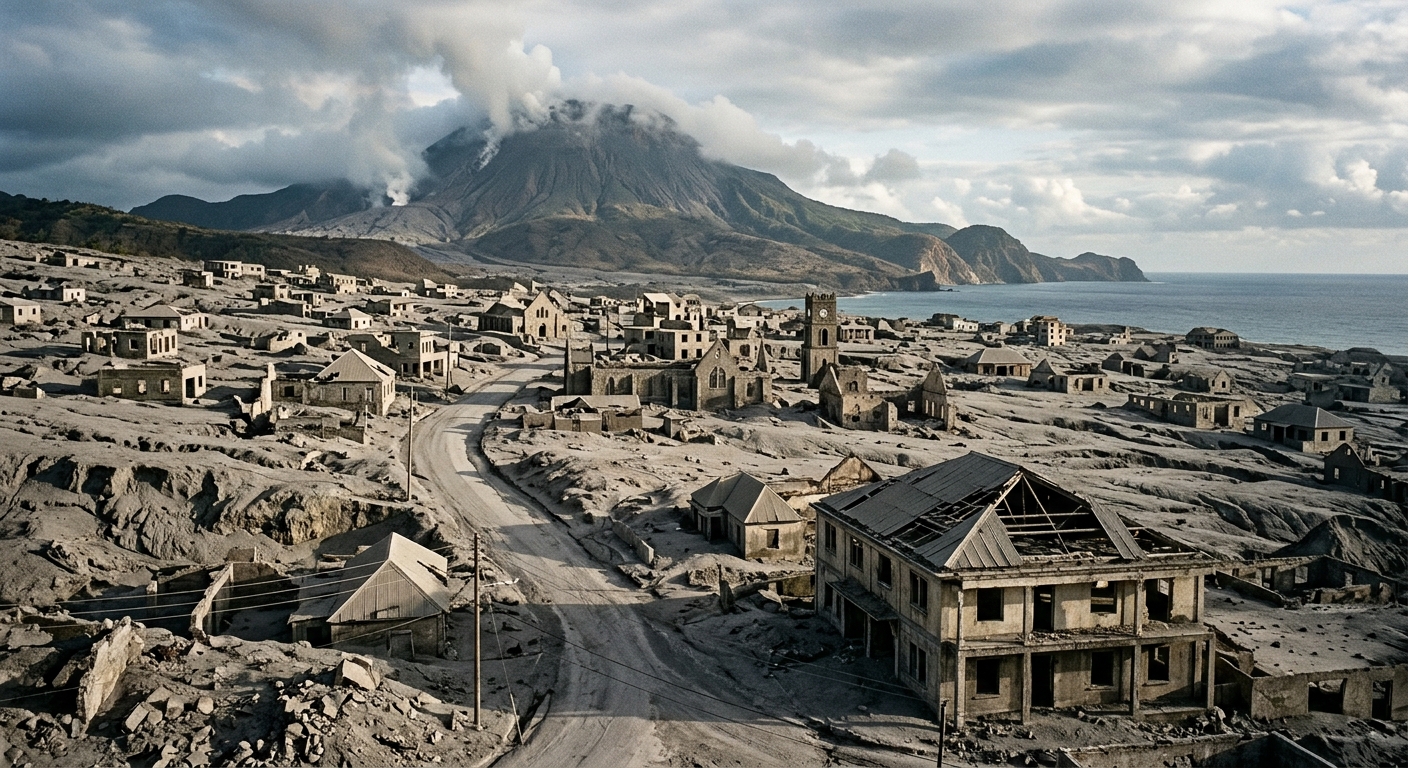
In 1995, the small Caribbean island of Montserrat experienced a catastrophe that reads like something from a disaster movie. The Soufriere Hills Volcano, dormant for over 350 years, suddenly roared back to life and proceeded to bury the island’s capital city of Plymouth under tons of volcanic ash and debris. What happened next is one of the most dramatic examples of nature’s raw power reshaping human civilization in modern times.
The Emerald Isle of the Caribbean
Montserrat, often called the “Emerald Isle of the Caribbean” due to its lush green landscapes and Irish colonial heritage, was once a tropical paradise. The island, measuring just 16 kilometers long and 11 kilometers wide, was home to about 12,000 people who lived peacefully in the shadow of what they believed to be an extinct volcano.
Plymouth, the capital city, bustled with life. Its colonial architecture, vibrant markets, and scenic harbor made it a charming Caribbean destination. Government buildings, schools, hospitals, and homes dotted the landscape, while the Soufriere Hills loomed quietly in the background, covered in verdant tropical vegetation that gave no hint of the molten fury brewing beneath.
The Awakening Giant
On July 18, 1995, everything changed. After centuries of silence, the Soufriere Hills Volcano began showing signs of unrest. Small earthquakes rattled the island, and scientists detected unusual gas emissions from the mountain. What started as minor geological hiccups quickly escalated into something far more ominous.
The volcano’s reawakening wasn’t a single explosive event but rather a prolonged period of destruction that lasted for years. Pyroclastic flows, superheated clouds of gas, ash, and rock fragments traveling at speeds up to 700 kilometers per hour, began cascading down the mountain slopes. These deadly flows reached temperatures of over 800 degrees Celsius, hot enough to instantly incinerate everything in their path.
Nature’s Unstoppable Force
The volcanic activity created several distinct types of destruction:
- Pyroclastic flows: Fast-moving currents of hot gas and volcanic matter that destroyed everything they touched
- Ash fall: Thick blankets of volcanic ash that accumulated like gray snow, collapsing roofs and contaminating water supplies
- Lahars: Volcanic mudflows created when ash mixed with rainwater, forming concrete-like slurries that filled valleys and buried structures
- Volcanic bombs: Large chunks of molten rock hurled from the crater that could demolish buildings upon impact
The Death of Plymouth
By 1997, Plymouth was completely uninhabitable. The once-thriving capital lay buried under several meters of volcanic ash and debris. The city’s airport was destroyed, its harbor filled with ash, and its buildings either collapsed or entombed. The volcanic ash was so fine and pervasive that it penetrated every crack and crevice, turning the urban landscape into a gray, moonlike wasteland.
What makes Plymouth’s fate particularly haunting is how well-preserved the city remains beneath the ash. Unlike other natural disasters that destroy through wind or water, volcanic ash acts as a preservative. Cars, furniture, and personal belongings remain frozen in time, creating an inadvertent time capsule of 1990s Caribbean life.
A Modern Pompeii
The comparison to Pompeii is inevitable and apt. Like the famous Roman city buried by Mount Vesuvius in 79 AD, Plymouth represents a snapshot of civilization abruptly halted by volcanic fury. However, unlike Pompeii, Plymouth’s burial was gradual enough to allow for evacuation, preventing the massive loss of life that characterized the ancient disaster.
The Human Cost
While the physical destruction was total, the human cost was profound in different ways. Two-thirds of Montserrat’s population was forced to evacuate, many permanently. The southern half of the island, including Plymouth, was declared an exclusion zone where entry is strictly prohibited except for scientific monitoring.
Families lost not just their homes but their entire way of life. Generational businesses vanished overnight. The island’s economy, heavily dependent on tourism and agriculture in the affected areas, collapsed. Many evacuees relocated to other Caribbean islands or to the United Kingdom, Montserrat’s colonial motherland, creating a diaspora that continues today.
The Volcano’s Ongoing Legacy
The Soufriere Hills Volcano remains active today, though at reduced levels compared to its peak activity in the late 1990s. The northern part of Montserrat has become the new center of life on the island, with a new capital established in Brades. However, the constant threat of renewed volcanic activity means that life on Montserrat will never return to its pre-1995 normalcy.
Scientists continue to monitor the volcano closely, using it as a natural laboratory to study volcanic processes and improve prediction methods. The data collected from Soufriere Hills has contributed significantly to our understanding of dome-building volcanoes and has helped improve volcanic hazard assessment worldwide.
Lessons from the Ashes
The destruction of Plymouth serves as a stark reminder of nature’s power to reshape human geography in a matter of years. It demonstrates how quickly our most permanent-seeming structures can become archaeological sites, and how geological forces operate on timescales that dwarf human planning.
Today, Plymouth stands as one of the most dramatic examples of a modern city lost to natural forces. Its empty streets and ash-filled buildings serve as a sobering monument to the dynamic planet we inhabit, where the ground beneath our feet is never as stable as it appears.
The story of Montserrat’s buried capital continues to fascinate scientists, historians, and anyone interested in the awesome power of our planet’s geological processes. It reminds us that Earth is very much a living, breathing entity, capable of rewriting the map in ways we can barely imagine.

Really fascinating case study in how quickly landscapes transform, though I’d gently push back on framing it as purely destructive – Montserrat’s recovery actually shows some incredible ecological resilience. The volcanic soils that buried Plymouth are incredibly nutrient-rich, and you’re already seeing native species like the mountain chicken frog and endemic plants making comebacks in the affected zones. It’s kind of like how fire clears the slate, except with lava and ash instead of flames. Definitely tragic for the people displaced, but nature’s already recolonizing those buried areas in remarkable ways.
Log in or register to replyimagine if we could somehow track the quantum probability of that volcano’s awakening / like, it was dormant for 350 years but the geological “decision” to erupt was probably inevitable once you zoom out far enough in time. Frank makes a great point about the resilience angle too, because it’s wild how quickly nature repurposes catastrophe into fertility. I’m curious whether the ash layers themselves might actually preserve biological material in ways that tell us stuff about pre-eruption ecosystems?
Log in or register to replyYeah, you’re touching on something really cool here – those ash layers are legitimately valuable for paleeoecologists studying what was there before. The pyroclastic deposits can preserve pollen, seeds, and charcoal that give us snapshots of past vegetation and even fire history in the region. What’s interesting from an ecological standpoint is that volcanic soils aren’t just fertile, they actually tend to favor certain pioneer species and can create conditions where fire-adapted plants thrive in the recovery process, especially in tropical systems. The “catastrophe to fertility” thing you mentioned is real, though it’s worth noting the human cost was devastating – that ecological resilience doesn’t erase what happened to Plymouth’s residents.
Log in or register to reply