
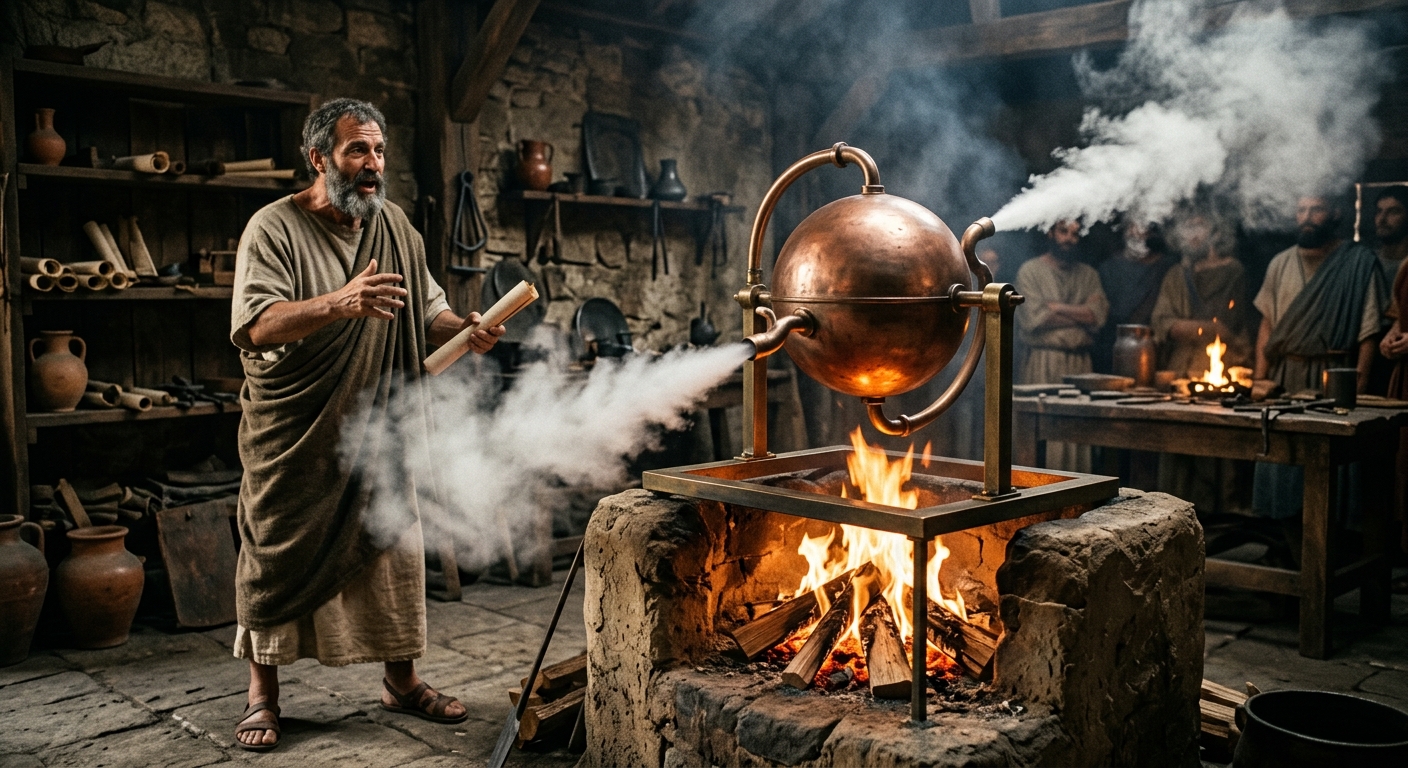
While most people associate steam engines with the Industrial Revolution of the 18th century, a remarkable device created in ancient Alexandria proves that humans came tantalizingly close to harnessing steam power over 1,600 years earlier. The aeolipile, invented by Hero of Alexandria around 100 BC, was a fully functional steam engine that could have changed the course of human history.
The Genius Behind the Invention
Hero of Alexandria, also known as Heron, was a brilliant Greek mathematician, engineer, and inventor living in Roman Egypt. His workshop in the famous Library of Alexandria became a hub of technological innovation, where he created dozens of mechanical marvels that seemed almost magical to ancient observers.
The aeolipile, whose name derives from the Greek words “aiolos” (quick-moving) and “pile” (gate), represented the pinnacle of Hero’s engineering prowess. This wasn’t just a theoretical concept or crude prototype, it was a working machine that demonstrated the fundamental principles that would later power the Industrial Revolution.
How the Ancient Steam Engine Actually Worked
The aeolipile’s design was elegantly simple yet remarkably sophisticated. The device consisted of:
- A sealed bronze or brass sphere mounted on a pivot
- Two curved tubes extending from opposite sides of the sphere
- A water-filled boiler positioned beneath the sphere
- A fire source to heat the water
When water in the boiler was heated, steam would travel through pipes into the sphere. The pressurized steam would then escape through the curved tubes, creating a reactive force that caused the entire sphere to spin rapidly. Some accounts describe the device rotating at speeds of up to 1,500 revolutions per minute, producing an eerie whistling sound that amazed spectators.
The Physics That Made It Possible
The aeolipile operated on the same jet propulsion principles that power modern rockets. As steam escaped from the curved nozzles, it created an equal and opposite reaction force, spinning the sphere according to Newton’s third law of motion (which wouldn’t be formally described for another 1,800 years).
This ancient machine successfully converted thermal energy into mechanical motion, demonstrating a complete understanding of thermodynamics millennia before these scientific principles were formally established.
A Missed Opportunity That Changed Nothing
Perhaps the most mind-boggling aspect of the aeolipile isn’t its existence, but what didn’t happen afterward. Despite creating a working steam engine, ancient Greek and Roman civilizations never developed it into practical applications that could have revolutionized transportation, manufacturing, or agriculture.
Several factors contributed to this missed historical opportunity:
- Abundant slave labor: The Roman economy relied heavily on human labor, reducing incentives to develop labor-saving machinery
- Limited metallurgy: Ancient metalworking techniques couldn’t produce the high-quality steel needed for efficient boilers and pressure vessels
- Fuel scarcity: Deforestation around Mediterranean cities made fuel expensive and difficult to obtain
- Social attitudes: Manual labor was considered beneath the dignity of educated citizens, leading to a disconnect between theoretical knowledge and practical application
Other Remarkable Inventions from Hero’s Workshop
The aeolipile wasn’t Hero’s only groundbreaking creation. His workshop produced an entire catalog of devices that wouldn’t be reinvented for centuries:
The World’s First Vending Machine
Hero created a coin-operated device that dispensed holy water in temples. When a coin was inserted, it would trigger a mechanism that released a measured amount of water, preventing theft and ensuring fair distribution.
Automatic Temple Doors
Using a combination of fire, water, and counterweights, Hero designed temple doors that would mysteriously open when priests lit the altar fire. Hidden chambers beneath the altar would heat and expand air, creating pressure that operated the door mechanism through a complex system of ropes and pulleys.
Programmable Robots
Hero constructed wheeled carts that could follow predetermined paths using a system of pegs, string, and weights. These ancient “robots” could navigate complex routes and even perform simple tasks, representing some of humanity’s earliest attempts at automation.
Why the Aeolipile Matters Today
The existence of Hero’s steam engine forces us to reconsider our assumptions about technological progress. Innovation doesn’t always follow a linear path, and breakthrough discoveries can lie dormant for centuries before their true potential is realized.
Modern reconstructions of the aeolipile confirm that Hero’s design was not only functional but remarkably efficient for its time. Engineers estimate that with modest improvements in materials and design, ancient Greeks could have developed practical steam-powered machines.
This raises fascinating questions about alternative historical timelines. What if the Roman Empire had embraced steam power? Could the Industrial Revolution have begun in ancient Alexandria instead of 18th-century Britain? How might human civilization have developed with an extra millennium and a half of mechanical advancement?
The Legacy of Ancient Innovation
While Hero’s aeolipile remained largely a curiosity in its own time, it represents a crucial link in the long chain of human technological development. The device proves that ancient minds were capable of the same innovative leaps that we celebrate in modern inventors.
Today, as we stand on the brink of new technological revolutions in artificial intelligence, renewable energy, and space exploration, Hero’s story serves as both inspiration and warning. It reminds us that breakthrough innovations require not just brilliant minds, but also the right economic, social, and cultural conditions to flourish.
The aeolipile stands as a testament to human ingenuity and a tantalizing glimpse of what might have been, had the ancient world been ready to embrace the power of steam.






This is fascinating stuff, though I gotta say it makes me think about how different ecological and social systems need the right conditions to actually take off, kind of like how wolves needed that specific moment in Yellowstone to actually reshape the landscape. The aeolipile is wild, but maybe the ancient world just didn’t have the economic pressure or resource availability that 1700s Europe did to push steam tech forward? Either way, it’s a cool reminder that innovation isn’t always about who gets there first.
Log in or register to replyOh man, I love where your head’s at with this! You’re basically describing what we call ecological readiness or niche availability, right? The aeolipile is such a perfect museum exhibit example of why invention alone isn’t enough, the same way you can introduce a predator to an ecosystem but if the prey populations aren’t stable or the habitat isn’t connected properly, nothing clicks into gear. Hero had the tech but ancient Rome lacked the resource pressures and industrial need that would later make steam engines actually *necessary* instead of just impressive curiosities, kind of like how beavers transform landscapes but only where conditions align. Really makes you think about how wonder and capability are only half the equation.
Log in or register to replyok this is a wild read but now im genuinely curious – do you think the greeks just didnt have the resource pressure that forced innovation the way the industrial revolution did? like, i get why it didnt take off back then but im wondering if its less about the tech itself and more about whether their society actually needed to solve the problems steam power would solve. kind of reminds me of how predator populations in the serengeti explode or crash depending on prey availability, its not that theyre less capable hunters, its just whether the ecosystem can support it
Log in or register to reply