
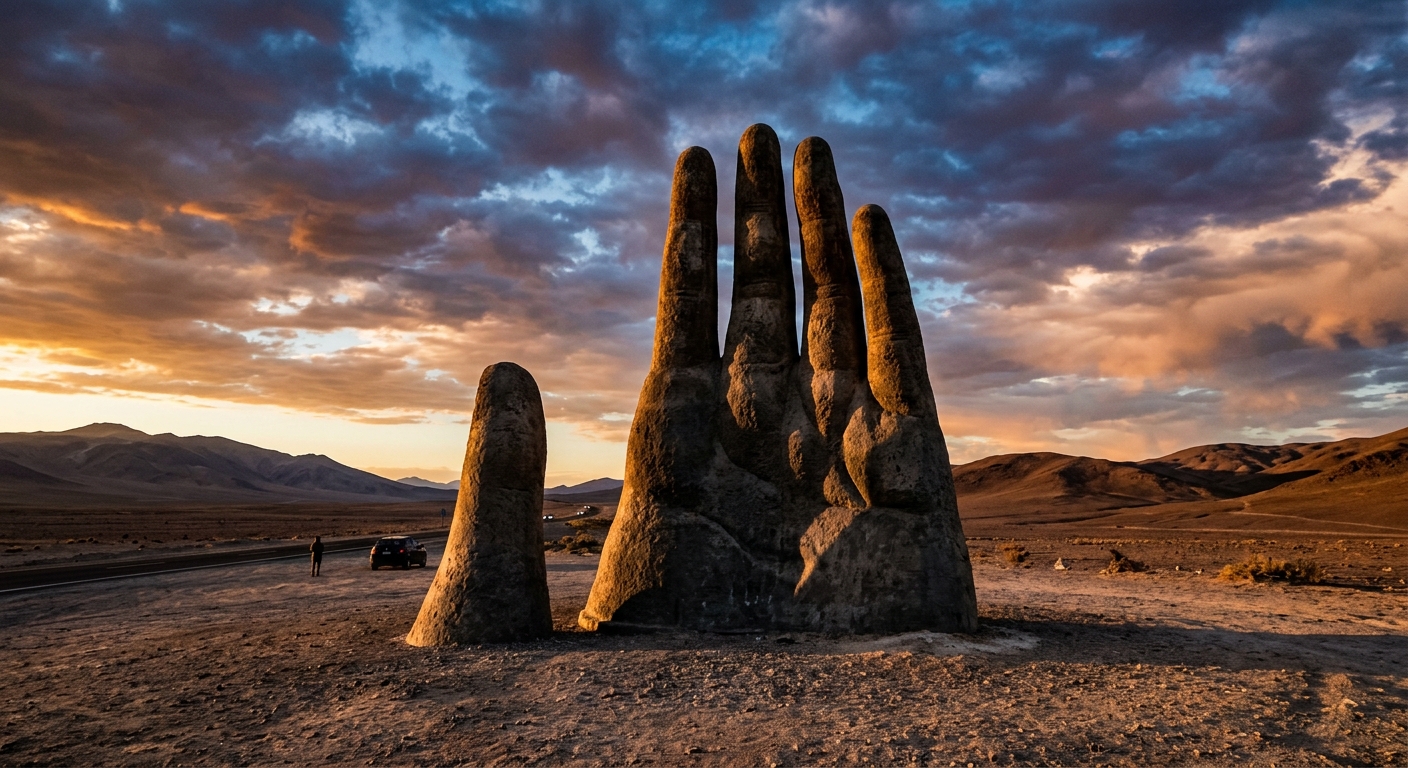
In the vast expanse of Chile’s Atacama Desert, where silence reigns and the horizon stretches endlessly, an enormous concrete hand bursts from the sand dunes like something from a fever dream. This isn’t the result of some ancient burial or geological phenomenon, but rather one of the most striking and unsettling art installations ever created.
The Hand That Stopped the World
Standing 36 feet tall and constructed entirely of concrete and iron, the “Mano del Desierto” (Hand of the Desert) has been greeting bewildered travelers since 1992. Created by Chilean sculptor Mario Irarrázabal, this monumental hand appears to be desperately clawing its way out of the earth, its fingers stretched toward the sky in what seems like a final plea for help.
Located approximately 46 miles south of the city of Antofagasta along the Panamericana Highway, the sculpture sits at an elevation of over 3,600 feet above sea level. The positioning is no accident: Irarrázabal specifically chose this remote location to emphasize the vulnerability and isolation of human beings when faced with the immensity of nature.
More Than Meets the Eye: The Deeper Meaning
While many visitors assume the hand represents someone drowning in sand, the true symbolism runs much deeper. According to Irarrázabal himself, the sculpture represents:
- Human vulnerability in the face of nature’s power
- The injustice and suffering experienced throughout human history
- A monument to the victims of torture and oppression
- The isolation felt by individuals in the modern world
The timing of its creation is particularly significant. Completed just two years after Chile’s return to democracy following the brutal Pinochet dictatorship, the Hand of the Desert serves as a powerful reminder of the nation’s dark past and the countless victims who seemed to disappear into the country’s vast landscapes.
The Artist Behind the Vision
Mario Irarrázabal, born in 1940, has made a career of creating oversized hand sculptures that challenge viewers’ perceptions. His works can be found in various locations around the world, but none have achieved the fame and mystique of the Atacama installation. The artist has consistently used the human hand as a symbol because of its universal recognition and emotional resonance.
Surviving in the World’s Harshest Desert
The Atacama Desert presents unique challenges for any permanent installation. Known as the driest non-polar desert on Earth, this region receives less than 0.04 inches of rainfall per year. Some weather stations in the Atacama have never recorded precipitation at all. The extreme conditions include:
- Temperature fluctuations from scorching days to freezing nights
- Intense UV radiation due to high altitude and thin atmosphere
- Powerful winds that can sandblast exposed surfaces
- Complete absence of vegetation for hundreds of miles
Despite these harsh conditions, the Hand of the Desert has remained remarkably intact for over three decades. The sculpture’s concrete construction and strategic positioning have allowed it to withstand the desert’s relentless assault.
A Magnet for the Curious and Conspiracy-Minded
Since its installation, the sculpture has attracted visitors from around the globe, many of whom stumble upon it unexpectedly while traveling the Panamericana Highway. The hand has become a popular stop for road trippers, photographers, and adventure seekers exploring Chile’s northern regions.
However, the sculpture has also attracted less welcome attention. Over the years, vandals have covered the hand with graffiti, forcing local authorities to clean and restore it multiple times. In 2010, the sculpture underwent a major restoration to remove accumulated damage and return it to its original stark appearance.
Internet Fame and Urban Legends
In the age of social media, the Hand of the Desert has taken on a life of its own online. Photographs of the sculpture regularly go viral, often accompanied by false stories about its origin. Some claim it’s an ancient artifact, others suggest it’s the result of a mysterious burial or even alien intervention.
The Science Behind the Setting
The Atacama Desert itself is almost as fascinating as the sculpture it hosts. This otherworldly landscape has been used by NASA to test Mars rovers because of its similarity to the Martian surface. The desert’s extreme dryness is caused by:
- Its location between two mountain ranges that block moisture
- The cold Humboldt Current offshore that prevents cloud formation
- High atmospheric pressure that suppresses precipitation
- The rain shadow effect from the Andes Mountains
Some areas of the Atacama are so devoid of life that scientists use them as analogs for studying potential life on other planets. The desert’s soil contains virtually no organic matter, making it one of the most sterile environments on Earth.
Visiting the Hand: A Pilgrimage to Nowhere
For those brave enough to venture into the Atacama, visiting the Hand of the Desert requires careful planning. The sculpture is accessible by car from the Panamericana Highway, but visitors should come prepared with plenty of water, sun protection, and emergency supplies. The nearest services are miles away, and cell phone coverage is spotty at best.
The best time to visit is during the Chilean winter months (June through August) when temperatures are more moderate. However, even then, visitors should be prepared for extreme temperature swings and the disorienting effects of the high altitude and intense solar radiation.
A Monument to Human Resilience
More than thirty years after its creation, the Hand of the Desert continues to provoke thought and emotion in all who encounter it. Whether viewed as a work of art, a political statement, or simply a bizarre roadside attraction, the sculpture serves as a powerful reminder of humanity’s capacity for both creation and destruction.
In a landscape where few living things can survive, this concrete hand stands as a testament to human creativity and the universal desire to leave a mark on the world. It challenges us to consider our place in the vastness of nature and to remember those who have been forgotten by history.
honestly the atacama is such an insane choice for a monument because it’s literally one of the places on earth most similar to mars, and there’s something almost haunting about how that hand reaches up from soil that’s so hostile to life – like it’s calling out across the cosmos itself. i’ve spent nights with my telescope pointed at the red planet wondering what’s out there, and then you realize we’ve basically built a desperate gesture toward the unknown right here in one of earth’s most alien landscapes, which kind of breaks my brain in the best way.
Log in or register to replyok so this is gonna sound random but i just learned that some animals in extreme desert environments like the atacama have these insane sleep adaptations, like certain species of scorpions and insects basically enter these hibernation states where theyre almost dormant for months. and now im thinking about this hand just reaching up from that hostile soil where literally nothing wants to sleep or rest there naturally, its just this monument refusing to give in to one of the harshest places on earth. also dont get me wrong the mars comparison is wild but what really gets me is imagining how unihemispheric sleep works – like one brain hemisphere stays alert while the other rests – and wondering if this sculpture is kind of like that? etern
Log in or register to replyoh this is so cool! i always love when art becomes its own kind of cryptid story, like people start making up folklore around it before they even know whats real lol. the atacama’s such an insane place that honestly a giant hand emerging from the ground feels like it *should* be hiding something ancient, even tho its just a sculpture. kinda like how people see a weird rock formation and suddenly theres a bigfoot legend – our brains are so desperate to tell stories about the landscape around us, you know?
Log in or register to reply