
When Ancient Meets Modern: The Shocking Discovery
In the dusty corridors of the Baghdad Museum, archaeologists made a discovery that would challenge everything we thought we knew about ancient technology. Small clay jars, barely six inches tall, contained copper cylinders and iron rods that bore an uncanny resemblance to modern electrical batteries. But these weren’t relics from the industrial age, they were crafted over 2,000 years ago, with evidence suggesting similar technology may have existed in ancient Egypt up to 4,000 years ago.
The implications were staggering: could ancient civilizations have harnessed electricity long before Benjamin Franklin’s famous kite experiment? And if so, what were they using this primitive electrical power for?
The Baghdad Battery: More Than Just Clay Pots
Discovered in 1936 by German archaeologist Wilhelm König, these mysterious artifacts consisted of:
- A terracotta jar approximately 5.5 inches high
- A copper cylinder fitted inside the jar
- An iron rod inserted through the copper cylinder
- Evidence of an acidic solution, likely vinegar or citric acid
- Bitumen (asphalt) sealing the top
When König first examined these objects, he noticed something remarkable: the iron rods showed signs of corrosion consistent with galvanic action, the same process that occurs in modern batteries. This wasn’t random deterioration, but the telltale signature of electrochemical reactions.
Testing the Ancient Technology
Modern researchers have recreated these ancient batteries using identical materials and methods. The results were astounding: these simple devices could generate between 0.8 to 2 volts of electricity. While that might seem insignificant by today’s standards, it’s more than enough power for electroplating, a process used to coat objects with thin layers of precious metals.
The Golden Connection: Electroplating in Ancient Egypt
The real mystery deepens when we examine ancient Egyptian artifacts. Archaeologists have long puzzled over the incredibly thin, even layers of gold found on various ceremonial objects, jewelry, and religious artifacts. Traditional fire-gilding techniques of the era typically produced thicker, more uneven coatings, yet Egyptian goldsmiths achieved results that mirror modern electroplating standards.
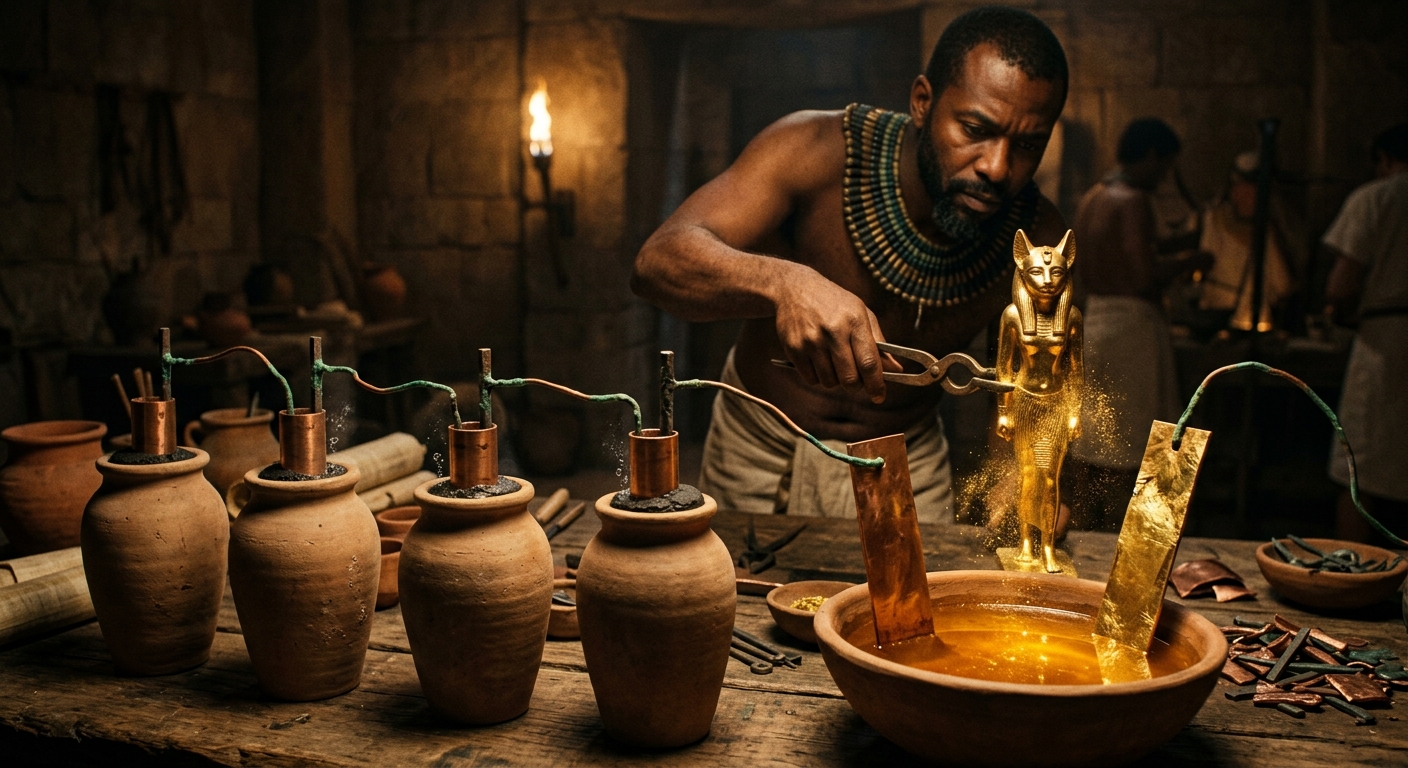
Dr. Arne Eggebrecht, a German Egyptologist, conducted groundbreaking experiments in the 1980s using reconstructed ancient batteries. His team successfully electroplated a small silver figurine with gold, achieving the same fine, uniform coating found on ancient Egyptian artifacts. The process required:
- A solution containing gold chloride
- The object to be plated (serving as the cathode)
- A gold electrode (serving as the anode)
- Electrical current from the ancient battery
Evidence Hidden in Plain Sight
Several clues support the electroplating theory:
- Uniform thickness: Many ancient Egyptian gold-plated objects show remarkably consistent coating thickness, difficult to achieve without electrical methods
- Sharp detail preservation: Electroplating preserves fine surface details better than mechanical gilding methods
- Chemical composition: Analysis of some ancient gold coatings reveals characteristics consistent with electrochemical deposition
- Tool markings: Some artifacts show no hammer marks or other signs of mechanical gold application
The Science Behind Ancient Electroplating
Understanding how this ancient technology worked requires diving into basic electrochemistry. When the Baghdad battery components are assembled with an electrolytic solution (like vinegar), a chemical reaction occurs:
The iron rod (anode) slowly dissolves, releasing electrons that travel through an external circuit to the copper cylinder (cathode). This electron flow constitutes an electrical current. In electroplating, the object to be coated becomes the cathode, attracting positively charged metal ions from the plating solution.
The Materials Were Readily Available
What makes this theory particularly compelling is that ancient Egyptians had access to all necessary materials:
- Copper: Extensively mined and worked in Egypt
- Iron: Available from meteorites and later, smelting
- Acidic solutions: Vinegar, citric acid from fruits, or even fermented beverages
- Gold salts: Could be created by dissolving gold in acidic solutions
- Clay vessels: Standard pottery technology
Skeptics and Alternative Theories
Not all archaeologists accept the electroplating theory. Skeptics argue that:
- No definitive battery artifacts have been found in Egyptian archaeological sites
- Alternative gilding methods could explain the uniform coatings
- The Baghdad batteries might have served different purposes, such as storing sacred scrolls
- Some proposed electroplated artifacts may have been created using mercury-gold amalgamation
However, proponents counter that organic battery components would have decomposed over millennia, leaving little trace. They also point out that ancient texts contain cryptic references to “divine fire” and mysterious lighting in temple ceremonies that darkness couldn’t extinguish.
Lost Knowledge and Modern Implications
If ancient Egyptians did master electroplating, it represents a fascinating example of lost technological knowledge. This wouldn’t be unique in history; the Romans perfected concrete recipes that weren’t matched until modern times, and Damascus steel techniques remained mysterious for centuries.
The implications extend beyond mere historical curiosity. Understanding how ancient peoples achieved sophisticated results with simple materials could inspire modern sustainable technologies. In an age of increasing electronic waste, perhaps there’s wisdom in rediscovering elegant, low-tech solutions.
The Broader Picture
This mystery fits into a larger pattern of underestimating ancient technological capabilities. From the Antikythera mechanism’s complex gearing to the acoustic properties of Mayan pyramids, archaeological discoveries continue revealing sophisticated understanding of physics, chemistry, and engineering in ancient civilizations.
The Enduring Mystery
Whether ancient Egyptians actually used electricity for electroplating remains one of archaeology’s most intriguing unsolved puzzles. The evidence is tantalizing but not conclusive, leaving room for ongoing debate and research.
What’s certain is that this mystery challenges our assumptions about technological progress. Perhaps innovation isn’t always linear, and perhaps our ancestors were more ingenious than we’ve given them credit for. In the golden artifacts of ancient Egypt, we might be seeing not just artistic mastery, but evidence of scientific knowledge that was lost to time, waiting millennia for rediscovery.






This is wild, but I’m curious about the environmental angle here – if they figured out electroplating that early, what were they using as electrolytes and how did they dispose of the chemical waste? I ask because modern electroplating is honestly one of the nastier industrial processes for water pollution, and it makes me wonder if ancient practices were somehow less damaging or if we’re just not finding the evidence of contamination. Either way, the ingenuity is mind-blowing and makes me think about how much ancient knowledge got lost.
Log in or register to replyThis is genuinely interesting, but I’m with Connie on wanting more environmental context – as someone who tracks long-term ecological shifts, I’m curious whether we have any sediment or soil chemistry records from Egyptian manufacturing sites that might show chemical signatures of repeated electroplating operations. Gregory’s point about the geological record is solid too, because even small-scale industrial processes tend to leave detectable traces in soil and water systems. The experimental reconstructions are cool proof-of-concept work, but scaling that up to explain artifact distribution would require evidence I haven’t seen yet.
Log in or register to replyYeah this is fascinating stuff, though I gotta say the geological record doesn’t really show evidence of large scale chemical waste problems from this period in the Nile valley, which makes me wonder if the scale was way smaller than modern operations or if the electrolytes used were pretty benign by comparison. The Nile’s sediment layers from that time are incredibly well preserved and we’d probably see some trace chemistry signature if there was significant disposal happening, so it makes you think they either figured out pretty clever recycling or just worked with whatever naturally occurring salts and organic solutions were lying around. Would love to know what those modern reconstructions are actually using as electrolytes, because that detail seems key to understanding whether this was more
Log in or register to reply