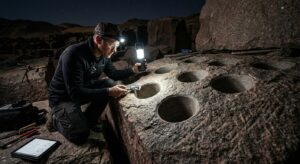
Hidden high in the Bolivian Andes, at an oxygen-starved altitude of 12,800 feet, lies one of archaeology’s most perplexing mysteries. The ancient site of Puma Punku contains massive stone blocks crafted with such incredible precision that they challenge everything we thought we knew about pre-Columbian engineering capabilities. These aren’t just roughly hewn stones, these are architectural marvels that would make today’s engineers envious.
The Impossible Precision of Ancient Bolivia
At Puma Punku, part of the larger Tiwanaku archaeological complex, massive H-shaped stone blocks weighing up to 130 tons each display a level of precision that seems almost supernatural. When archaeologists and engineers measured these blocks, they discovered something that shouldn’t be possible: the dimensions are identical down to the millimeter across multiple stones.
To put this in perspective, modern construction tolerances for precision stonework typically allow for variations of several millimeters. Yet these ancient Bolivian craftsmen, working over 1,000 years ago without power tools, metal instruments, or even the wheel, achieved tolerances that rival contemporary laser-cutting technology.
The Mathematical Marvel
The H-blocks at Puma Punku aren’t just precisely cut, they’re geometrically perfect. Each block features:
- Perfectly straight edges that show no deviation when measured with modern instruments
- Right angles that are exactly 90 degrees
- Smooth surfaces that appear polished to a mirror-like finish
- Complex interlocking systems that require no mortar
- Uniform dimensions that repeat across dozens of blocks with millimeter accuracy
The largest of these blocks measures approximately 7.81 meters long, 5.17 meters wide, and averages 1.07 meters thick. When researchers measured multiple blocks of the same “model,” they found virtually no variation in these dimensions, a feat that would be challenging even with today’s computer-controlled machinery.
The Engineering Enigma
The precision of Puma Punku’s construction raises fundamental questions about ancient capabilities. The site sits on the Altiplano, a high plateau where the thin air makes physical labor exponentially more difficult. Yet somehow, ancient engineers managed to quarry massive blocks of red sandstone and andesite from locations miles away, transport them to the site, and shape them with impossible accuracy.
Material Mysteries
The choice of materials adds another layer to the mystery. The builders selected two types of stone: red sandstone for the larger blocks and andesite for smaller, more intricate pieces. Andesite is an extremely hard volcanic rock that ranks 5.5 to 6 on the Mohs hardness scale, making it nearly as hard as steel.
Working andesite with the copper and bronze tools available to pre-Columbian civilizations should have been nearly impossible, yet the blocks show evidence of sophisticated cutting, drilling, and polishing techniques. Some blocks contain perfectly circular holes drilled completely through several feet of solid rock, while others feature complex stepped cuts and interlocking channels that required three-dimensional planning.
Theories and Explanations
The millimeter-perfect precision at Puma Punku has spawned numerous theories about how such accuracy was achieved. Mainstream archaeologists propose that the builders used sophisticated measuring systems, standardized tools, and possibly templates made from more workable materials like wood or clay.
The Master Template Theory
One leading hypothesis suggests that ancient engineers created master templates, possibly from wood, which they used to ensure consistency across all blocks of the same type. This would explain the identical dimensions but doesn’t address how they achieved such precision when carving the incredibly hard stone.
Advanced Tool Technology
Some researchers propose that the Tiwanaku civilization possessed more advanced tools than previously believed. Recent experiments have shown that copper tools alloyed with arsenic can achieve surprising hardness, potentially making precision stonework more feasible than once thought.
Modern Attempts at Replication
Contemporary stonemasons and engineers have attempted to replicate the precision of Puma Punku using both ancient and modern techniques. While modern power tools can achieve similar precision, attempts using only tools available to ancient civilizations have failed to match the millimeter-perfect accuracy found at the site.
These replication attempts have revealed just how extraordinary the achievement at Puma Punku truly was. Even with detailed knowledge of the final product and access to modern measuring instruments, craftsmen struggle to match the precision of blocks carved over a millennium ago.
The Broader Implications
The precision of Puma Punku’s H-blocks forces us to reconsider assumptions about ancient technological capabilities. This site represents just one example of sophisticated engineering that challenges the narrative of linear technological progress.
The identical millimeter-perfect dimensions suggest not just skilled craftsmanship, but systematic, standardized production methods that indicate a level of organization and technical knowledge that rivals modern construction practices. Whether achieved through lost techniques, advanced tools, or simply extraordinary skill and patience, Puma Punku stands as a testament to the remarkable capabilities of ancient engineers.
Today, as we struggle to understand how such precision was achieved without modern technology, Puma Punku reminds us that human ingenuity and determination can accomplish what seems impossible. The site continues to challenge our understanding of the past while inspiring questions about what other ancient achievements we have yet to fully comprehend.