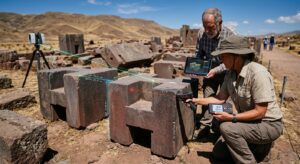
Deep in the basements of Egyptian museums and scattered across archaeological sites lie thousands of stone vessels that represent one of history’s most perplexing mysteries. These aren’t crude pottery or simple carved bowls. They are impossibly precise granite, diorite, and quartzite containers with paper-thin walls, perfect symmetry, and drilling tolerances that modern engineers struggle to achieve even with computer-controlled machinery.
The Impossible Precision of Ancient Craftsmanship
When archaeologists first examined these vessels using modern measuring equipment, they discovered something extraordinary. The walls of many containers varied by less than 2mm in thickness throughout the entire piece. Some vessels have necks so narrow that a human hand cannot fit through, yet the interior has been perfectly hollowed out into complex shapes including undercut areas that seem physically impossible to create.
The most mind-bending examples include vessels carved from a single piece of granite with interior chambers that are larger than the opening that provides access to them. Imagine carving a ship inside a bottle, except the bottle is made of one of the hardest stones on Earth, and the ship has multiple decks with perfectly smooth walls.
Materials That Challenge Ancient Tool Theory
The choice of materials makes these artifacts even more puzzling. Ancient Egyptian craftsmen didn’t work with soft limestone or sandstone for these vessels. Instead, they selected some of the hardest materials available:
- Granite: Rating 6-7 on the Mohs hardness scale
- Diorite: One of the most difficult stones to work with hand tools
- Quartzite: Harder than steel and extremely brittle
- Porphyry: A volcanic rock with embedded crystals that make uniform carving nearly impossible
To put this in perspective, these stones are so hard that even today’s diamond-tipped drill bits wear down quickly when working with them. Yet somehow, ancient craftsmen created vessels with walls so thin they’re translucent when held up to light.
Modern Attempts to Replicate Ancient Techniques
Several teams of engineers and archaeologists have attempted to recreate these vessels using both ancient and modern techniques. The results have been humbling for modern technology.
The Copper Tool Experiments
Traditional archaeology suggests these vessels were created using copper tools, sand as an abrasive, and tremendous patience. Experimental archaeologists have spent months attempting to hollow out granite using these methods. While they can eventually create a crude vessel, achieving the precision and complex internal geometries of the original artifacts remains impossible.
Dr. Christopher Dunn, a precision engineer, calculated that creating just one of these vessels using traditional methods would require over 600 hours of continuous work by a master craftsman. Even then, achieving the documented precision would be nearly impossible without modern measuring instruments.
Computer-Controlled Machinery Challenges
When modern engineers attempted to replicate these vessels using CNC (Computer Numerical Control) machines, they encountered unexpected difficulties. The combination of the stone’s hardness, brittleness, and the required precision pushed even advanced machinery to its limits.
Several attempts resulted in cracked vessels when the cutting tools generated too much heat or vibration. The ancient craftsmen somehow solved these problems without the benefit of computer modeling, advanced cooling systems, or vibration dampening technology.
The Mathematical Perfection Mystery
Perhaps the most intriguing aspect of these vessels is their mathematical precision. Laser scanning has revealed that many containers are perfectly symmetrical to within fractions of a millimeter. This level of accuracy requires not just skilled hands but also sophisticated measuring techniques.
Perfect Circles and Impossible Curves
The circular profiles of these vessels are geometrically perfect. Creating a perfect circle by hand, especially while working on the interior of a narrow-necked vessel, should be impossible without modern measuring tools. Yet thousands of these containers exhibit this precision.
Some vessels feature compound curves and complex interior shapes that would challenge modern CAD software to design, let alone ancient craftsmen to execute by hand.
Theories and Explanations
The precision of these artifacts has spawned numerous theories about ancient Egyptian capabilities and techniques.
The Lost Technology Theory
Some researchers propose that ancient Egyptians possessed advanced drilling and cutting technologies that were later lost to history. This theory suggests sophisticated knowledge of tool-making, possibly including early forms of mechanical drilling devices or advanced abrasive techniques.
The Master Craftsman Hypothesis
Another explanation focuses on the possibility that ancient Egyptian artisans developed techniques and skills that required lifetimes to master. These methods might have been closely guarded secrets passed down through generations of specialized craftsmen.
Acoustic Drilling Possibilities
Some engineers have proposed that ancient craftsmen might have discovered acoustic drilling techniques, using sound vibrations to break down stone with remarkable precision. While this remains speculative, certain frequencies can indeed fracture stone along predictable lines.
The Timeline That Doesn’t Add Up
Adding another layer to this mystery is the timeline. Many of these precisely crafted vessels predate the Great Pyramid of Giza. Some examples have been found in tombs dating to Egypt’s earliest dynasties, suggesting that this advanced stone-working technology existed over 4,500 years ago.
This timeline challenges our understanding of technological development. According to conventional history, the tools and techniques available to ancient Egyptians should not have been capable of producing such precision work.
The Questions That Remain
Today, thousands of these mysterious vessels sit in museum collections and storage facilities around the world. Each one represents a challenge to our understanding of ancient capabilities and technological development.
The fact that modern engineers, with all their advanced tools and computer-aided design systems, struggle to replicate these ancient artifacts suggests that we may have significantly underestimated the sophisticated knowledge and techniques available to our ancestors.
Whether through lost technologies, incredibly refined hand-crafting techniques, or methods we haven’t yet considered, ancient Egyptian stone workers achieved a level of precision that continues to baffle experts today. These stone vessels stand as silent testimony to human ingenuity and remind us that ancient civilizations may have possessed knowledge and capabilities that we’re only beginning to understand.