The Mystery Carved in Stone
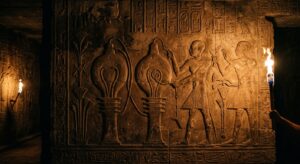
Deep within the Dendera Temple complex in Egypt, approximately 60 kilometers north of Luxor, lies one of archaeology’s most controversial enigmas. Carved into the stone walls of this ancient structure are reliefs that have sparked intense debate among historians, archaeologists, and alternative history enthusiasts for decades. These intricate carvings depict objects that bear an uncanny resemblance to modern electrical devices, particularly fluorescent light bulbs complete with filaments, power sources, and conducting cables.
The Dendera Temple, dedicated to Hathor, the goddess of music, dance, and fertility, was constructed during the Ptolemaic period, roughly between 54 and 20 BCE. While the temple itself is relatively young by Egyptian standards, the knowledge and symbolism it contains may represent traditions stretching back thousands of years into Egypt’s mysterious past.
What Exactly Do These Carvings Show?
The most famous relief, known as the “Dendera Light,” depicts several elongated, bulb-shaped objects that appear to be connected to a power source via snake-like cables. Inside these bulb-like structures, serpentine forms seem to emanate from small objects that remarkably resemble modern electrical filaments. The entire apparatus appears to be supported by djed pillars, ancient Egyptian symbols representing stability and the backbone of the god Osiris.
The technical details are surprisingly specific:
- Oval or elongated bulb-shaped containers
- Internal serpentine forms that could represent electrical discharge
- Cable-like connections leading to what appears to be a power source
- Supporting structures that mirror modern electrical installations
- Lotus flowers at the base, potentially representing electrical sockets
- Figures holding knife-like objects that could be interpreted as switches
The Conventional Archaeological Explanation
Mainstream Egyptology provides a very different interpretation of these enigmatic carvings. According to conventional archaeological wisdom, the reliefs represent purely mythological and religious symbolism that has been misinterpreted by modern observers eager to find advanced ancient technology.
In this traditional interpretation:
- The bulb-shaped objects represent the primordial mound of creation
- The serpents symbolize the emergence of life and divine energy
- The djed pillars are religious symbols, not electrical supports
- The “cables” are lotus stems, representing rebirth and creation
- The entire scene depicts the creation myth and the daily rebirth of the sun god Ra
Dr. Aidan Dodson, an Egyptologist at the University of Bristol, emphasizes that “every element of these carvings has clear precedent in Egyptian religious iconography and mythology. There is no need to invoke anachronistic technological explanations when the religious context provides perfectly adequate meaning.”
The Alternative Theory: Ancient Electrical Technology
However, a growing number of researchers and engineers have proposed a radically different interpretation. Proponents of the “ancient technology” theory argue that the similarities to modern electrical devices are too specific and numerous to be mere coincidence.
Engineer and author Christopher Dunn has analyzed the reliefs from a technical perspective and notes several compelling parallels to electrical systems. The proportions of the “bulbs,” the positioning of internal elements, and the apparent power distribution network all suggest a sophisticated understanding of electrical principles.
Supporting Evidence
Advocates for the electrical interpretation point to several intriguing factors:
- The precision and technical detail of the carvings suggest direct observation rather than symbolic representation
- Ancient Egyptian texts mention “divine light” that could be controlled and directed
- The Baghdad Battery and other artifacts suggest ancient knowledge of electrical principles
- The absence of soot in many Egyptian underground chambers despite the need for illumination
- References in ancient texts to light that “never dimmed” and could be “awakened” by priests
Scientific Analysis and Modern Experiments
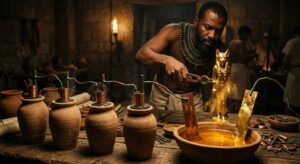
In an attempt to test the electrical theory, several researchers have constructed working models based on the Dendera reliefs. Most notably, electrical engineer Walter Garn successfully created a functioning plasma discharge tube using only materials and techniques available to ancient Egyptians.
Garn’s experiments demonstrated that it was theoretically possible to create primitive electrical lighting using:
- Copper conductors wrapped in insulating materials
- Electrolyte solutions as power sources
- Evacuated containers as primitive bulbs
- Static electricity generators based on friction
While these experiments prove the theoretical possibility of ancient electrical devices, they do not constitute proof that such technology actually existed in ancient Egypt.
The Broader Implications
If the electrical interpretation of the Dendera carvings is correct, it would fundamentally challenge our understanding of ancient civilizations and technological development. It would suggest that advanced knowledge was either developed independently in ancient times or inherited from an even earlier, more sophisticated civilization.
This possibility raises profound questions about the linear progression of human technology and the potential for lost knowledge throughout history. It also opens discussions about the relationship between science and spirituality in ancient cultures, where technological achievements might have been interpreted through religious frameworks.
The Ongoing Debate
Despite decades of study and debate, the true meaning of the Dendera carvings remains unresolved. The archaeological establishment maintains its traditional interpretation, while a growing number of alternative researchers continue to find compelling evidence for ancient electrical technology.
What makes this mystery particularly fascinating is that both interpretations require us to reconsider our assumptions, either about the sophistication of ancient symbolic thinking or about the technological capabilities of our ancestors. Whether divine light or electric light, the Dendera reliefs represent a remarkable achievement in human creativity and knowledge.
The debate continues to evolve as new analytical techniques and archaeological discoveries shed additional light on this enduring enigma, ensuring that the mystery of Dendera will continue to captivate and challenge our understanding of the ancient world for years to come.