
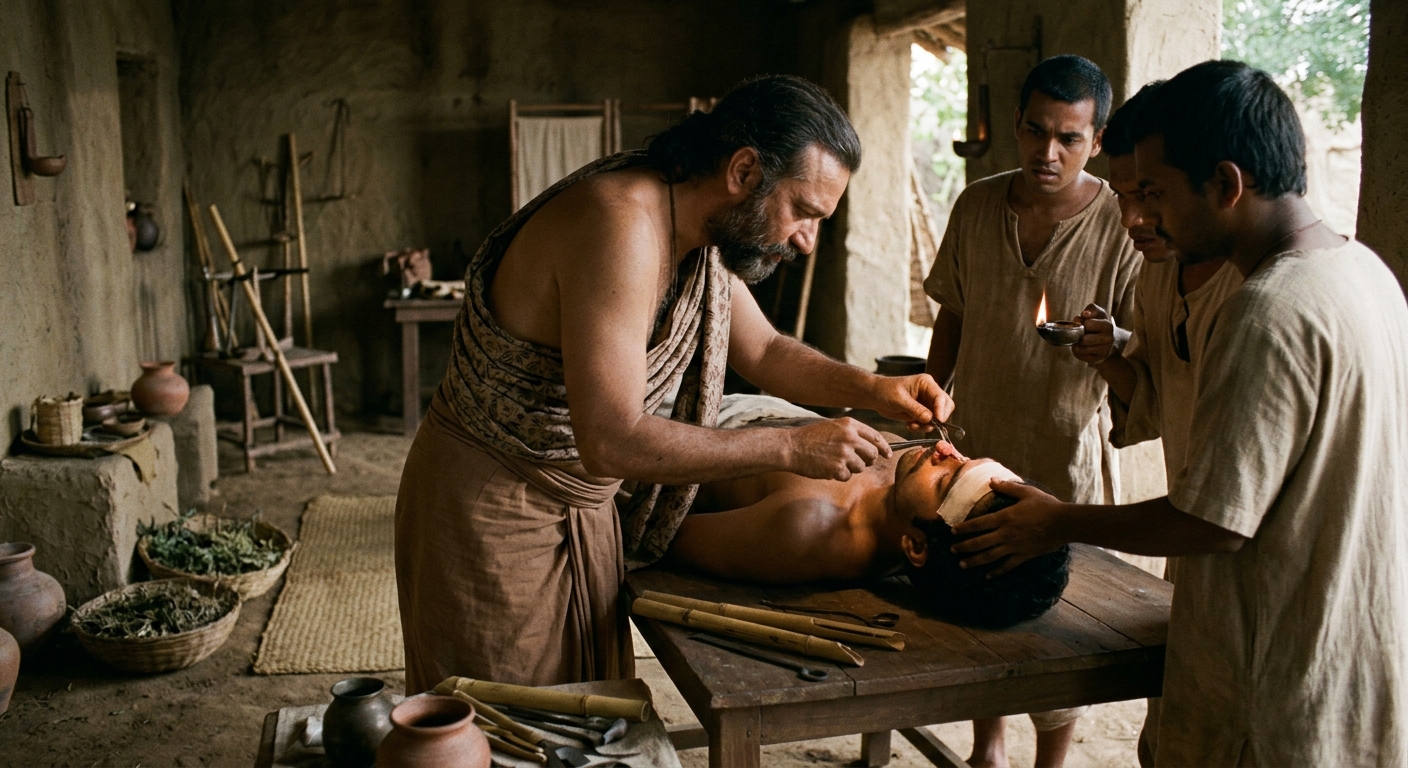
When you think of plastic surgery, images of modern operating rooms with gleaming instruments and advanced anesthetics probably come to mind. But what if I told you that skilled surgeons were performing complex nose reconstructions over 2,600 years ago, using techniques so sophisticated that they influenced modern surgical practices?
Welcome to the remarkable world of ancient Indian medicine, where the art of rhinoplasty was not just practiced but perfected centuries before Western civilization even began documenting basic surgical procedures.
The Father of Plastic Surgery You’ve Never Heard Of
Around 600 BCE, while much of the world was still struggling with basic wound treatment, an Indian physician named Sushruta was revolutionizing surgery. His comprehensive medical text, the Sushruta Samhita, described over 300 surgical procedures and catalogued more than 120 surgical instruments. Among these groundbreaking techniques was a detailed method for reconstructing noses that would make modern plastic surgeons nod in approval.
Sushruta didn’t just dabble in nose reconstruction, he mastered it. His texts describe step-by-step procedures that are remarkably similar to techniques used today, complete with guidelines for patient preparation, surgical methodology, and post-operative care.
Why Ancient India Needed Nose Surgery
The prevalence of rhinoplasty in ancient India wasn’t driven by cosmetic desires. Instead, it arose from a harsh reality of justice and warfare in the ancient world. Nose amputation was a common form of punishment for crimes, particularly adultery. Warriors also frequently suffered nasal injuries in battle.
In a society where facial disfigurement carried enormous social stigma, the ability to reconstruct a nose wasn’t just medical innovation, it was social salvation. Sushruta and his contemporaries understood that their surgical skills could restore not just physical form, but human dignity and social standing.
The Ingenious Forehead Flap Technique
The centerpiece of ancient Indian rhinoplasty was the forehead flap technique, a procedure so elegant that it remains virtually unchanged in modern plastic surgery. Here’s how these ancient surgeons worked their magic:
- Measurement and Planning: Surgeons would measure the nasal defect using a leaf as a template
- Flap Creation: A corresponding piece of skin from the patient’s forehead would be carefully outlined
- Surgical Transfer: The forehead skin, still attached by a narrow bridge, would be rotated down to cover the nasal area
- Shaping and Suturing: The transferred tissue would be carefully shaped and sewn into place
- Healing Process: After several weeks, the connecting bridge would be cut, creating an independent nasal structure
What makes this technique truly remarkable is its sophistication. Ancient Indian surgeons understood principles of blood supply, tissue viability, and wound healing that Western medicine wouldn’t formally recognize for over two millennia.
Tools of the Ancient Trade
The surgical instruments described in the Sushruta Samhita read like an inventory from a modern operating room. Ancient Indian surgeons used:
- Sharp and blunt knives of various sizes
- Scissors and forceps
- Needles for suturing
- Probes and dilators
- Saws for bone work
- Specialized tools for different types of tissue
Many of these instruments were crafted with precision that rivals modern surgical tools. Archaeological findings have revealed ancient Indian surgical implements made from high-quality metals, designed with ergonomic considerations that demonstrate deep understanding of surgical technique.
Beyond the Nose: A Surgical Renaissance
While rhinoplasty might be the most famous achievement of ancient Indian surgery, it was just one jewel in a crown of medical innovations. Sushruta and his colleagues performed cataract surgery, kidney stone removal, and complex abdominal procedures. They developed techniques for treating fractures, understanding of anatomy that was centuries ahead of its time, and even performed early forms of brain surgery.
The Sushruta Samhita also describes surgical training methods that sound surprisingly modern. Students practiced on fruits and vegetables before working on cadavers, and were required to demonstrate proficiency with instruments before treating patients. This systematic approach to surgical education wouldn’t appear in Western medicine until the 19th century.
The Long Journey to Western Recognition
It wasn’t until British physicians working in India during the colonial period encountered these ancient techniques that Western medicine began to take notice. In 1794, British doctors witnessed Indian surgeons performing successful rhinoplasty procedures and documented them in European medical journals.
This sparked interest among European surgeons, leading to the development of what became known as the “Indian method” of rhinoplasty. Ironically, techniques that had been practiced in India for over two millennia were suddenly hailed as innovative advances in European medical circles.
Modern Legacy of Ancient Innovation
Today’s plastic surgeons still use variations of the forehead flap technique pioneered by Sushruta and his contemporaries. The fundamental principles remain unchanged: careful planning, understanding of tissue blood supply, and meticulous attention to healing processes.
Modern rhinoplasty has certainly benefited from advances in anesthesia, antiseptics, and surgical instruments, but the core methodology traces its roots directly back to ancient Indian operating chambers. When a modern plastic surgeon reconstructs a nose using a forehead flap, they’re employing a technique that has remained essentially unchanged for over 2,600 years.
A Testament to Human Ingenuity
The story of ancient Indian rhinoplasty serves as a powerful reminder that human ingenuity and medical innovation aren’t modern inventions. Thousands of years ago, skilled physicians were solving complex surgical problems with limited tools but unlimited creativity and determination.
These ancient surgeons didn’t have the benefit of modern technology, but they possessed something equally valuable: careful observation, systematic thinking, and the courage to push the boundaries of what was thought possible. Their legacy lives on every time a modern surgeon restores form and function to a damaged nose, proving that some innovations are truly timeless.
The next time you hear about cutting-edge plastic surgery, remember that the foundations were laid not in gleaming modern hospitals, but in ancient India, where visionary physicians were already performing miracles with steady hands and brilliant minds over two and a half millennia ago.





This is fascinating stuff, and it really reminds me how human ingenuity works across cultures and time periods. What strikes me most is how this surgical innovation emerged in ancient India during a period when the subcontinent had already experienced multiple cycles of monsoon-driven erosion and landscape transformation – basically, societies were thriving on geologically young alluvial plains formed by the Indus and Ganges river systems, which probably fostered the kind of dense urban development and specialized knowledge that made advanced medicine possible. The fact that this technique remained essentially unchanged for 2,600 years is pretty incredible, and it makes you wonder what other ancient practices we’ve overlooked just because they came from cultures outside the Western narrative.
Log in or register to replyThis is such a cool reminder that ecological knowledge and innovation aren’t new either, you know? Makes me think about all the sophisticated land management practices indigenous cultures developed over millennia that we’re only now “rediscovering” in urban ecology. Ancient Indian surgeons understood anatomy and precision the way native peoples understood how to cultivate and restore ecosystems, yet we treat so much of that accumulated wisdom like it’s brand new science. Really makes you wonder what we could learn if we approached other cultures’ practices with that same respect and curiosity.
Log in or register to replyThis is a great reminder that sophisticated observation and problem-solving flourish wherever humans have deeply studied their world, and honestly it makes me think about cave ecosystems in a similar way / indigenous peoples navigated underground spaces for thousands of years and likely understood cave biology way better than we do now, yet we’re only starting to map these systems and study the incredible adaptations of troglobites like eyeless fish and albino salamanders. The precision required for ancient rhinoplasty surgery probably came from that same careful attention to detail that survival in caves demands.
Log in or register to reply