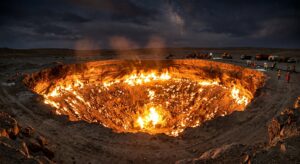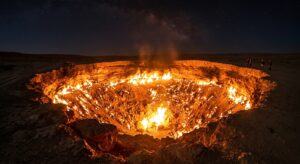
In the heart of the Karakum Desert in Turkmenistan lies one of Earth’s most mesmerizing and terrifying spectacles – a fiery crater that has been burning continuously for over five decades. Known locally as the “Door to Hell” or “Gates of Hell,” this 230-foot-wide pit of eternal flames represents one of the most dramatic examples of human error creating an otherworldly phenomenon.
The Birth of an Accidental Inferno
The story begins in 1971 when Soviet engineers were conducting routine natural gas exploration in the vast Karakum Desert. What started as a standard drilling operation quickly turned into an environmental disaster when the ground beneath their equipment suddenly collapsed, creating a massive crater approximately 70 meters wide and 20 meters deep.
The collapse wasn’t just a structural failure – it unleashed something far more dangerous. The crater began spewing enormous quantities of methane gas into the atmosphere, creating a potentially lethal situation for anyone in the vicinity and an environmental hazard that could affect the entire region.
Faced with this unexpected crisis, the Soviet engineers made a decision that seemed logical at the time but would have consequences lasting decades: they decided to burn off the escaping methane gas, believing it would be consumed within days or weeks. They lit the crater on fire, expecting the flames to quickly exhaust the gas supply and solve their problem.
They were spectacularly wrong.
The Science Behind the Eternal Flame
The reason the Darvaza gas crater continues to burn after all these years lies in the geology beneath the Karakum Desert. The area sits atop one of the world’s largest natural gas reserves, with an underground network of gas pockets and caverns that seems virtually inexhaustible.
Understanding the Gas Composition
The flames are primarily fueled by:
- Methane (CH4): The primary component, burning with the characteristic blue flames visible at night
- Ethane and propane: Heavier hydrocarbons that contribute to the fire’s intensity
- Hydrogen sulfide: Responsible for the sulfurous smell that permeates the area
- Carbon dioxide: A byproduct of combustion that creates some of the crater’s dramatic visual effects
The continuous supply of these gases from deep underground reservoirs ensures that the fire never lacks fuel. Geological surveys suggest that the gas field extends far beyond the crater itself, with interconnected chambers and fissures that may stretch for kilometers beneath the surface.
A Tourist Attraction Born from Disaster
What began as an industrial accident has transformed into one of Central Asia’s most unique tourist destinations. The stark contrast between the barren desert landscape and the roaring flames creates an almost alien atmosphere that draws thousands of visitors annually.
The Visual Spectacle
During daylight hours, the crater appears as a brown, scarred pit in the earth with shimmering heat waves rising from its depths. But as darkness falls, the true magic reveals itself. The entire crater illuminates with dancing flames of various colors – brilliant oranges and yellows dominate, while blue flames flicker around the edges where methane burns most purely.
The sound is equally impressive: a constant roar reminiscent of a massive blowtorch, punctuated by occasional pops and hisses as different gas pockets ignite. The heat is intense enough to be felt from hundreds of feet away, creating updrafts that can affect local weather patterns.
Environmental and Economic Impact
While the Door to Hell has become a symbol of Turkmenistan and a source of tourism revenue, it represents a significant environmental concern. The crater continuously releases carbon dioxide and other greenhouse gases into the atmosphere, contributing to climate change on a scale that’s difficult to quantify.
The Waste of Natural Resources
From an economic perspective, the burning crater represents an enormous waste of valuable natural gas. Experts estimate that millions of cubic meters of gas have been consumed over the decades – enough to heat entire cities or generate substantial export revenue for Turkmenistan’s economy.
The Turkmen government has occasionally announced plans to extinguish the flames and properly cap the crater, but these efforts have repeatedly failed or been abandoned due to technical challenges and the surprising complexity of the underground gas network.
Attempts to Tame the Beast
Over the years, various attempts have been made to extinguish the flames or harness the escaping gas for productive use. In 2010, President Gurbanguly Berdimuhamedow ordered experts to find ways to put out the fire, citing both environmental concerns and the waste of natural resources.
However, extinguishing the crater has proven far more challenging than anyone anticipated. The underground gas network is so extensive and complex that simply capping the visible crater might only redirect the gas to emerge elsewhere, potentially creating new craters or dangerous gas accumulations.
Engineering Challenges
The extreme heat, toxic gases, and unstable ground conditions make any intervention extremely dangerous. The crater’s edges continue to erode slowly, and the intense flames make it impossible for workers to approach close enough for conventional capping operations.
Some engineers have proposed flooding the crater with sand or concrete, while others suggest drilling relief wells to redirect the gas flow. However, each solution carries significant risks and costs, with no guarantee of success.
Cultural Impact and Local Legends
The dramatic appearance of the burning crater has inevitably spawned local folklore and cultural significance. The name “Door to Hell” reflects not just the visual similarity to popular depictions of hellfire, but also the way the phenomenon has captured the imagination of local populations and international visitors alike.
For many visitors, standing at the edge of the crater at night provides an almost spiritual experience – a direct encounter with the raw power of Earth’s geological processes and an unexpected reminder of humanity’s ability to unleash forces beyond our control.
The Future of the Door to Hell
As Turkmenistan continues to develop its economy and address environmental concerns, the fate of the Darvaza gas crater remains uncertain. While it continues to attract tourists and international attention, the ongoing waste of natural resources and environmental impact ensure that pressure to find a solution will persist.
Whether the flames will continue burning for another 50 years or finally be extinguished through human intervention remains one of the many mysteries surrounding this extraordinary geological phenomenon. Until then, the Door to Hell stands as a testament to both the awesome power of Earth’s hidden forces and the unintended consequences of human industrial activity.
This burning crater serves as a powerful reminder that our planet still holds surprises that can humble even our most advanced engineering capabilities – a 230-foot-wide lesson in respecting the forces that lie beneath our feet.