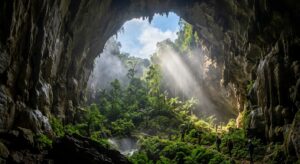
Deep beneath the bustling city of Guilin in southern China lies one of the most spectacular natural wonders on Earth: a subterranean cathedral that has been sculpting itself for an almost incomprehensible 180 million years. Known as the Reed Flute Cave, this underground marvel earned its poetic name from the melodious reeds that once grew abundantly outside its entrance, reeds that local artisans fashioned into beautiful flutes.
But the real music happens inside, where water, time, and stone have collaborated to create a symphony in limestone that defies imagination.
A Journey Through Deep Time
To truly grasp the magnitude of Reed Flute Cave’s age, consider this: when the first limestone formations began taking shape here, dinosaurs hadn’t even evolved yet. The Triassic Period was just beginning, and life on Earth was recovering from the greatest mass extinction in planetary history. For perspective, humans have only existed for about 300,000 years, making these formations roughly 600 times older than our entire species.
The cave system extends approximately 240 meters through a limestone hill, but every centimeter of its interior tells a story written in stone over millions of millennia. The limestone itself formed from ancient sea beds, compressed and transformed over geological time scales that challenge human comprehension.
Nature’s Master Sculptor at Work
The Reed Flute Cave showcases nature’s most patient artistry through the slow, methodical process of speleogenesis. Over tens of millions of years, slightly acidic groundwater seeped through cracks in the limestone bedrock, gradually dissolving the rock and carving out vast chambers and winding passages.
Stalactites and Stalagmites: The Cave’s Crown Jewels
As water continued its relentless work, it began depositing minerals in stunning formations that seem almost too perfect to be natural:
- Stalactites hang from the ceiling like stone icicles, formed as mineral-rich water drips leave behind tiny deposits of calcium carbonate
- Stalagmites grow upward from the floor where those same drips accumulate over thousands of years
- Flowstone creates curtain-like sheets where water flows along the cave walls
- Cave pearls form in pools where water movement causes minerals to accumulate in perfect spheres
What makes these formations particularly mesmerizing is their incredible diversity. Some stalactites resemble massive organ pipes, while others look like frozen waterfalls or ancient temple pillars. The creative names given to various formations, such as “Crystal Palace,” “Dragon Pagoda,” and “Virgin Forest,” barely capture their otherworldly beauty.
The Palace of Natural Arts
Reed Flute Cave has been known to locals for over 1,200 years, with ancient inscriptions dating back to 792 CE found on its walls. These historical visitors described it as the “Palace of Natural Arts,” a name that has endured because it so perfectly captures the cave’s essence.
The main chamber soars to heights of 18 meters, creating a natural cathedral that dwarfs many human-made structures. Rock formations create natural balconies, archways, and alcoves that seem designed by some master architect, yet they’re entirely the product of natural processes operating across geological time.
A Living Laboratory
What many visitors don’t realize is that Reed Flute Cave is still very much alive and growing. The formations continue to evolve, with new mineral deposits added grain by grain with each passing day. In some areas, the growth rate can be measured: stalactites typically grow between 0.1 to 10 millimeters per year, meaning some of the larger formations took hundreds of thousands of years to reach their current size.
Modern Illumination of Ancient Beauty
While Reed Flute Cave has been known for over a millennium, it wasn’t until the 1960s that modern lighting systems transformed it into the spectacular tourist attraction it is today. Carefully placed multicolored lights now illuminate the formations, creating an almost supernatural atmosphere that highlights every ridge, curve, and crystalline surface.
The lighting serves a dual purpose: it allows visitors to appreciate the incredible detail of the formations while also protecting the cave environment. The specific wavelengths and placement of lights are designed to minimize impact on the cave’s delicate ecosystem while maximizing the visual impact.
The Bigger Picture: Karst Landscapes
Reed Flute Cave sits within the broader Guilin karst landscape, one of the most spectacular examples of limestone terrain on Earth. This region features thousands of cone-shaped hills, underground rivers, and cave systems that have inspired Chinese artists and poets for centuries. The entire area represents one of the planet’s finest examples of tower karst topography, where limestone has been carved into dramatic peaks and valleys.
Climate and Preservation
The cave maintains a constant temperature of around 20°C (68°F) year-round, with humidity levels near 100%. These stable conditions have helped preserve not only the geological formations but also historical artifacts and inscriptions found within. This natural climate control system has been operating for millions of years, creating perfect conditions for both formation growth and preservation.
A Window into Earth’s Deep History
Perhaps the most mind-bending aspect of Reed Flute Cave is how it serves as a tangible connection to Earth’s deep past. Walking through its chambers is literally traveling through time, surrounded by formations that began growing when our planet was an almost alien world. The cave represents a continuous record of environmental change, with each layer of mineral deposition capturing conditions from different geological epochs.
Scientists study these formations to understand past climate conditions, groundwater patterns, and even seismic activity. The cave’s structures serve as natural archives, preserving information about Earth’s history in stone, drop by patient drop.
Reed Flute Cave stands as a testament to the incredible artistry that emerges when geological processes are given enough time to work their magic. In our fast-paced world, it offers a humbling reminder of the vast scales of time that govern our planet’s most spectacular creations.