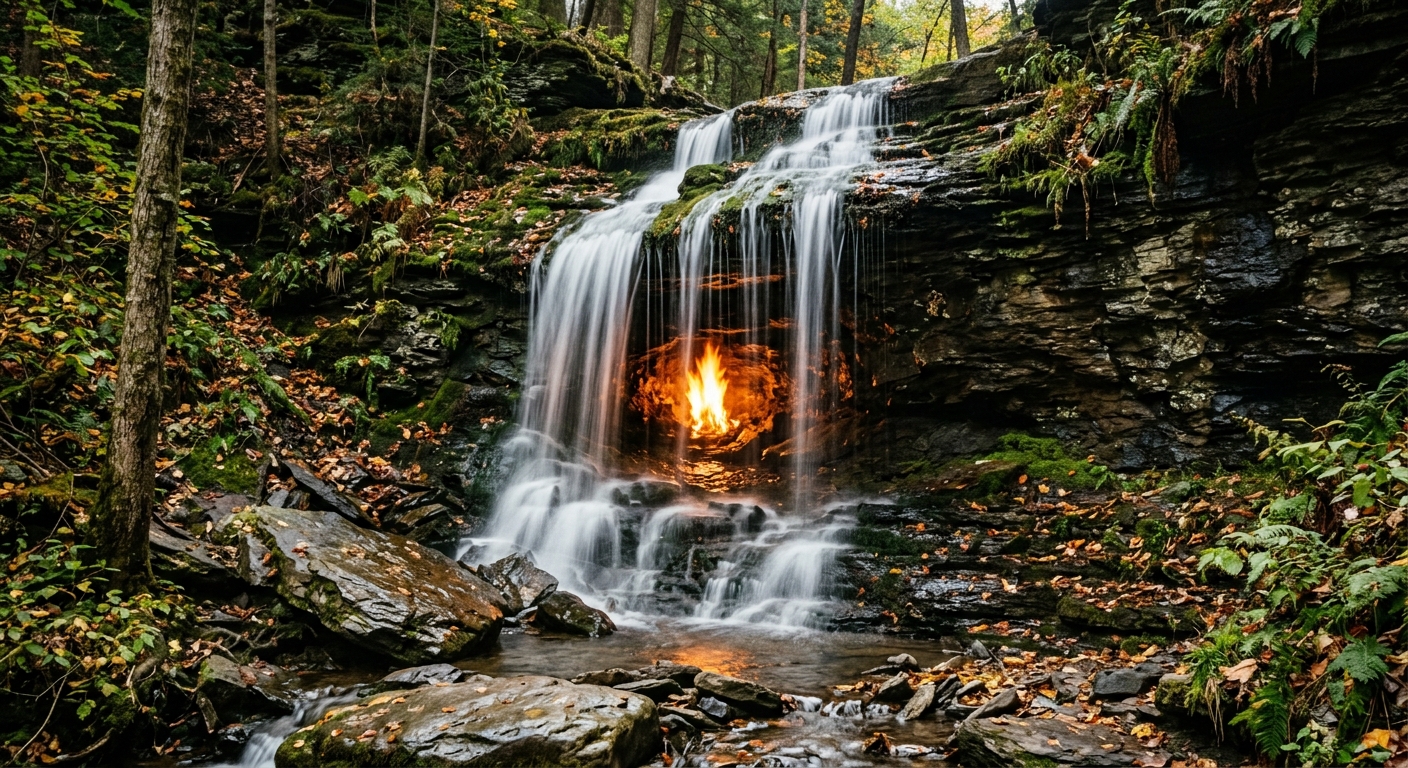
Deep in the forests of western New York, nature has created something that seems to defy the basic laws of physics. Behind a curtain of cascading water at Chestnut Ridge Park, a small but persistent flame dances in defiance of everything we think we know about fire and water. Welcome to Eternal Flame Falls, where the impossible becomes reality.
Where Fire and Water Coexist
Located in Orchard Park, just south of Buffalo, Eternal Flame Falls presents visitors with a spectacle that looks like something from a fantasy novel. The waterfall itself stands about 30 feet tall, tumbling down weathered shale rock formations. But what makes this natural wonder truly extraordinary is the small grotto behind the cascade, where a flame burns continuously, fed by natural gas seeping from the earth.
The flame typically measures about 4 to 8 inches tall, though its size can vary depending on gas flow and weather conditions. What makes this phenomenon so captivating is not just its existence, but its persistence. While the flame can occasionally be extinguished by heavy water flow or strong winds, it can be easily relit and often reignites naturally.
The Science Behind the Magic
The secret to Eternal Flame Falls lies deep beneath the surface, in geological processes that have been occurring for millions of years. The flame is fed by natural gas, primarily methane, that seeps through cracks in the underlying shale bedrock. This gas originates from organic matter that was buried and compressed over geological time, eventually breaking down into hydrocarbons.
What makes this location particularly special is the specific geological configuration that allows the gas to escape in just the right spot. The shale formations in western New York are part of the Marcellus Shale, a rock formation rich in natural gas that extends across much of the northeastern United States. However, natural gas seeps are relatively rare, and finding one positioned perfectly behind a waterfall is even more extraordinary.
The Perfect Storm of Geology
Several factors had to align perfectly to create this natural wonder:
- Gas-rich shale bedrock: The underlying Marcellus Shale contains abundant organic matter that has converted to natural gas over millions of years
- Fracture systems: Cracks in the rock allow the gas to migrate upward and escape to the surface
- Protective overhang: The rock formation creates a natural shelter that protects the flame from direct water contact
- Proper ventilation: The grotto provides enough airflow to sustain combustion while offering protection from the elements
A Flame That Predates Human History
While we cannot know exactly how long the flame has been burning, geological evidence suggests that gas has been seeping from this location for thousands of years. Indigenous peoples of the region, including the Seneca Nation, were likely aware of this natural phenomenon long before European settlers arrived. Many Native American cultures viewed such natural fires as sacred, considering them gifts from the spirits or manifestations of divine power.
The “eternal” nature of the flame is somewhat of a misnomer, as it can be extinguished and does require relighting from time to time. However, the continuous supply of natural gas means that the potential for fire exists perpetually, making it essentially eternal from a human perspective.
Not Quite Unique, But Still Extraordinary
Eternal Flame Falls is not the only natural gas seep that creates a persistent flame. Similar phenomena can be found in other parts of the world, including the famous “Door to Hell” in Turkmenistan and various eternal flames in locations like Turkey, Iraq, and Indonesia. However, the combination of a natural gas flame with a waterfall is exceptionally rare.
What sets Eternal Flame Falls apart is its accessibility and the striking visual contrast between the elements of fire and water. Most natural gas seeps occur in remote or inhospitable locations, making them difficult for the average person to visit and appreciate.
Recent Scientific Discoveries
In recent years, scientists have taken a closer look at Eternal Flame Falls, and their findings have been surprising. Research conducted by geologists from Indiana University revealed that the gas composition at the falls is unusual compared to other natural seeps in the region. The gas shows signs of being relatively young in geological terms and appears to be generated through different processes than typical natural gas deposits.
This discovery suggests that our understanding of how natural gas forms and migrates may be incomplete. The flame at Eternal Flame Falls is providing scientists with new insights into subsurface geological processes and the complex ways that organic matter can be converted into hydrocarbons.
Visiting the Natural Wonder
For those inspired to witness this geological marvel firsthand, Eternal Flame Falls is accessible via a moderate hiking trail in Chestnut Ridge Park. The hike is approximately 1.5 miles round trip and involves some scrambling over rocks and stream crossings. Visitors should be prepared for potentially muddy conditions and should bring a lighter or matches, as the flame may need to be relit if it has been recently extinguished.
The falls are most impressive during spring when snowmelt increases water flow, creating a more dramatic waterfall backdrop for the flame. However, higher water levels can also make it more challenging to access the grotto where the flame burns.
Conservation and Protection
As awareness of Eternal Flame Falls has grown, so too has visitation to this delicate natural area. Local park authorities and environmental groups emphasize the importance of protecting this unique ecosystem. Visitors are encouraged to follow Leave No Trace principles and to be respectful of the natural environment.
The continued existence of the flame depends on maintaining the delicate balance of geological conditions that allow gas to seep from the earth. Human activities that could disrupt subsurface gas flow or damage the rock formations pose potential threats to this natural wonder.
A Window into Earth’s Hidden Processes
Eternal Flame Falls serves as a remarkable reminder of the dynamic processes constantly occurring beneath our feet. This small flame, dancing behind its watery curtain, represents millions of years of geological history compressed into a single, visible phenomenon. It demonstrates how the Earth continues to surprise us, revealing hidden wonders in unexpected places and challenging our understanding of how natural systems work.
In our modern world of artificial lighting and controlled environments, encountering a truly natural flame fed by ancient gases provides a humbling connection to the deeper forces that shape our planet. Eternal Flame Falls stands as a testament to the incredible complexity and beauty of Earth’s geological systems, proving that sometimes the most extraordinary wonders are hidden in plain sight, waiting to be discovered by those curious enough to look.