Nature’s Deadliest Illusion: The Cobra Lily’s False Light Trap
Hidden in the boggy wetlands of Northern California and Oregon lurks one of nature’s most cunning predators. The Cobra Lily (Darlingtonia californica) doesn’t chase its prey or use venom to kill. Instead, it employs a far more sinister strategy: deception through architecture.
This carnivorous plant has evolved what scientists call “false windows” – translucent patches that create deadly optical illusions. Like a house of mirrors designed by a serial killer, the Cobra Lily’s interior becomes a maze of confusion where insects lose their way and ultimately their lives.
The Architecture of Death
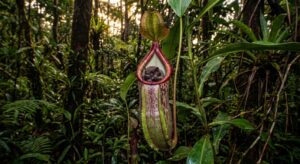
The Cobra Lily’s hunting mechanism begins with its distinctive hooded structure, which gives the plant its serpentine name. Rising from the bog like a coiled snake ready to strike, each pitcher can grow up to three feet tall. But the real genius lies in the details of its internal design.
The pitcher’s hood contains numerous translucent windows that allow light to filter through. To a flying insect, these windows appear to be exits – bright patches that promise escape to the outside world. However, these are elaborate fakes, evolutionary lies told in the language of light.
The Lure: Sweet Nectar and Fatal Attraction
The deadly dance begins when insects are attracted to the plant’s nectar, secreted around the pitcher’s rim. This nectar isn’t just food; it’s bait laced with a subtle narcotic that makes insects sluggish and less coordinated. As they feed, their movements become increasingly erratic.
The rim itself is treacherous – slippery and angled downward like a funnel. One wrong step, and the insect tumbles into the pitcher’s depths. But this is where the Cobra Lily’s true brilliance reveals itself.
Lost in a Labyrinth of Light
Once inside the pitcher, trapped insects face a psychological prison. The false windows create the illusion of multiple escape routes, but each bright patch leads nowhere. Insects exhaust themselves flying toward these phantom exits, burning precious energy in futile escape attempts.
Meanwhile, the real exit – the narrow opening at the top – remains hidden in shadow. The plant’s hood blocks direct light from above, making the true escape route nearly invisible to the panicked insects below.
The Downward-Pointing Hairs: A One-Way Street
Even if an insect manages to orient itself correctly, the pitcher’s walls are lined with thousands of downward-pointing hairs. These microscopic spears allow easy entry but make climbing out nearly impossible. It’s nature’s equivalent of a medieval dungeon trap.
The hairs serve another crucial function: they guide struggling insects deeper into the plant’s digestive zone. Each attempt to escape only pushes the victim further from freedom.
The Final Stage: Drowning and Digestion
At the bottom of the pitcher lies a pool of digestive fluid. Unlike other carnivorous plants that produce their own enzymes, the Cobra Lily takes a more collaborative approach. The fluid contains bacteria and insect larvae that help break down the drowned prey.
This aquatic graveyard is surprisingly complex. The fluid’s chemistry changes throughout the season, becoming more acidic as more prey accumulates. Some Cobra Lilies have been found with hundreds of insect carcasses in various stages of decomposition.
A Slow, Inevitable Death
Death in a Cobra Lily pitcher is neither quick nor merciful. Trapped insects may survive for hours or even days, slowly weakening as they exhaust themselves against the false windows. Some larger insects have been observed making dozens of escape attempts before finally succumbing to exhaustion and drowning.
Evolutionary Masterpiece
The Cobra Lily’s false window system represents millions of years of evolutionary refinement. This plant has solved the fundamental challenge faced by all carnivorous plants: how to capture mobile prey while remaining rooted in place.
Scientists believe the false window adaptation evolved specifically to exploit insects’ natural tendency to fly toward light sources when seeking escape routes. It’s a exploitation of insect psychology on a molecular level.
Why the Deception Works
Research has shown that the Cobra Lily’s success rate is remarkably high. Studies indicate that over 90% of insects that fall into the pitcher never escape. This efficiency rivals that of professional pest traps designed by humans.
The key lies in the plant’s ability to override insects’ navigation systems. Most flying insects use light patterns to orient themselves, and the false windows create a navigation nightmare that few can solve before their strength gives out.
A Bog Specialist’s Survival Strategy
The Cobra Lily’s carnivorous lifestyle isn’t just about being predatory – it’s about survival in one of Earth’s most nutrient-poor environments. Bogs are essentially aquatic deserts, where essential nutrients like nitrogen and phosphorus are extremely scarce.
By supplementing its diet with insect protein, the Cobra Lily can thrive in conditions that would starve most other plants. Each captured fly or beetle provides a concentrated dose of the nutrients that the bog soil lacks.
This remarkable plant proves that evolution can craft solutions stranger than any human imagination. In the quiet bogs of the Pacific Northwest, the Cobra Lily continues its ancient work – a living testament to nature’s capacity for beautiful, terrible innovation.