
Hidden in the mountains of Utah lies one of Earth’s most extraordinary secrets: a single living organism that weighs as much as 800 elephants and has been quietly growing for tens of thousands of years. Meet Pando, the trembling giant that masquerades as an entire forest but is actually one colossal tree.
The Forest That Isn’t a Forest
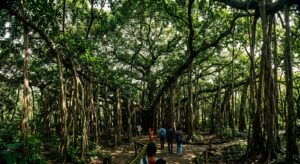
At first glance, Pando appears to be a typical aspen grove covering 106 acres in Utah’s Fishlake National Forest. Thousands of golden-leafed trees sway in the mountain breeze, their characteristic leaves creating the gentle trembling sound that gives quaking aspens their name. But beneath the soil lies an incredible truth: every single one of these 47,000 stems shares the same root system and identical DNA.
Pando, which means “I spread” in Latin, is what scientists call a clonal colony. Rather than reproducing through seeds like most trees, this ancient organism spreads by sending up new shoots from its massive underground root network. Each “tree” you see is actually more like a branch of one enormous plant that spans an area larger than 80 football fields.
Breaking the Scales: A 6-Million-Kilogram Giant
The sheer scale of Pando defies comprehension. With an estimated total weight of 6 million kilograms (13.2 million pounds), it holds the title as the heaviest known living organism on Earth. To put this in perspective:
- Pando weighs more than 30 blue whales combined
- It’s heavier than 800 African elephants
- The biomass equals approximately 1,000 cars
- It outweighs the largest known fungal networks by millions of kilograms
Most of this incredible mass exists underground in the form of an intricate root system that connects every visible stem. These roots can extend up to 30 meters from any given trunk, creating an underground web of life that has been growing continuously for millennia.
Ancient Beyond Imagination
While the individual stems of Pando live typical aspen lifespans of 100-150 years, the root system tells a different story entirely. Scientists estimate that this remarkable organism began its life somewhere between 9,000 and 80,000 years ago, with many researchers favoring an age of around 14,000 years.
This means Pando was already ancient when the pyramids were built. It was thriving during the last ice age and has witnessed the rise and fall of countless civilizations. The organism has survived ice ages, volcanic eruptions, fires, droughts, and dramatic climate shifts that would have killed any ordinary tree.
The Secret to Immortality
Pando’s longevity stems from its unique reproductive strategy. While individual stems may die from disease, fire, or old age, the root system remains protected underground. When stems are damaged or destroyed, the roots simply send up new shoots to replace them. This process of constant renewal has allowed the organism to achieve a form of biological immortality.
The root system can survive extreme conditions that would kill surface vegetation. It can remain dormant during harsh winters, droughts, or other environmental stresses, then burst back to life when conditions improve. This resilience has enabled Pando to persist through dramatic environmental changes that have eliminated countless other species.
A Living Laboratory
Scientists consider Pando a natural laboratory for understanding plant biology, genetics, and ecology. Since every stem shares identical DNA, researchers can study how environmental factors influence gene expression across different parts of the colony. Stems growing in shadier areas develop differently than those in full sunlight, despite having the same genetic code.
The grove also provides crucial insights into forest ecology and fire management. Aspens are considered a keystone species, supporting diverse wildlife communities. Pando’s massive size makes it home to numerous bird species, small mammals, and insects that depend on aspen habitat.
Facing Modern Threats
Despite surviving for millennia, Pando now faces unprecedented challenges. Scientists have observed concerning signs of decline in recent decades:
- Reduced regeneration of new stems
- Increased mortality of existing trunks
- Browsing pressure from deer and elk
- Competition from conifer species
- Climate change impacts
The lack of natural fires, which historically cleared competing vegetation and stimulated new growth, has allowed other tree species to invade Pando’s territory. Additionally, heavy browsing by ungulates prevents new shoots from maturing, slowly starving the root system of energy.
Conservation Efforts
Recognizing the urgent need for protection, scientists and land managers have implemented several conservation strategies. Fencing protects portions of the grove from browsing animals, allowing new stems to establish. Selective removal of competing conifers helps maintain the open conditions aspens prefer. Researchers also monitor the grove’s health through regular surveys and environmental assessments.
More Than Just a Tree
Pando represents something profound about life on Earth: the incredible diversity of forms that evolution can produce. This single organism challenges our basic concepts of individuality and shows how life finds extraordinary ways to persist and thrive. It reminds us that some of our planet’s most remarkable inhabitants might be hiding in plain sight, masquerading as something ordinary while harboring extraordinary secrets.
The next time you see a grove of quaking aspens, take a moment to consider what might lie beneath. You might be looking at one of Earth’s most ancient and magnificent life forms, a living giant that has been quietly growing since before recorded history began.

This is a cool comparison, but I’d gently push back on the superorganism angle here – Pando’s root network is more like a continuous vascular system than an ant colony’s chemical signaling infrastructure. The real wild part for me is how clonal plants sidestep senescence entirely, which opens up fascinating questions about whether toxins and defenses get “tired” over millennia the way they might in individuals. I wonder if Pando’s chemical ecology has evolved differently precisely because it doesn’t face the same constraints as organisms with generation turnover.
Log in or register to replyokay this is actually insane because pando is basically the mycelial network equivalent of a superorganism, like its literally doing what a massive ant colony does but at a completely different scale, everything connected through underground infrastructure working as one unified biomass. the fact that its been growing for 80k years without becoming sterile is wild – its got way better colony management than most species honestly
Log in or register to replyomg aaron youre so right, its like nature found the ultimate cheat code for immortality!! david attenborough actually did this amazing segment on clonal colonies and watching pando described as basically this underground empire really puts it in perspective – like all those “trees” are just the fruiting bodies of one massive organism spreading across utah lol. have you ever looked into how it responds to disturbances, like does the whole clone feel it when part of it gets damaged or does each ramete kinda do its own thing? ngl id love to know how the resource distribution works through all those root connections tbh
Log in or register to reply