
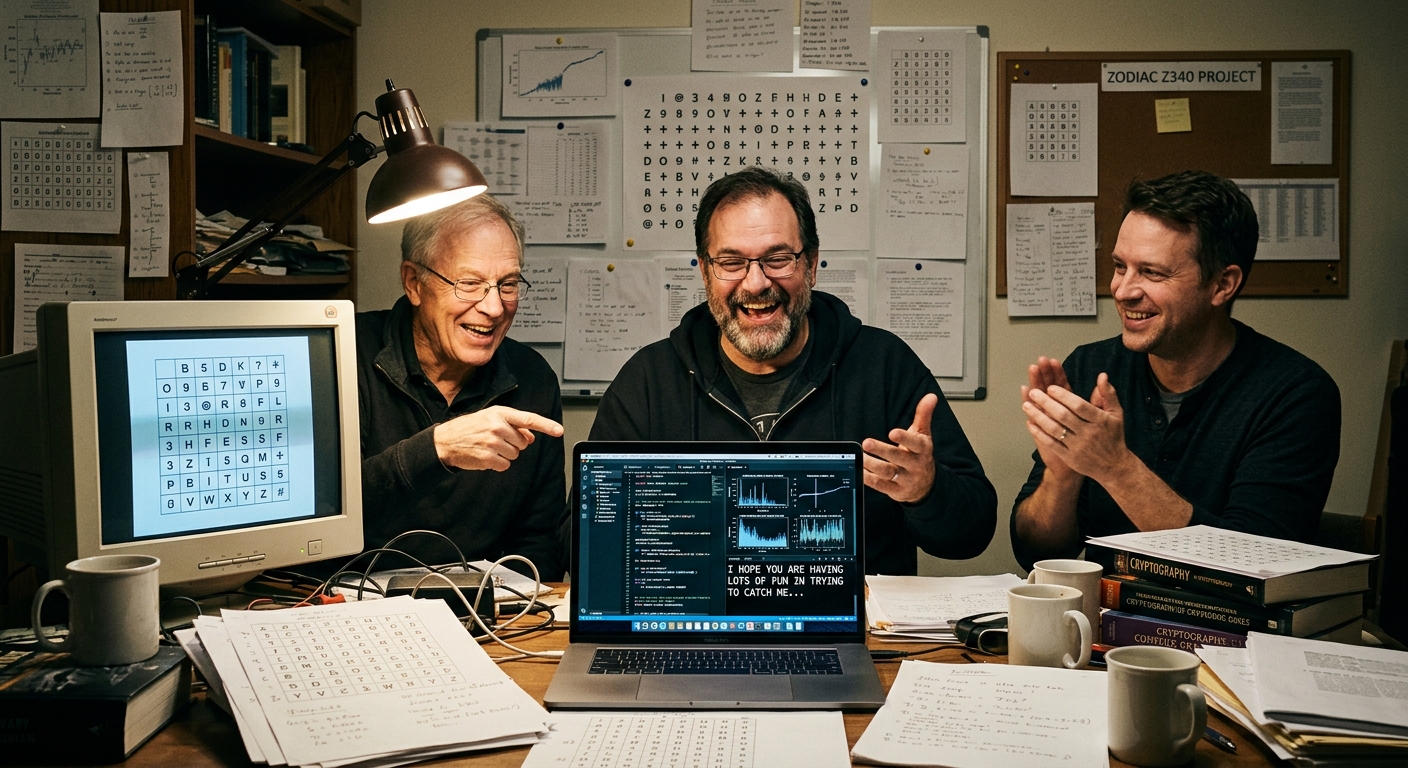
For over five decades, one of America’s most notorious serial killers taunted police, the media, and amateur sleuths with a cryptic message that seemed impossible to decode. The Zodiac Killer’s 340-character cipher, sent to the San Francisco Chronicle in November 1969, became one of the most infamous unsolved puzzles in criminal history. Then, in December 2020, three amateur codebreakers armed with nothing but determination and modern computing power accomplished what the FBI, CIA, and countless cryptographers had failed to do for 51 years.
The Monster Behind the Messages
Between 1968 and 1969, the Zodiac Killer terrorized Northern California, claiming responsibility for at least five murders and possibly many more. What set this serial killer apart wasn’t just the brutality of the crimes, but the psychological warfare that followed. The killer sent a series of letters and cryptograms to local newspapers, each one designed to torment investigators and the public.
The first cipher, known as the 408 cipher due to its character count, was cracked within a week by a high school teacher and his wife. It contained a chilling message about the killer’s motivations, but provided no useful leads about his identity. However, the second cipher proved far more resistant to conventional cryptanalytic methods.
The Cipher That Wouldn’t Break
The 340 cipher arrived at the San Francisco Chronicle on November 8, 1969, accompanied by a letter claiming additional victims. Unlike its predecessor, this puzzle seemed to mock every attempt at solution. The grid of strange symbols, numbers, and letters became a holy grail for cryptographers and true crime enthusiasts worldwide.
What made the 340 cipher so challenging wasn’t just its complexity, but its apparent randomness. Traditional frequency analysis, the backbone of classical codebreaking, yielded no meaningful patterns. For decades, investigators wondered if the cipher even contained a real message, or if the Zodiac Killer had simply created an unsolvable puzzle to waste their time.
Decades of Failed Attempts
The FBI’s Cryptanalysis and Racketeering Records Unit worked on the cipher for years. Professional cryptographers, computer scientists, and amateur puzzle solvers all took their shots at the stubborn code. Some claimed to have solved it, producing messages that seemed plausible but couldn’t be verified. Others concluded it was deliberately unsolvable, designed purely to frustrate investigators.
By the 2000s, the cipher had taken on an almost mythical status in cryptographic circles. It appeared in documentaries, inspired fictional works, and became a benchmark for testing new codebreaking techniques. Yet it remained unbroken, its secrets locked away behind an impenetrable wall of symbols.
Enter the Amateur Dream Team
The breakthrough came from an unlikely trio: David Oranchak, a software developer from Virginia; Jarl Van Eycke, a Belgian computer programmer; and Sam Blake, an Australian mathematician. None were professional cryptographers, but all shared an obsession with unsolved puzzles and the computational skills to tackle them systematically.
Their approach differed from previous attempts in crucial ways. Instead of assuming the cipher followed standard cryptographic conventions, they considered the possibility that the Zodiac Killer had made errors or used unconventional methods. They also leveraged modern computing power to test millions of possible solutions automatically.
The Power of Persistence and Processing
The team’s breakthrough insight involved recognizing that the cipher might not read in the straightforward left-to-right, top-to-bottom pattern that most codebreakers had assumed. Using a technique called “period 19 transposition,” they rearranged the cipher’s symbols in a diagonal pattern that revealed the hidden message.
The process still required enormous computational resources. Their software tested approximately 650,000 possible reading directions before finding the correct one. What human codebreakers might have taken lifetimes to attempt, their computers accomplished in days.
The Message Revealed
When the solution finally emerged, it proved both satisfying and disturbing. The decrypted message read: “I hope you are having lots of fun in trying to catch me that wasn’t me on the TV show which brings up a point about me I am not afraid of the gas chamber because it will send me to paradice all the sooner because I now have enough slaves to work for me where everyone else has nothing when they reach paradice so they are afraid of death I am not afraid because I know that my new life is life will be an easy one in paradice death.”
The message contained several telling characteristics that convinced experts of its authenticity, including the killer’s distinctive misspelling of “paradise” as “paradice,” which had appeared in previous confirmed Zodiac communications.
Verification and Vindication
The team didn’t immediately announce their discovery. Instead, they spent weeks verifying their solution and ensuring they hadn’t fallen into the same trap that had snared previous would-be solvers. They contacted the FBI, which confirmed the solution’s validity using independent analysis.
The verification process revealed just how difficult the cipher had been to crack. The unusual transposition method, combined with several spelling errors and the killer’s unconventional symbol usage, had created a perfect storm of cryptographic confusion that had stymied professional efforts for decades.
Why It Took So Long
The 51-year delay in solving the cipher resulted from several factors working in combination. First, the Zodiac Killer’s amateur approach to cryptography, while crude, actually made the cipher more difficult to solve because it didn’t follow established patterns that professional codebreakers expected.
Second, the technology needed to test hundreds of thousands of possible solutions simply didn’t exist for most of the cipher’s unsolved lifetime. Even early computers would have required months or years to perform the calculations that modern machines completed in hours.
Finally, the solution required a specific insight about the cipher’s construction that, while logical in hindsight, wasn’t obvious to investigators working with limited computational resources and conventional assumptions about how codes should work.
The Bigger Picture
The solution of the 340 cipher represents more than just a victory for puzzle enthusiasts. It demonstrates how citizen scientists, armed with modern tools and fresh perspectives, can achieve breakthroughs that elude traditional experts. The case has inspired new approaches to other unsolved ciphers and cold cases, showing that sometimes the key to old mysteries lies not in new evidence, but in new ways of analyzing existing information.
While the cipher’s solution unfortunately didn’t reveal the Zodiac Killer’s identity or provide new leads for investigators, it did offer closure to a decades-old puzzle and demonstrated the power of persistence, collaboration, and computational innovation in solving seemingly impossible problems.






omg this is so cool – reminds me of that bbc doc where attenborough talks about how nature solves problems we cant, and honestly the same applies to humans with fresh eyes and better tools! i wonder if the codebreakers approached it more like pattern recognition the way animals do (like how ravens solve puzzles) or if it was purely computational brute force, tbh im fascinated by what the actual message said tho – did you find it chilling or more just… cryptic? 🧬
Log in or register to replyThis is fascinating stuff, and Quinn makes a great point about fresh thinking versus just better tech! I think there’s something really interesting happening when new people look at old problems – kind of like how I discovered native plant gardening by accident instead of following traditional lawn care rules. Sometimes the breakthrough isn’t just computational power, it’s being willing to question assumptions that everyone else accepted. Really curious what specific angle these three tried that the FBI missed.
Log in or register to replyThis is such a cool example of how computation keeps opening doors that seemed permanently locked, though I’m curious whether the “fresh thinking” part was mostly just having better algorithms or if these folks actually approached the problem differently than the FBI cryptographers did back then. It makes you wonder how many other “unsolvable” problems are just waiting for the right combination of computing power and maybe a slightly different angle, right?
Log in or register to reply