
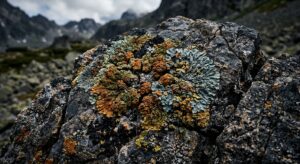
Walking through a forest, you’ve undoubtedly noticed the crusty, colorful patches adorning tree bark, rocks, and even bare soil. Most people assume these are simply another type of plant, perhaps a moss or some primitive vegetation. But what if I told you that these seemingly simple organisms represent one of nature’s most extraordinary partnerships, a biological alliance so successful it has conquered nearly every environment on Earth?
Meet lichens: the masters of biological deception that have been hiding in plain sight for millions of years.
The Great Biological Masquerade
Lichens aren’t plants at all. They’re not even a single organism. Instead, they represent a fascinating symbiotic relationship between two completely different life forms: fungi and algae (or sometimes cyanobacteria). This partnership is so intimate and successful that for centuries, scientists classified lichens as a single entity, completely missing the remarkable collaboration happening right before their eyes.
The discovery of this dual nature revolutionized our understanding of symbiosis and challenged the very concept of what constitutes an individual organism. When German botanist Simon Schwendener first proposed the dual hypothesis in 1867, the scientific community was so resistant to the idea that it took decades for his theory to gain acceptance.
A Partnership Built for Survival
In this biological alliance, each partner brings something crucial to the table. The fungal component, called the mycobiont, provides structure and protection. It forms the body of the lichen, creating a tough, often weatherproof exterior that can withstand extreme conditions. The fungus also absorbs water and minerals from the environment, acting like a biological sponge.
The algal partner, known as the photobiont, serves as the lichen’s personal solar panel. Through photosynthesis, the algae convert sunlight into sugars and other organic compounds, essentially feeding both partners. This arrangement allows lichens to thrive in environments where neither organism could survive alone.
The Architecture of Cooperation
The structure of a lichen reveals the sophisticated nature of this partnership. Most lichens are organized in distinct layers:
- Upper cortex: A protective fungal layer that shields the interior from UV radiation and physical damage
- Algal layer: Where the photosynthetic partners live, positioned to receive optimal sunlight
- Medulla: A loose fungal tissue that stores water and nutrients
- Lower cortex: The bottom protective layer, often equipped with structures for attachment
This layered architecture represents millions of years of evolutionary fine-tuning, creating a living system that’s incredibly efficient at resource management and environmental adaptation.
Masters of Extreme Living
Perhaps the most mind-blowing aspect of lichens is their ability to colonize environments that would be lethal to most other life forms. These organisms have been found thriving in the Arctic tundra, scorching deserts, high-altitude mountains, and even in Antarctica, where they endure months of darkness and temperatures that would freeze most living things solid.
Some lichens can survive complete dehydration, essentially becoming dormant until water becomes available again. Others can withstand radiation levels that would be fatal to humans. In fact, lichens have even survived exposure to the vacuum of space in controlled experiments, making them serious candidates for potential life on other planets.
The Pollution Detectives
Lichens have an unexpected role as environmental sentinels. Because they absorb nutrients directly from the air and rain rather than through roots, they’re extremely sensitive to air pollution. Different species have varying tolerances to pollutants, making them living indicators of air quality. In heavily polluted areas, sensitive lichen species disappear, while more tolerant species may persist.
Scientists use lichen communities to monitor ecosystem health and track pollution levels over time. This biological monitoring system is so effective that it’s used worldwide to assess environmental conditions and guide conservation efforts.
The Slow-Motion World of Lichen Time
Lichens operate on a completely different timescale than most organisms we’re familiar with. Some lichen colonies are estimated to be thousands of years old, growing incredibly slowly, sometimes less than a millimeter per year. This patient approach to life allows them to persist in harsh environments where faster-growing organisms would quickly exhaust available resources.
The map lichen (Rhizocarpon geographicum), found on rocks in mountainous regions, grows so slowly and predictably that scientists use it as a biological clock to date geological events, a technique called lichenometry.
Hidden Diversity in Plain Sight
Despite their often humble appearance, lichens represent an incredibly diverse group. Scientists have identified over 20,000 lichen species worldwide, and new species are discovered regularly. They come in an astounding variety of forms, colors, and sizes:
- Crustose lichens: Form crusty patches tightly attached to surfaces
- Foliose lichens: Leaf-like with loose attachment points
- Fruticose lichens: Branching, shrub-like structures that can hang like biological curtains
Some lichens produce vibrant pigments, creating spectacular displays of orange, yellow, red, and even fluorescent colors that can transform entire landscapes.
The Future of an Ancient Partnership
As climate change and environmental pressures reshape ecosystems worldwide, lichens face new challenges. However, their incredible adaptability and the flexibility of their symbiotic relationship may give them advantages in changing conditions. Some species are expanding their ranges, while others retreat to refugia.
Scientists are also exploring practical applications of lichen biology, from developing new antibiotics based on lichen compounds to using their pollution-monitoring capabilities for environmental management.
The next time you notice those seemingly simple organisms decorating a rock or tree trunk, take a moment to appreciate the remarkable biological partnership you’re witnessing. In a world where cooperation often seems rare, lichens remind us that some of nature’s greatest successes come from different life forms working together, creating something greater than the sum of their parts.
This is such a great post, and Trevor’s point about nitrogen cycling really resonates with my fieldwork. I’ve been monitoring amphibian populations around some local wetlands for two decades now, and I’ve noticed the lichen communities on nearby trees are actually key indicators of air quality and overall ecosystem health, which directly affects the microhabitats where our frogs breed. The resilience of lichens in harsh conditions honestly gives me hope for restoration projects, because if these symbiotic partnerships can adapt and persist through climate stress, maybe there’s still time for us to help our amphibians bounce back too.
Log in or register to replyok this is so cool because ive been thinking about symbiosis a lot lately with my plant collection, and lichens are like the ultimate proof that cooperation works better than solo living, right? im genuinely curious if anyone here has observed whether lichens growing on trees affects the plants themselves in noticeable ways, like do your host trees seem healthier or do the lichens just coexist without much interaction? ive got some specimens on my windowsill that ive been trying to propagate and the fungal/algal relationship is just endlessly fascinating to me, plus theres something humbling about realizing these tiny crusty things have basically cracked the code to surviving literally everywhere on earth
Log in or register to replyThis is absolutely mind-blowing when you think about it from a rainforest perspective. I’ve seen lichens absolutely thriving on tree bark in the Amazon and Borneo canopy, and they’re so crucial for that ecosystem’s nitrogen cycling that most people completely miss them. The crazy part is how these fungi-algae partnerships are literally weathering rock faces and creating soil in places where nothing else can survive, which eventually enables entire forest communities to establish themselves. Kind of makes you realize that some of nature’s most transformative partnerships are happening at scales we usually walk right past.
Log in or register to reply