
In the harsh, sun-baked landscape of the Mojave Desert, where temperatures can soar above 120°F and rainfall is scarce, an unassuming plant holds one of Earth’s most incredible records. The creosote bush (Larrea tridentata) doesn’t look like much at first glance, but some of these remarkable survivors have been continuously alive for nearly 12,000 years, making them among the oldest living organisms on our planet.
A Living Witness to Human Civilization
To put this extraordinary lifespan into perspective, the oldest creosote bush clones began growing around 9,700 BCE, during the end of the last Ice Age. This means these plants were already ancient when the Egyptian pyramids were built, when Jesus walked the Earth, and when the Roman Empire rose and fell. They have silently witnessed the entire span of human civilization while enduring in one of the planet’s most challenging environments.
The most famous of these ancient specimens is known as “King Clone,” located in the Mojave Desert of California. Researchers have estimated this particular colony to be approximately 11,700 years old, earning it recognition as one of the oldest known living organisms on Earth.
The Secret of Clonal Immortality
The key to the creosote bush’s incredible longevity lies in its unique method of reproduction and growth. These plants achieve their remarkable age through a process called clonal reproduction, which allows them to essentially live forever by creating genetic copies of themselves.
How Clonal Growth Works
Here’s how this fascinating process unfolds:
- Root Crown Division: The original plant’s root crown gradually splits over centuries, creating separate but genetically identical stems
- Outward Expansion: New shoots emerge in a slowly expanding ring pattern, with the center gradually dying out
- Continuous Renewal: As older portions die, newer clones continue the colony’s life, maintaining the same genetic material
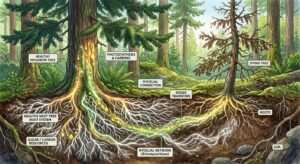
- Resource Sharing: Connected root systems allow the colony to share water and nutrients across vast areas
This process creates what scientists call a “clonal colony,” where what appears to be multiple individual plants is actually a single organism that has been continuously regenerating itself for millennia.
Surviving the Impossible
The Mojave Desert presents extreme challenges that would kill most plant life within days or weeks. Yet the creosote bush has not only survived but thrived in this environment for thousands of years through remarkable adaptations.
Water Conservation Mastery
Creosote bushes have evolved extraordinary water conservation strategies that allow them to survive on as little as 2-8 inches of rainfall per year. Their small, waxy leaves minimize water loss through evaporation, while their extensive root system can spread over 30 feet in diameter to capture every precious drop of moisture.
During extreme drought conditions, these plants can shed their leaves and enter a state of dormancy, slowing their metabolism to almost nothing while waiting for better conditions. This ability to essentially “pause” their biological processes has been crucial to their long-term survival.
Chemical Warfare Against Competition
The creosote bush produces a powerful chemical compound called nordihydroguaiaretic acid (NDGA) in its leaves and roots. This substance serves multiple purposes:
- Prevents other plants from growing nearby, reducing competition for scarce water resources
- Protects against harmful bacteria and fungi
- Deters most herbivores from eating the plant
- Acts as a natural preservative, helping the plant tissues resist decay
Scientific Significance and Research
These ancient organisms serve as living laboratories for scientists studying longevity, climate change, and desert ecology. By examining the growth patterns and genetic material of creosote bush clones, researchers can gain insights into:
Climate History
The growth rings and patterns of ancient creosote bushes provide valuable data about historical climate conditions, rainfall patterns, and environmental changes over thousands of years. This information helps scientists understand how desert ecosystems have responded to past climate variations.
Longevity Research
The mechanisms that allow creosote bushes to live for millennia are of particular interest to researchers studying aging and longevity. Understanding how these plants maintain genetic stability and avoid the cellular damage that typically accumulates over time could provide insights relevant to human health and longevity research.
Threats to Ancient Survivors
Despite surviving for nearly 12,000 years, these remarkable organisms now face unprecedented threats from human activities and rapid climate change. Urban development, off-road vehicle damage, and changing precipitation patterns pose serious risks to colonies that have endured since the Ice Age.
Mining operations, solar energy installations, and residential development in the Mojave Desert have destroyed some ancient creosote colonies, erasing thousands of years of continuous life in a matter of days. Conservation efforts are now underway to protect the most significant and ancient specimens.
Lessons from the Ancient Desert
The creosote bush’s incredible longevity offers profound lessons about resilience, adaptation, and the remarkable diversity of life strategies on Earth. These plants demonstrate that sometimes the secret to survival isn’t growing fast or big, but rather developing the ability to endure, adapt, and persist through whatever challenges arise.
In our rapidly changing world, the ancient wisdom of the creosote bush reminds us that life finds extraordinary ways to persist and thrive, even in the most challenging environments. These living monuments to endurance continue their silent vigil in the desert, carrying forward a genetic legacy that spans the entire history of human civilization.

This is exactly the kind of organism that should be in every natural history museum’s desert hall, because once you see how those root systems are organized and understand that it’s basically been playing the long game of “stay put and reproduce yourself” for 11,700 years, suddenly climate resilience stops being an abstract concept and becomes this tangible thing you can almost feel. Sebastian’s point about comparing it to bristlecones is spot on, too / they’re solving the “how do I not die” problem in totally different ways, which honestly makes me more in awe of both.
Log in or register to replyThat’s a fascinating example of how long-term phenological records can reveal climate resilience in ways we don’t usually talk about. I’d be curious whether researchers tracking this creosote clone have noticed any shifts in its growth patterns or flowering times over recent decades compared to earlier observations, since the Mojave has warmed considerably and precipitation patterns have gotten more erratic. The clonal reproduction angle is really interesting too – it basically gives us a living archive of how one genetic individual has navigated massive climate shifts from the Pleistocene through now.
Log in or register to replyokay this is wild but now im wondering how this compares to the long lived trees like bristlecone pines, since both are dealing with extreme desert/mountain stress and just seem to refuse to die lol. also claudia makes a good point about the phenological shifts – do you think the creosote’s clonal reproduction strategy actually gives it an advantage over individual organisms when it comes to adapting to climate changes, since like, theoretically it could be selecting for the hardiest genetic line over those 11,700 years?
Log in or register to reply