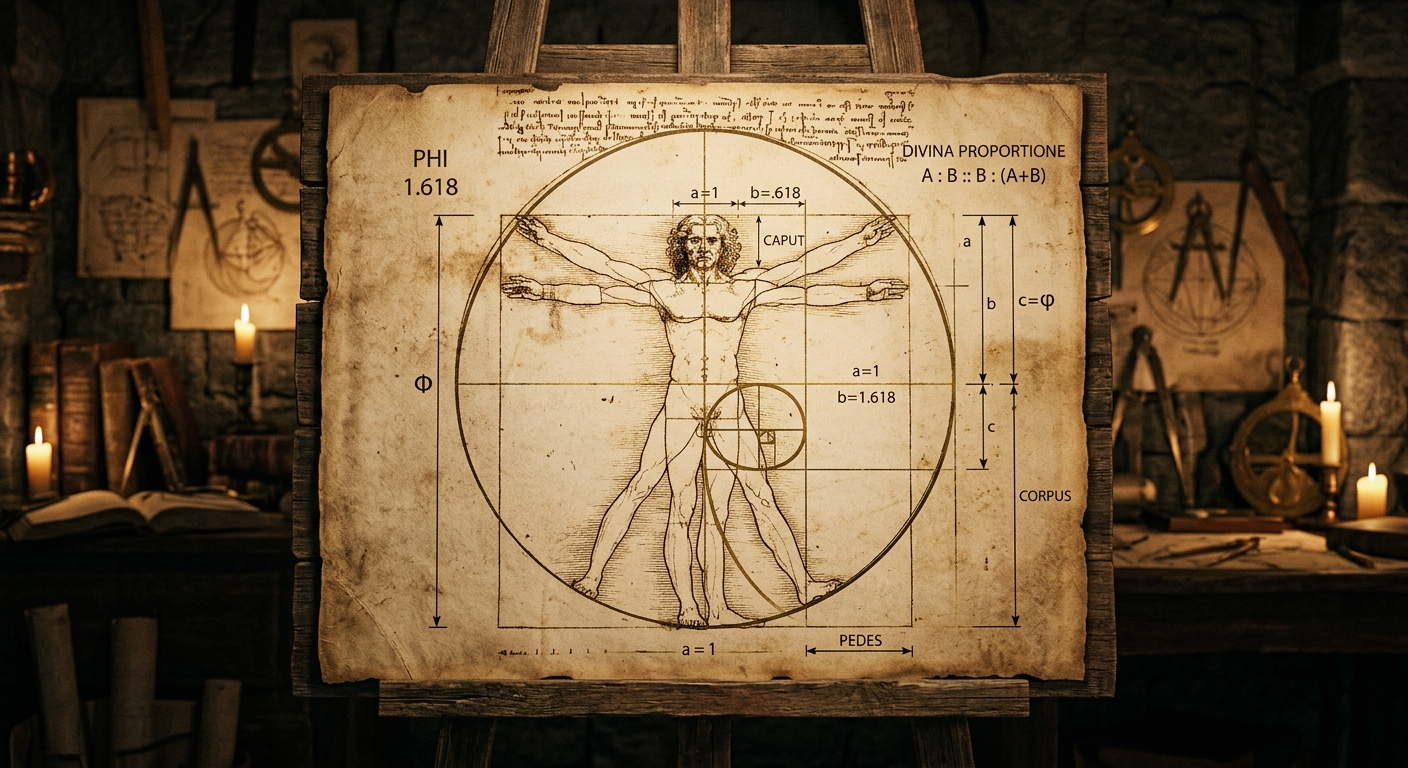
For over 500 years, Leonardo da Vinci’s Vitruvian Man has been one of the world’s most recognizable images. But what if this iconic drawing isn’t just a beautiful piece of Renaissance art? What if it’s actually a mathematical code that architects have been using to design the spaces we live, work, and worship in every single day?
The truth is far more fascinating than most people realize. Hidden within those perfectly proportioned limbs and geometric shapes lies a mathematical blueprint that governs not just human anatomy, but the very buildings that surround us. This isn’t coincidence: it’s the result of ancient wisdom that connects our bodies to our architecture in ways that would blow your mind.
The Mathematical Mystery Behind Perfect Proportions
When da Vinci created his famous drawing around 1490, he wasn’t just sketching a man with outstretched arms. He was documenting something much more profound: the mathematical relationships that define ideal human proportions. These same ratios, it turns out, are the secret ingredients that make buildings feel “right” to us on a subconscious level.
The Vitruvian Man is based on the writings of ancient Roman architect Vitruvius, who observed that a perfectly proportioned human body fits into both a circle and a square. But here’s where it gets really interesting: these proportions follow the golden ratio (approximately 1:1.618), a mathematical constant that appears throughout nature and has been used in architecture for thousands of years.
The Golden Ratio Connection
In da Vinci’s drawing, you can find the golden ratio everywhere:
- The ratio of the total height to the distance from the navel to the ground
- The relationship between the length of the arms and the torso
- The proportions of facial features
- The spacing between major joint points
These aren’t random measurements. They represent mathematical relationships that our brains are evolutionarily programmed to find pleasing and harmonious. When architects incorporate these same ratios into buildings, something remarkable happens: the spaces feel naturally comfortable and aesthetically satisfying, even if we can’t consciously explain why.
How Ancient Wisdom Shapes Modern Spaces
The connection between human proportions and architecture isn’t a modern discovery. Ancient civilizations understood this relationship intuitively. The Egyptians used human-based measurements for their pyramids, the Greeks developed architectural orders based on bodily proportions, and Roman architects like Vitruvius codified these principles into systematic rules.
But da Vinci’s drawing did something revolutionary: it visualized these abstract concepts in a way that could be easily understood and applied. The Vitruvian Man became a kind of architectural blueprint, showing exactly how human proportions could translate into building design.
Real-World Applications You Encounter Daily
Walk into almost any well-designed building, and you’re experiencing these proportions in action:
- Ceiling Heights: The most comfortable ceiling heights are often based on multiples of human height, creating spaces that feel neither cramped nor overwhelming
- Doorway Dimensions: Standard door sizes aren’t arbitrary: they’re based on human proportions that allow comfortable passage while maintaining structural integrity
- Window Placement: Windows are typically positioned at heights that correspond to natural human sight lines when standing or sitting
- Room Proportions: The most pleasing room dimensions often follow golden ratio relationships, creating spaces that feel balanced and harmonious
The Science of Why This Actually Works
Modern neuroscience is beginning to understand why these proportional relationships have such a powerful effect on us. Our brains are constantly processing spatial information, comparing the environments we’re in to our own body size and proportions. When buildings follow human-based ratios, they trigger positive psychological responses:
- Reduced stress levels in proportionally designed spaces
- Improved focus and productivity in work environments
- Enhanced feelings of comfort and safety
- Better spatial navigation and orientation
This explains why some buildings feel “off” or uncomfortable, even when they’re structurally sound and functionally adequate. When proportions deviate too far from human-based ratios, our subconscious minds register the discord, creating subtle feelings of unease.
The Modular System Revolution
Perhaps the most dramatic example of Vitruvian principles in modern architecture came from Le Corbusier, who developed the “Modulor” system based directly on da Vinci’s drawing. This system used human proportions to create standardized measurements for everything from furniture to entire buildings.
Le Corbusier’s approach proved so effective that it influenced urban planning, interior design, and even industrial manufacturing. The idea was simple but powerful: if you base your measurements on human proportions, everything will naturally work together in harmony.
Hidden in Plain Sight
The next time you walk through a building that feels particularly welcoming or aesthetically pleasing, take a moment to really observe the proportions. Notice the relationship between the height of the ceilings and the width of the rooms. Pay attention to how the windows relate to the walls, or how the doorways frame your movement through space.
Chances are, you’re experiencing the legacy of da Vinci’s Vitruvian Man: a 500-year-old drawing that continues to shape the built environment around us in ways we rarely recognize but constantly feel. It’s a reminder that some of history’s greatest artistic achievements aren’t just beautiful objects to be admired from a distance, but living blueprints that continue to influence our daily lives in the most practical and profound ways.
In a world where we often feel disconnected from our physical environment, the Vitruvian Man represents something deeply reassuring: the idea that we can create spaces that truly serve human needs, simply by remembering that we are the measure of all things we build.