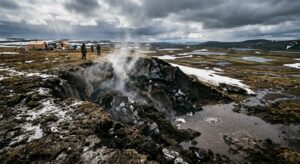
When most people think of the hottest place on Earth, images of endless sand dunes and scorching Sahara winds come to mind. But the truth is far more surprising – and far more extreme. The hottest temperature ever reliably recorded on our planet didn’t happen in Africa at all, but in a place so alien it resembles another world entirely.
The Record That Shattered Everything We Thought We Knew
On July 10, 1913, in Death Valley, California, thermometers recorded an astounding 134°F (56.7°C) – a temperature so extreme it remains unmatched more than a century later. To put this in perspective, this is hot enough to cause third-degree burns on exposed skin within minutes, hot enough to cook an egg on the ground, and dangerously close to the temperature at which human proteins begin to denature.
What makes this record even more mind-blowing is that it occurred at Furnace Creek, aptly named for its hellish conditions. The measurement was taken by an official Weather Bureau observer, making it the highest air temperature ever reliably recorded on Earth’s surface.
Why Death Valley Becomes Earth’s Natural Oven
Death Valley’s extreme heat isn’t just a fluke – it’s the result of a perfect storm of geographical and atmospheric conditions that create what scientists call a “heat trap.” Understanding why this happens requires diving into the valley’s unique geography.
The Basin Effect
Death Valley sits 282 feet below sea level, making it the lowest point in North America. This creates a natural bowl where hot air becomes trapped and continuously heated. Unlike elevated areas where hot air can rise and escape, the valley’s walls act like the sides of a massive oven, containing and concentrating heat.
The Albedo Factor
The valley floor consists largely of salt flats and dark-colored rocks that absorb rather than reflect solar radiation. During peak summer, the ground surface can reach temperatures exceeding 200°F (93°C) – hot enough to cause severe burns instantly. These superheated surfaces then radiate heat back into the air throughout the day and well into the night.
Mountain Wall Barriers
Surrounding mountain ranges, some reaching over 11,000 feet high, create additional barriers that prevent hot air from escaping. The Panamint Range to the west and the Amargosa Range to the east form natural walls that trap heated air masses, creating a convection system that continuously recycles scorching air.
How Death Valley Compares to Other Extreme Heat Zones
While the Sahara Desert certainly experiences brutal heat, with temperatures regularly reaching 120-130°F (49-54°C), it has never officially matched Death Valley’s record. Here’s how Earth’s hottest places stack up:
- Death Valley, USA: 134°F (56.7°C) – World record holder
- Flaming Mountains, China: Ground temperatures up to 176°F (80°C)
- Dasht-e Lut, Iran: Satellite data shows surface temperatures reaching 177°F (80.8°C)
- Sahara Desert, Libya: Disputed record of 136°F (58°C) in 1922, later invalidated
- Sonoran Desert, Mexico: Regular temperatures of 125°F (51.7°C)
The Science Behind Surviving Impossible Heat
What’s truly remarkable is that life persists even in these extreme conditions. Death Valley hosts a surprising array of organisms that have evolved extraordinary adaptations to survive temperatures that would kill most life forms within hours.
Extremophile Bacteria
Researchers have discovered heat-loving bacteria thriving in Death Valley’s hottest spots. These extremophiles have developed unique proteins and cellular structures that remain stable at temperatures that would denature normal biological molecules. Some species can survive in temperatures exceeding 160°F (71°C).
Desert Pupfish Miracle
Perhaps most astounding is the Devil’s Hole pupfish, which lives in water temperatures reaching 93°F (34°C) – near the upper limit of what most fish can survive. This species exists nowhere else on Earth and represents one of the most endangered fish species, with populations sometimes dropping below 100 individuals.
Climate Change and the Future of Extreme Heat
Scientists are closely monitoring Death Valley as climate change intensifies global temperature extremes. Recent studies suggest that the valley could experience even more extreme temperatures in coming decades, potentially breaking its own century-old record.
In 2020 and 2021, Death Valley recorded temperatures of 130°F (54.4°C) multiple times – the hottest reliably recorded temperatures since 1913. This trend has researchers concerned about what future summers might bring to Earth’s hottest place.
The Broader Implications
Understanding how extreme heat affects ecosystems in places like Death Valley provides crucial insights for predicting how climate change will impact life across the planet. The valley serves as a natural laboratory for studying the absolute limits of life on Earth – and potentially on other planets.
Visiting Earth’s Furnace Safely
Despite its extreme conditions, Death Valley attracts over one million visitors annually. The National Park Service strongly advises against hiking during summer months when temperatures exceed 120°F. Even brief exposure to these conditions can result in heat stroke, severe dehydration, and death.
For those brave enough to visit during cooler months, Death Valley offers an otherworldly landscape of salt flats, colorful badlands, and stark beauty that truly feels like stepping onto an alien planet – one where the very air shimmers with heat and life clings to existence at the absolute edge of possibility.
The next time someone mentions the Sahara as Earth’s hottest place, you’ll know the truth lies hidden in a California valley where temperatures defy belief and life defies all odds.