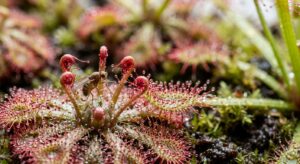
In the shadowy wetlands of North and South Carolina, a botanical marvel sits patiently among the moss and acidic soil, waiting for its next meal. The Venus flytrap (Dionaea muscipula) isn’t just another pretty plant – it’s a calculating predator that can literally count, demonstrating one of the most sophisticated hunting strategies in the plant kingdom.
While most plants are content to photosynthesize and absorb nutrients from soil, the Venus flytrap has evolved into something far more extraordinary: a mathematical genius that uses numerical precision to determine when to strike. This carnivorous wonder doesn’t just snap shut at the first sign of movement – it counts to five before making its deadly decision.
The Anatomy of a Living Trap
Each Venus flytrap leaf consists of two hinged lobes connected by a midrib, creating what looks like a gaping mouth lined with intimidating spines called cilia. The inner surface of each lobe is adorned with a brilliant red coloration and tiny trigger hairs – typically three per lobe – that serve as the plant’s sensory network.
These trigger hairs are the key to understanding the flytrap’s counting ability. When an unsuspecting insect lands on the trap and brushes against these sensitive structures, it sets off a remarkable chain of biological events that would make any mathematician proud.
The Electrical Language of Plants
Scientists have discovered that Venus flytraps communicate through electrical signals, much like neurons in animal nervous systems. When a trigger hair is bent, it generates an electrical impulse called an action potential that travels throughout the plant tissue. This electrical signature is the flytrap’s way of keeping count.
But here’s where it gets truly fascinating: the plant doesn’t react to just one touch. Evolution has taught this botanical predator that false alarms are costly. Closing a trap requires enormous energy, and once shut, the plant can’t photosynthesize with that leaf for days or even weeks. Therefore, the Venus flytrap has developed a fail-safe system based on mathematical precision.
The Five-Count Rule: Why Numbers Matter
Recent research has revealed that Venus flytraps follow a sophisticated counting system that governs their entire hunting strategy:
- Count 1-2: The trap remains open, treating initial touches as potential false alarms
- Count 3-5: The trap snaps shut, but only partially, creating a loose cage
- Count 5+: The plant begins producing digestive enzymes and seals the trap completely
This numerical approach serves multiple purposes. First, it prevents the plant from wasting energy on non-food items like falling debris or raindrops. Second, it ensures that only struggling, living prey triggers the full digestive response. A dead insect won’t continue moving, so it won’t reach the critical five-touch threshold for enzyme production.
The Science Behind the Count
Dr. Rainer Hedrich and his team at the University of Würzburg made groundbreaking discoveries about this counting mechanism through careful experimentation. Using tiny electrodes, they measured the electrical activity within Venus flytrap tissues and found that each trigger hair activation creates a measurable electrical signature.
The plant’s cells act like biological batteries, accumulating these electrical charges until they reach specific thresholds. It’s essentially a living calculator, using bioelectricity to perform mathematical operations that determine life-or-death decisions.
Beyond Counting: The Complete Hunting Strategy
The Venus flytrap’s mathematical abilities extend far beyond simple counting. Once the trap closes around its prey, the plant continues to monitor movement and adjust its behavior accordingly.
The Digestive Decision
After the initial closure (triggered by touches 3-5), the plant enters what scientists call the “decision phase.” If the trapped creature continues to struggle and triggers additional hair touches, the plant interprets this as confirmation that it has caught valuable prey. This is when the real magic happens:
The trap seals hermetically, creating a stomach-like chamber where digestive enzymes break down the prey over 5-12 days. The plant can then absorb essential nutrients like nitrogen and phosphorus that are scarce in its native boggy environment.
Energy Economics
This counting system is essentially an energy budget calculator. Each trap can only close a limited number of times before it dies – typically 3-5 closures per trap. By ensuring that each closure is worthwhile, the plant maximizes its survival chances in nutrient-poor environments.
Evolutionary Marvel: How Plants Learned to Count
The evolution of counting ability in Venus flytraps represents one of the most remarkable examples of plant intelligence. Unlike animals with centralized nervous systems, plants have developed distributed intelligence networks that allow for complex decision-making without a brain.
This mathematical hunting strategy likely evolved over millions of years in response to the challenging conditions of North Carolina’s Green Swamp and similar habitats. In these acidic, nutrient-depleted environments, the ability to efficiently capture and process animal prey provides a crucial competitive advantage.
Implications for Plant Intelligence
The Venus flytrap’s counting ability has revolutionized our understanding of plant cognition. It demonstrates that plants can:
- Store and process information over time
- Make complex decisions based on accumulated data
- Exhibit memory-like functions
- Perform mathematical operations
Conservation and Wonder
Today, wild Venus flytraps face significant threats from habitat destruction, illegal collection, and climate change. These mathematical marvels exist naturally in only a few counties in North and South Carolina, making their conservation crucial for preserving one of nature’s most extraordinary examples of plant intelligence.
Understanding the sophisticated mechanisms behind the Venus flytrap’s hunting strategy not only satisfies our curiosity about the natural world but also provides insights that could inform everything from robotics to sustainable agriculture.
The next time you encounter a Venus flytrap, remember that you’re looking at a living calculator – a plant that has mastered the art of counting to survive in one of Earth’s most challenging environments. In the grand theater of evolution, few performances are as mathematically precise or as deadly beautiful as the Venus flytrap’s five-count hunt.