In the darkest corners of rotting logs and decomposing leaves, something extraordinary is happening. A creature without a brain, without a nervous system, and technically without even a fixed body shape is solving complex problems that challenge even the most sophisticated computer algorithms. Meet Physarum polycephalum, a slime mold that’s rewriting our understanding of intelligence and network design.
What Exactly Is a Slime Mold?
Despite its misleading name, slime molds aren’t actually molds at all. They belong to a group called myxomycetes, ancient organisms that blur the line between plants, animals, and fungi. Physarum polycephalum exists as a single, massive cell called a plasmodium that can stretch across several feet, pulsating and flowing like a living, yellow carpet.
This remarkable organism has no central nervous system, no brain, and no fixed structure. Instead, it’s essentially a bag of cytoplasm containing millions of nuclei, all working together in perfect harmony. Yet this seemingly simple creature demonstrates problem-solving abilities that would impress any engineer or computer scientist.
Maze Masters Without Minds
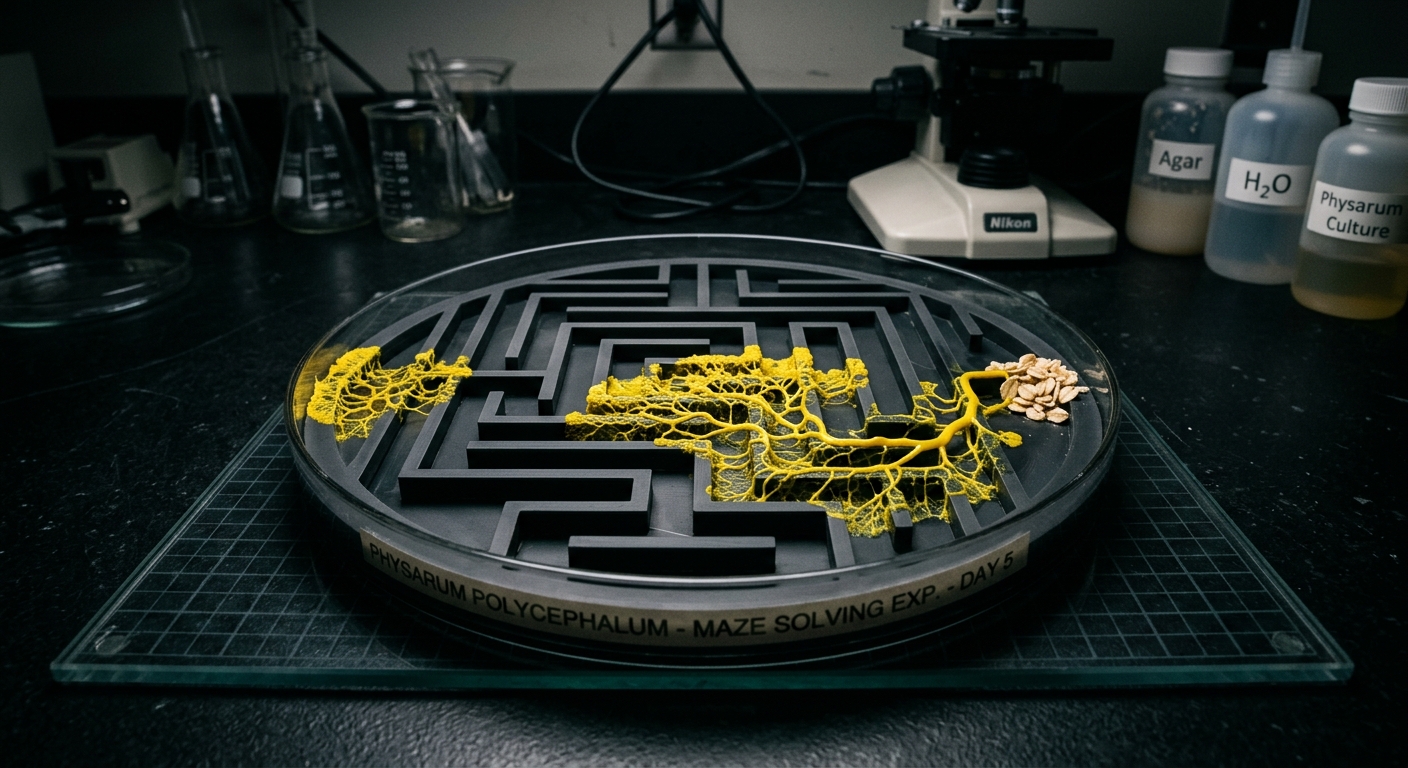
In 2000, Japanese scientist Toshiyuki Nakagaki conducted an experiment that stunned the scientific community. He placed a slime mold at one end of a maze with food at the other end. Within hours, the organism had not only found its way through the maze but had identified and followed the shortest possible path to the food source.
But here’s where it gets truly mind-blowing: when researchers created mazes with multiple food sources, the slime mold found the most efficient routes to connect all food sources simultaneously. It was essentially solving the same optimization problems that challenge modern logistics companies and urban planners.
How Does It Work?
The slime mold’s maze-solving ability comes from its unique search strategy:
- Exploration Phase: The organism spreads out in all directions, sending thin tendrils to explore every possible pathway
- Reinforcement Phase: When a tendril finds food, chemical signals strengthen successful pathways
- Optimization Phase: Unsuccessful routes are gradually abandoned as nutrients flow toward the most efficient paths
- Network Formation: The final result is a streamlined network connecting all food sources via the shortest routes
Natural Network Engineers
Perhaps even more impressive than their maze-solving abilities is how slime molds design transport networks. Scientists have discovered that these organisms can recreate some of humanity’s most sophisticated infrastructure projects with startling accuracy.
In one famous experiment, researchers placed oat flakes (a favorite food) on a map in positions corresponding to major cities around Tokyo. They then introduced slime mold at Tokyo’s location. Incredibly, the organism created a network that closely resembled the actual Tokyo rail system, one of the most efficient transport networks in the world.
Beating Human Engineers
The slime mold’s network wasn’t just similar to the Tokyo rail system; in some ways, it was actually better. The biological network showed:
- Greater fault tolerance (if one route was damaged, alternatives were readily available)
- More efficient resource distribution
- Better connectivity between distant locations
- Lower overall construction and maintenance costs if built in reality
The Secret of Distributed Intelligence
How does an organism without a brain accomplish these feats? The answer lies in distributed intelligence, a concept that’s revolutionizing our understanding of problem-solving in nature.
The slime mold’s entire body acts as a living computer. Each part of the organism processes local information about food sources, obstacles, and chemical gradients. These simple, local decisions combine to produce complex, intelligent behavior at the organism level.
This process involves:
- Chemical Communication: Different parts of the organism communicate through chemical signals
- Physical Feedback: The flow of cytoplasm creates physical pressure that influences growth direction
- Environmental Sensing: The organism responds to light, moisture, temperature, and chemical gradients
- Memory Formation: Previous experiences influence future behavior patterns
Real-World Applications
Scientists and engineers are now studying slime molds to improve human technology. Their problem-solving strategies are being applied to:
Urban Planning
City planners are using slime mold algorithms to design more efficient road networks, optimize public transportation routes, and plan utility infrastructure.
Computer Networks
The internet and telecommunications companies are implementing slime mold-inspired algorithms to route data more efficiently and create more resilient networks.
Supply Chain Management
Logistics companies are adopting these natural optimization strategies to streamline delivery routes and warehouse locations.
The Bigger Picture
The slime mold’s abilities challenge our fundamental assumptions about intelligence and consciousness. They demonstrate that complex problem-solving doesn’t require a centralized brain or sophisticated nervous system. Instead, intelligence can emerge from simple rules applied across a distributed system.
This discovery has profound implications for artificial intelligence, robotics, and our understanding of consciousness itself. It suggests that intelligence is far more fundamental and widespread in nature than we previously believed.
Next time you’re walking through a forest, remember that beneath your feet, in the rotting logs and decomposing leaves, some of nature’s most brilliant engineers are quietly at work, solving problems that challenge our greatest minds, all without a single thought.